An office sound masking system plays a tuned, low-level background sound through ceiling loudspeakers so that conversations from farther away become harder to understand. It does not block or absorb sound. Published installed prices for commercial systems mostly run from about $2 to $4 or more per square foot of covered area, and labor, ceiling type, and zoning move a project within that range. Masking works best across large open floors. Confidential calls, video meetings, and conversations between neighboring desks still need an enclosed room or a phone booth.
Last Updated: November 4, 2026 | Author: William | Reviewed by: Richard
How an office sound masking system works
A commercial sound masking system has three parts: a sound generator, a control unit that sets level and zoning, and loudspeakers (often called emitters) laid out in a grid across the ceiling. In a direct-field system the emitters face down into the room, either set into ceiling tiles or hung below an open ceiling. In an indirect system they sit above a suspended ceiling and fire upward, so the sound reaches the room after passing through the tiles.
The system lowers the signal-to-noise ratio for speech at the listener’s position. When the background level rises closer to the level of a distant conversation, fewer speech sounds stand out, and the listener catches fragments instead of sentences. That is why acousticians measure the result with speech intelligibility metrics rather than with a simple decibel reduction: nothing about the talker’s voice changes.
The sound itself is not plain white noise. A masking spectrum is shaped to cover the frequency range of speech while staying smooth enough that people stop noticing it. Commissioning checks both the level and the spectrum at many points across the floor. ASTM E1573 is the U.S. test method used to measure and report masking sound levels in A-weighted and one-third-octave-band terms, so a buyer can confirm that the installed sound matches the specification. The method measures the masking sound only, not the overall acoustics of the office.
Typical masking levels
The U.S. General Services Administration’s Sound Matters guide recommends floor-wide masking at 45 to 48 dBA in open workspaces, tuned by group zone, and 40 to 42 dBA in private offices that need normal speech privacy. The legacy WELL Building Standard v1 sound masking feature uses 48 dBA as its maximum for open offices and 42 dBA for enclosed offices, measured at the nearest workspace. Those ceilings matter because raising the level is not a free fix. Above the design range, the masking itself becomes the noise people complain about.
Sound masking in a private office
In an enclosed office, masking does a different job. The walls and door already reduce what leaks out. The masking sound covers what remains, so a conversation in the next office is less intelligible to the person outside. Sound Matters treats masking at 40 to 42 dBA as one element of private-office design, alongside partition and background noise ratings. For rooms meant for confidential conversation, the wall and door construction does most of the work, and masking only covers what still leaks through.
What sound masking can do
Sound masking is the cover layer in what Sound Matters calls the ABCs of noise control: absorb, block, and cover. Used in that role, it can:
- make conversations from neighboring workstation groups less intelligible, which reduces the distraction that open offices are known for;
- even out a floor where quiet periods make every phone call or laugh stand out;
- raise speech privacy between private offices whose partitions stop at the ceiling tile rather than at the structure above; and
- help ceiling absorption and screens reach their intended result instead of working against a too-quiet background.
That last point is supported by laboratory work. In a 2007 study of two adjacent workstations, Virjonen and colleagues found that speech privacy improved with higher masking level, more ceiling absorption, taller screens, and higher rooms. They also found that sufficient privacy could not be reached when the masking level was below 40 dBA, even with the best combination of absorbers and screens. Their conclusion was that masking and absorption have to be designed together. Neither substitutes for the other.
What sound masking cannot do
Sound masking does not stop sound from traveling. It cannot quiet a loud source such as a printer, a nearby kitchen, or low-frequency equipment rumble. It provides no visual privacy. And because it lowers intelligibility gradually with distance, it does little for the person sitting next to the talker.
A 2014 field study by Perkins and Will shows both the benefit and the boundary. Volunteers on three floors of an occupied office tried to identify recorded speech with the masking system off and then on, with the masked background averaging about 47 dB. The system had a greater effect in large open offices and little effect in some smaller open areas with hard surfaces. The estimated privacy zone in the open office was about 23 feet from the talker, so colleagues closer than that could still follow a conversation at normal voice. Enclosed offices with partitions running to the structure above were largely private even without masking.
For a buyer, that translates into a few practical limits:
- Close neighbors still hear. Masking reduces distraction across a room, not between two adjacent desks.
- Small hard rooms gain little. In a compact, reflective space, absorption usually has to come first.
- Meeting rooms need their own setting. Masking inside a meeting room also lowers intelligibility for the people in the meeting, so any level there has to be set for that room. The privacy of the meeting comes mainly from the walls and door.
- Masking is not confidentiality. It lowers the chance of being understood at a distance, but it does not protect HR, legal, finance, or client calls held in the open.
White noise machine vs sound masking system
A white noise machine is a single local device that plays a flat or adjustable sound for one desk, a reception counter, or a small room. A sound masking system is a zoned network with a shaped spectrum, a level set for each zone, and a measured result. A portable unit can soften a small area, but it cannot produce an even level across an open floor, and the sound gets louder the closer you sit to the unit. If the goal is white noise for a whole office floor, the matching purchase is a commercial masking design, not more machines.
What determines the cost of a commercial sound masking system
Most published figures are installed costs per square foot of covered floor area. They come from manufacturers and their partners, not from independent price surveys, so treat them as planning ranges rather than quotes.
| Source (date) | Published figure | What it covers |
|---|---|---|
| Biamp engineers in Consulting-Specifying Engineer (Nov 2021) | Historically about $2.00–$2.50 per sq ft, expected to move toward $2.50–$3.00; major markets or union buildings about $4.00 | Average installed cost; labor named as the largest factor |
| Soft dB (May 2024) | From $4.00 per sq ft | Components, installation, cabling, commissioning, and calibration for its adaptive system |
These factors move a project up or down within those ranges:
- Covered area. Restrooms, stairwells, mechanical rooms, and some meeting rooms are usually left out, so the masked area is smaller than the gross floor area.
- Ceiling type. A suspended tile ceiling allows standard direct or indirect emitters. An open ceiling needs hanging emitters and more careful layout.
- Emitter density and zoning. More emitters and finer zones give a more even sound field, but they add hardware and tuning time. Some networked systems allow per-emitter adjustment, while others adjust only by zone.
- Labor market. The same scope costs more in a major city or a union building.
- Extra functions. Paging, background music, scheduling, and adaptive level control add cost.
- New build vs retrofit. Working above an occupied ceiling, often after hours, is slower than installing during fit-out.
- Building scale. Per-square-foot cost tends to fall as the covered area grows. For buildings of roughly 100,000 square feet and up, the Biamp engineers note that indirect masking can sometimes cost less.
Illustrative estimate (not a quote): take a 10,000 sq ft office floor and assume 7,000 sq ft of open workspace and offices need coverage. At $2.50 to $4.00 per sq ft, the installed system would land around $17,500 to $28,000. Your own figure depends on the factors above and on local labor rates.
What to ask in a sound masking quote
Choosing the best sound masking system for an office comes down to how the result will be designed, tuned, and verified:
- Which areas are included, and which are deliberately excluded?
- Is the system direct or indirect, and how does that suit our ceiling?
- What target level and spectrum will be set in each zone, and on what basis?
- Can level be adjusted per zone or per emitter after people move in?
- Will commissioning include measurements to ASTM E1573, with a written report?
- Who adjusts the system after occupancy, and is that adjustment included in the price?
- How will employees be told what the sound is, so it is not mistaken for an HVAC fault or for soundproofing?
When you still need a phone booth with sound masking
Masking changes the background. It does not give anyone a place to go. Most offices that install it still need enclosed space for work that should not happen at an open desk:
- private client, sales, and support calls;
- video meetings, where the speaker’s own voice and the call audio both reach neighbors;
- HR, legal, finance, and recruiting conversations;
- interviews and one-on-ones when meeting rooms are booked; and
- people who take calls all day and set off complaints from the desks around them.
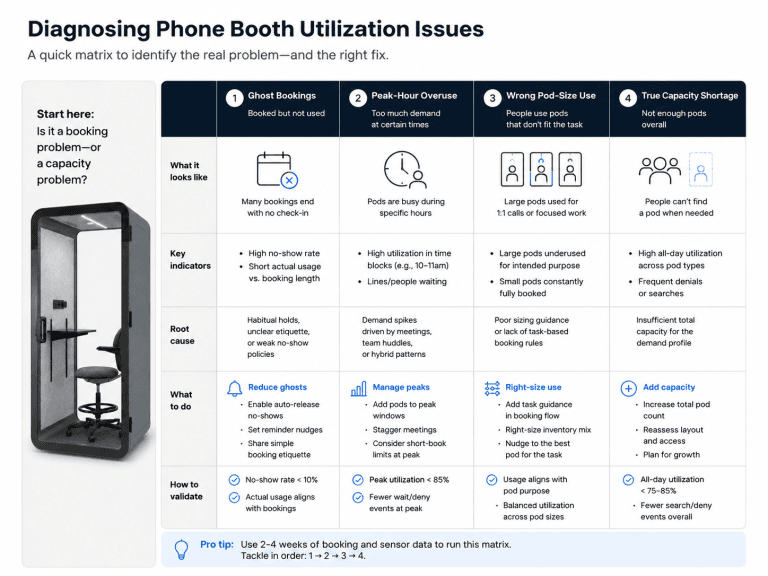
Size the enclosed capacity from how often these tasks happen at the same time, not from headcount alone. Frequent short calls point to one-person booths. Small private meetings point to a meeting pod. Place booths near the people who use them, or the calls stay at the desk.
For a one-person call space, ask for complete-product acoustic data rather than a single panel rating. ISO 23351-1 is the laboratory method for measuring the speech level reduction of furniture ensembles and enclosures. Elite-S achieved ISO 23351-1 Class A acoustic performance with 33 dB speech level reduction. In B&H office testing under controlled conditions, Elite-S showed a 40-45 dB sound level difference.
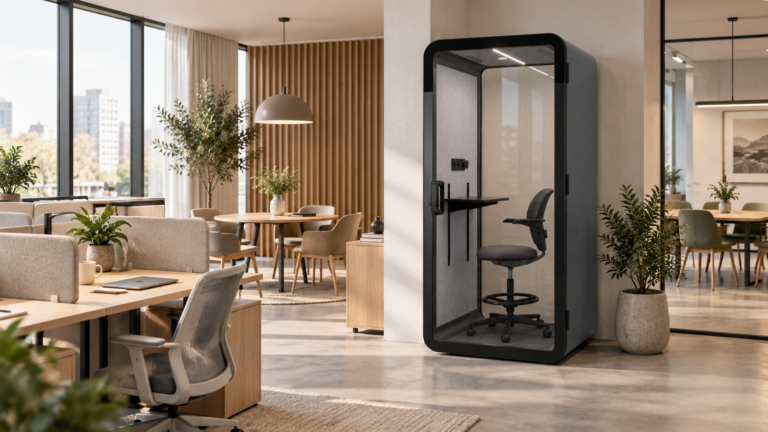
B&H Ergonomics’ office phone booths cover one-person call and focus space. For focus rooms and small meetings as well, compare the full range of acoustic office pods by capacity, footprint, and use case.
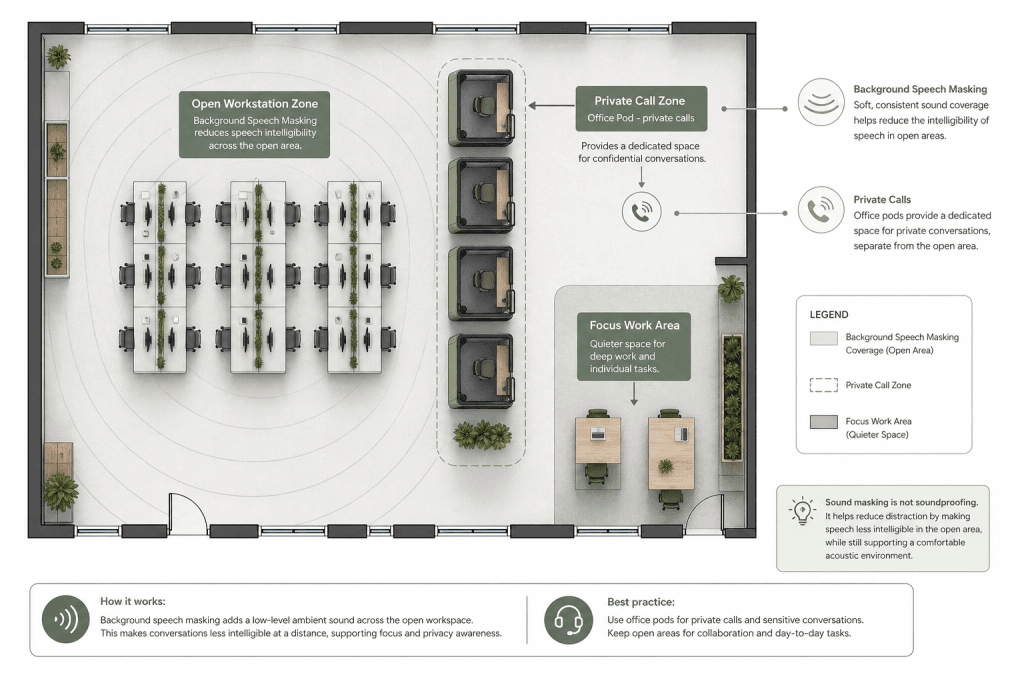
A layered plan: absorption, masking and enclosed rooms
Sound Matters advises using all three noise-control techniques together. When budget forces a choice, it suggests treating the architecture first, mechanical systems second, and electronic masking third. In practice, a workable sequence is:
- Record where and when complaints happen, and whether the issue is distraction, privacy, or a specific loud source. The open office noise reduction plan walks through that diagnosis.
- Fix layout conflicts, such as a call-heavy team seated next to a focus-heavy team.
- Add absorption where hard ceilings, glass, and bare walls reflect speech. Office acoustic panels are one option for walls and ceilings.
- Install sound masking across the open zones and commission it to a measured level.
- Provide phone booths and pods for the tasks that need enclosure, then review usage and complaints after a few weeks and adjust levels, zones, or booth count.
FAQ
Does sound masking really work?
Yes, for its intended job. Research in both laboratory and occupied offices shows that properly set masking reduces the intelligibility of speech from farther away, especially in large open areas. It does much less in small reflective rooms and between adjacent desks, and it never makes a conversation silent.
How much does sound masking cost per square foot?
Published installed figures from manufacturers mostly fall between about $2 and $4 or more per square foot of covered area, depending on labor rates, ceiling type, zoning, and extra features. Ask for a quote based on the actual covered area and a commissioning plan.
Is sound masking the same as white noise?
No. White noise has a flat spectrum and usually comes from a single local device. A sound masking system uses a spectrum shaped around speech, distributed evenly through ceiling emitters and set zone by zone.
Can sound masking replace acoustic pods?
No. Masking improves the shared background across the floor. Pods and phone booths give people an enclosed place for calls, meetings, and confidential work. An office with both problems needs both layers.