Quick Answer
A meeting pod ROI calculator starts with the meetings that actually happen. Count occupied small-group meetings and important one-to-one conversations, apply a finance-approved hourly value, and compare the result with the complete project cost. Then test low, base, and high utilization scenarios. Add avoided construction when a huddle-room build-out is part of the alternative.
The practical question is simple: will this pod be used often enough to solve a real room or privacy bottleneck?
Last Updated: August 26, 2026 | Author: Richard | Estimated Reading Time: 9 minutes
What This Calculator Helps a CFO Decide
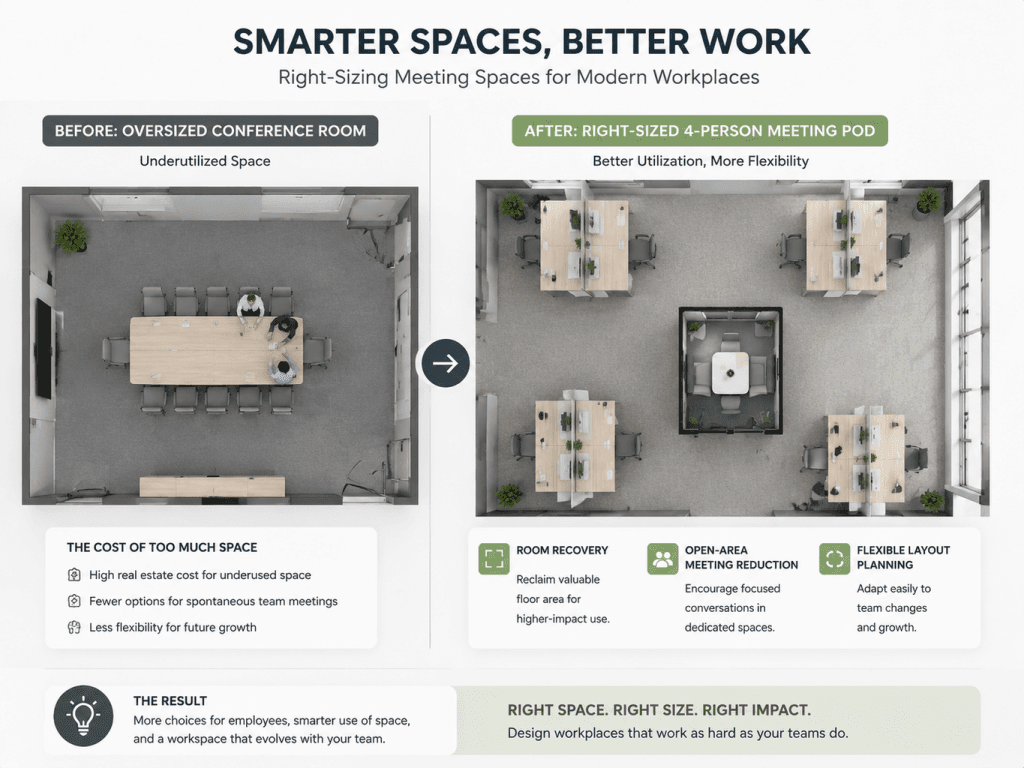
A 4-person meeting pod earns its place when it changes a measurable workplace constraint: small groups are occupying oversized rooms, important conversations have nowhere suitable to happen, or a huddle-room project is being considered.
Use the model to decide:
- whether small groups are using rooms that are too large for the meeting;
- whether important one-to-one conversations are taking place in exposed or unsuitable areas;
- whether a huddle-room build-out is a real alternative;
- whether the proposed location is close enough to the teams that create the demand;
- whether the expected use supports a defensible payback period.
For product and configuration comparisons, review B&H Ergonomics meeting pods.
Start With Actual Use, Not Maximum Capacity
Maximum capacity tells you what the pod can hold. Utilization tells you whether it earns its keep. A four-person label says nothing about how often the pod will be occupied or whether it sits close to the teams that need it.
Start with a short observation period or calendar review. Record:
- occupied meetings per day;
- the usual number of participants;
- average meeting length;
- how often a larger room is used by a small group;
- how often an important one-to-one discussion needs more privacy than an open desk area provides.
Include quiet periods in the average. They are part of the operating pattern and they affect payback.
The Meeting Pod ROI Formula
Use this structure for a first-pass model:
Observed annual meeting hours =
occupied sessions per day x average meeting length x workdays per year

Observed annual participant-hours =
observed annual meeting hours x average participants

Modeled annual meeting-use value =
observed annual participant-hours x finance-approved hourly value

Adjusted annual recovery =
modeled annual meeting-use value
+ verified avoided build-out value
+ other documented cost recovery

Payback period in months =
all-in pod cost / (adjusted annual recovery / 12)

Simple year-one ROI =
(adjusted annual recovery - all-in pod cost) / all-in pod cost x 100
Participant-hours turn meeting activity into a common financial unit. Finance can then decide which portion belongs in the approved savings case.
Inputs for a CFO-Ready Worksheet
| Input | What to enter | Practical check |
|---|---|---|
| Occupied sessions per day | Observed average for the target team or area | Pull from room bookings or a short sample |
| Average meeting length | Calendar or observation data | Use the length meetings actually run |
| Average participants | Typical attendance for the target meetings | Use attendance, not room capacity |
| Workdays per year | The company’s actual calendar | Match the finance model |
| Finance-approved hourly value | Internal loaded labor value or another accepted basis | Use the finance team’s method |
| All-in pod cost | Confirmed project quote | Include the complete delivery scope |
| Avoided build-out | A planned and documented alternative cost | Use the real project budget |
| Utilization scenario | Low, base, and high cases | Show the operating range |
Finance needs a complete quote: product configuration, delivery address, transport, unloading, installation responsibility, and any site requirements.
Example Calculation
Here is an example set of planning inputs. Each line can be replaced with the buyer’s own numbers.
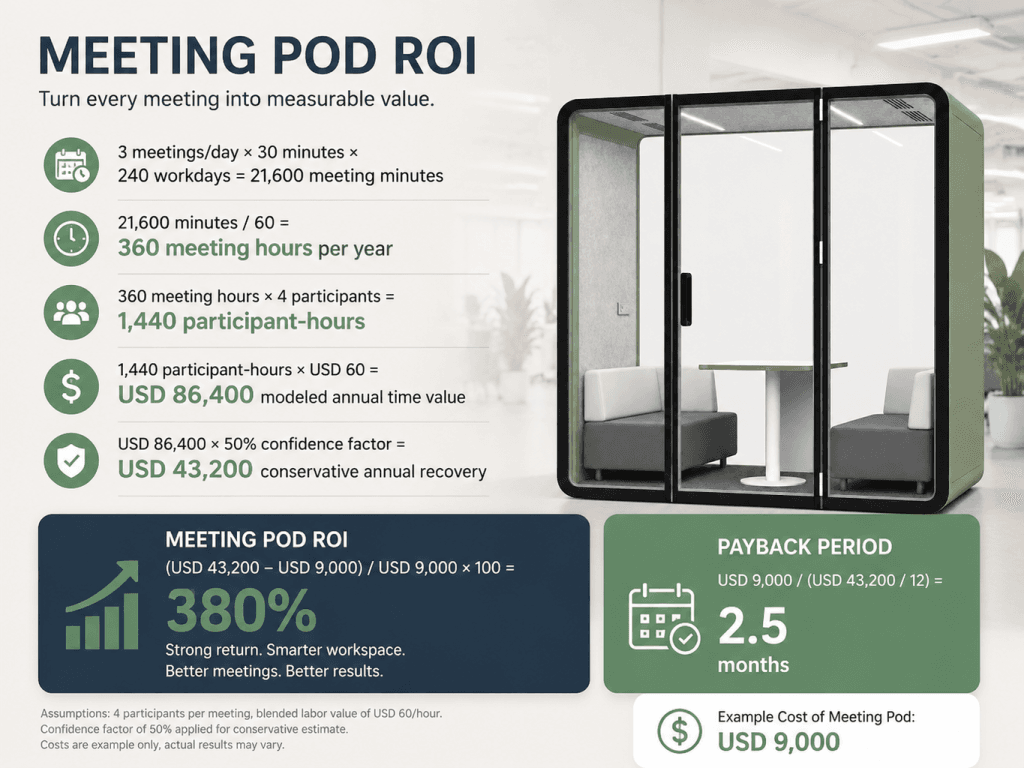
The example uses:
- 3 occupied meetings per day;
- 30 minutes per meeting;
- 240 workdays per year;
- 4 participants per meeting;
- a blended labor value of USD 60 per hour;
- a 50% confidence factor for the modeled value;
- an example meeting pod cost of USD 9,000.
USD 9,000 is an example for the calculation, not a B&H price list or quote. The final B&H price depends on the delivery address, furniture selection, final configuration, quantity, delivery terms, access conditions, and project scope. Confirm the live project price with B&H.
The calculation is:
3 meetings/day x 30 minutes x 240 workdays = 21,600 meeting minutes
21,600 minutes / 60 = 360 meeting hours per year

360 meeting hours x 4 participants = 1,440 participant-hours
1,440 participant-hours x USD 60 = USD 86,400 modeled annual time value
USD 86,400 x 50% confidence factor = USD 43,200 conservative annual recovery
Using the example cost:
Simple ROI = (USD 43,200 - USD 9,000) / USD 9,000 x 100 = 380%

Payback period = USD 9,000 / (USD 43,200 / 12) = 2.5 months
Swap in the buyer’s meeting frequency, meeting length, participant count, finance-approved value, and confirmed quote before presenting the case.
Model Utilization as a Range
The example uses three occupied meetings per day. Build three cases for the target team:
| Scenario | How to define it | Decision use |
|---|---|---|
| Low | Conservative occupied-session count during quieter periods | Downside case |
| Base | Observed average for the target area | Approval case |
| High | Repeated peak pattern supported by booking or observation data | Upside case |
Use the base case as the headline, show the high case as upside, and let the low case reflect the quiet periods in the observation data.
Use the average meeting length that appears in the calendar or observation data, including cancellations and early finishes in the sample.
What Can Count as Meeting-Pod Value?
Small-Group Meeting Recovery
Count recurring two-to-four-person meetings that currently occupy a larger room or move into an open area because the right-sized rooms are unavailable. The value is clearest when the larger room is needed by another team or the open setting creates a real privacy or interruption problem.
Important One-to-One Conversations
A 4-person pod can also support an important one-to-one conversation when a phone booth is too small and an open desk area is unsuitable. Examples include interviews, manager conversations, sensitive project reviews, and client discussions. Count those sessions when they replace a room booking, a recurring search for privacy, or a documented workflow problem.
Avoided Build-Out
Include the cost of avoided construction when a huddle room, small meeting room, contractor scope, or renovation project was under consideration. If no build-out was planned, enter zero.
Flexibility Value
Relocation, redeployment, and future layout flexibility matter in a changing lease or workplace plan. Keep them as qualitative value unless finance has an approved monetary method.
Keep These Out of the Base Case
- vague productivity gains;
- every informal conversation on the floor;
- theoretical resale value;
- tax benefits without finance or tax-advisor review;
- construction savings when no construction project existed;
- a full daily schedule that the team has not observed.
Use Elite-L as the B&H Planning Example
B&H Ergonomics lists Elite-L as a 4-person meeting pod. It is a practical starting point for enclosed small-group meetings, hybrid discussions, and important one-to-one conversations that need more room than a phone booth.
Start with Elite-L, then confirm the target group size, table and screen requirements, location, circulation, ventilation, power, delivery route, and meeting duration before requesting the final configuration.
Request a configured quote for the project so the financial model uses the same scope as the purchase decision.
DDP, Delivery, and Installation Boundaries
For the agreed B&H DDP scope, transport and unloading are included. Installation is a separate line item unless the quote says otherwise.
The modular design supports straightforward assembly. Before approval, assign each responsibility:
| Project responsibility | What the quote should show |
|---|---|
| Transport | Destination, delivery term, and included freight scope |
| Unloading | Whether unloading at the agreed delivery point is included |
| Internal movement | Who moves packaged components from the delivery point to the final room |
| Assembly | Who assembles the modular pod and what tools or labor are required |
| Final placement | Who positions and levels the pod in the approved location |
| Testing and handover | Who checks power, ventilation, lighting, doors, and accessories |
| Packaging removal | Whether removal is included or assigned to the buyer |
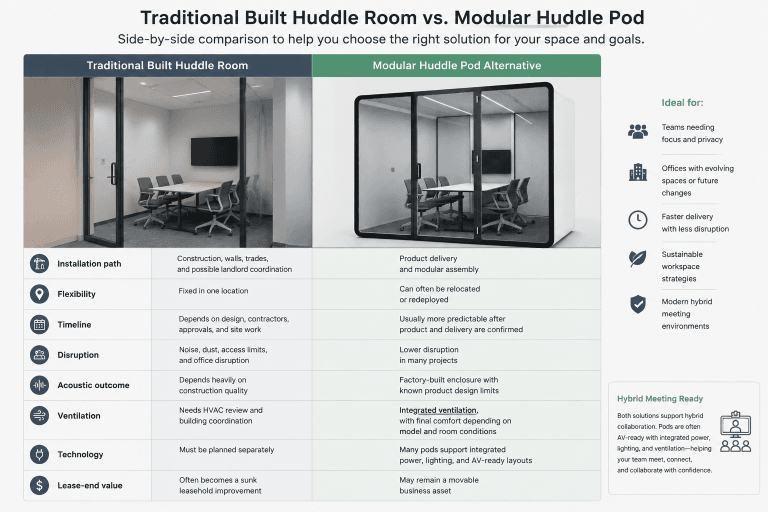
Compare like with like: add assembly and installation to the pod quote before comparing it with a fully installed construction budget.
Compare It With a Huddle-Room Build-Out
Compare the two options on the same project basis:
| Decision area | Meeting pod | Huddle-room build-out |
|---|---|---|
| Initial scope | Product configuration, delivery, unloading, and any separately quoted services | Design, materials, contractors, equipment, and project management |
| Installation | Separate line item; modular assembly is straightforward | Included in the construction scope, with more coordination |
| Disruption | Delivery, assembly, and site access planning | Demolition, noise, dust, access restrictions, and phased work |
| Future layout | Modular asset may support relocation or redeployment | Fixed to the building layout unless remodeled |
| Cost model | Use the complete quoted scope | Use the complete construction and soft-cost budget |
If a huddle-room build-out is not part of the plan, set avoided construction to zero. For broader huddle-room planning, see the B&H huddle room guide.
The Pattern That Makes a Pod Pay Back
The case is strongest when several of these conditions line up:
- small groups regularly occupy oversized rooms;
- important one-to-one conversations lack a suitable private space;
- huddle rooms are overbooked or unavailable;
- the proposed pod is near the teams that create the demand;
- the buyer has observed use data;
- the quote clearly separates transport, unloading, installation, and site responsibilities;
- the workplace needs enclosed capacity without committing to permanent construction.
When to Pause the Project
Pause and gather better data when:
- small-group meeting demand is infrequent;
- the proposed location is inconvenient;
- existing rooms already meet the observed demand;
- the model assumes daily full-load use;
- the buyer counts unverified productivity gains;
- delivery or installation responsibility is unclear;
- the pod is being purchased mainly for appearance.
If the low-utilization case fails, revisit the location, capacity, or purchase timing before committing the budget.
CFO and Facility Manager Approval Checklist
Before approval, document:
- The number of occupied small-group and important one-to-one meetings.
- Typical meeting length and participant count.
- The observation period and how cancellations or empty periods were handled.
- The proposed location and the teams expected to use the pod.
- The complete quote and delivery destination.
- What DDP transport and unloading include.
- Who is responsible for internal movement, assembly, installation, testing, and packaging removal.
- Whether an actual huddle-room build-out was being considered.
- Low, base, and high utilization calculations.
- The finance-approved hourly value and the date for reviewing actual use after installation.
Final Recommendation
Build the case from observed behavior, then let the quote and the utilization range do the work. The example above shows the math; the live approval case should use the final B&H amount and the meeting pattern at the proposed location.
FAQ
What is a meeting pod ROI calculator?
A meeting pod ROI calculator compares a complete pod project cost with modeled annual recovery from observed small-group meetings, important one-to-one conversations, documented room displacement, and any verified avoided build-out.
Why does utilization matter more than maximum capacity?
Maximum capacity describes how many people can use the pod at one time. Utilization describes how often it is occupied. Payback follows utilization, so use observed sessions and include quiet periods.
When can I include avoided construction cost?
Include it when a real huddle-room or small-room project was being considered and its cost is documented. Enter zero for a theoretical room.
Does B&H DDP include installation?
The agreed DDP scope includes transport and unloading. Installation is a separate line item unless the quote says otherwise. The pod is modular, so assembly is straightforward; assign assembly and final placement before approval.
Is Elite-L suitable for every 4-person meeting?
Elite-L is a B&H starting point for 4-person enclosed meetings. Confirm the furniture, screen, ventilation, power, circulation, meeting duration, and site conditions against the floor plan.