Snel antwoord
Een ROI-calculator voor een vergaderpod begint met de vergaderingen die daadwerkelijk plaatsvinden. Tel bezette vergaderingen met kleine groepen en belangrijke één-op-ééngesprekken, pas een door Finance goedgekeurde uurwaarde toe en vergelijk het resultaat met de totale projectkosten. Toets vervolgens scenario's met lage, gemiddelde en hoge bezetting. Neem vermeden bouwkosten mee wanneer de inrichting van een huddle room onderdeel is van het alternatief.
De praktische vraag is eenvoudig: wordt deze pod vaak genoeg gebruikt om een daadwerkelijk knelpunt in ruimte of privacy op te lossen?
Laatst bijgewerkt: 26 augustus 2026 | Auteur: Richard | Geschatte leestijd: 9 minuten
Wat deze calculator een CFO helpt beslissen
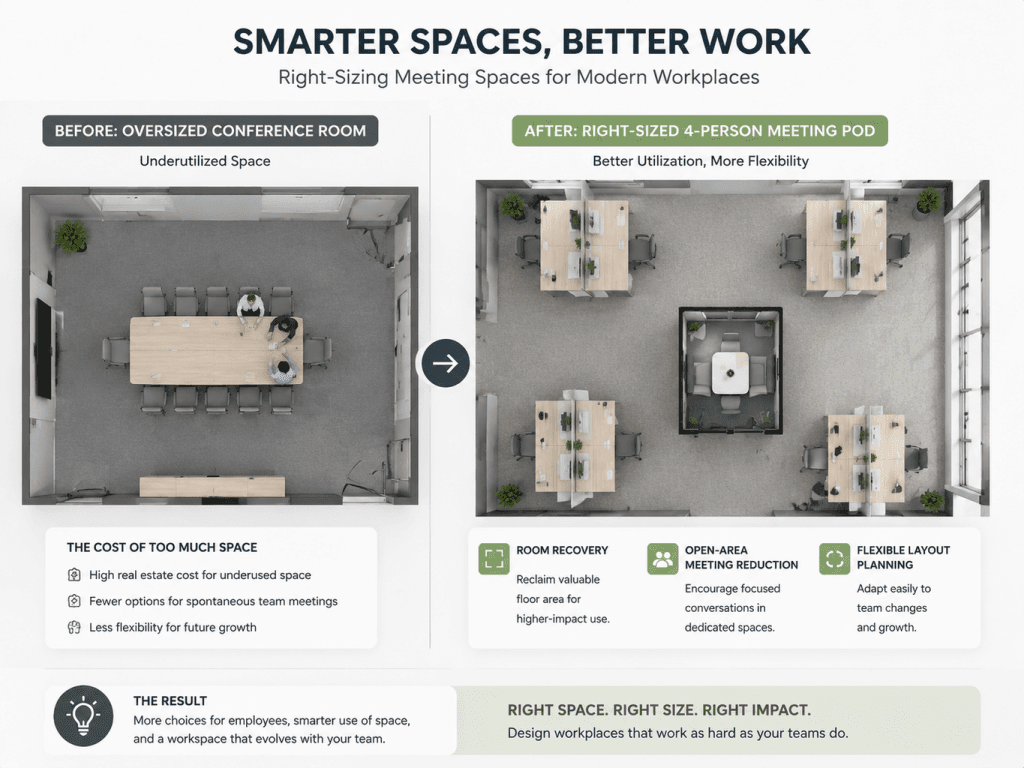
Een vergaderpod voor 4 personen verdient zijn plaats wanneer deze een meetbare beperking op de werkplek verandert: kleine groepen bezetten te grote ruimtes, belangrijke gesprekken kunnen nergens op een geschikte plek plaatsvinden, of de inrichting van een huddle room wordt overwogen.
Gebruik het model om te bepalen:
- of kleine groepen ruimtes gebruiken die te groot zijn voor de vergadering;
- of belangrijke één-op-ééngesprekken plaatsvinden in open of ongeschikte ruimten;
- of de inrichting van een huddle room een reëel alternatief is;
- of de voorgestelde locatie dicht genoeg bij de teams ligt die de vraag creëren;
- of het verwachte gebruik een verdedigbare terugverdientijd ondersteunt.
Bekijk voor product- en configuratievergelijkingen B&H Ergonomics vergaderpods.
Begin met daadwerkelijk gebruik, niet met maximale capaciteit
De maximale capaciteit geeft aan hoeveel personen de pod kan bevatten. De bezettingsgraad geeft aan of de pod zijn waarde bewijst. Een aanduiding voor vier personen zegt niets over hoe vaak de pod bezet zal zijn of of hij dicht bij de teams staat die hem nodig hebben.
Begin met een korte observatieperiode of een controle van agenda's. Leg het volgende vast:
- bezette vergaderingen per dag;
- het gebruikelijke aantal deelnemers;
- de gemiddelde vergaderduur;
- hoe vaak een grotere ruimte door een kleine groep wordt gebruikt;
- hoe vaak een belangrijk één-op-ééngesprek meer privacy vereist dan een open werkplek biedt.
Neem rustige perioden mee in het gemiddelde. Ze maken deel uit van het gebruikspatroon en beïnvloeden de terugverdientijd.
De ROI-formule van de Meeting Pod
Gebruik deze structuur voor een eerste modelopzet:
Waargenomen jaarlijkse vergaderuren =
bezette sessies per dag x gemiddelde vergaderduur x werkdagen per jaar

Waargenomen jaarlijkse deelnemeruren =
waargenomen jaarlijkse vergaderuren x gemiddeld aantal deelnemers

Gemodelleerde jaarlijkse waarde van vergadergebruik =
waargenomen jaarlijkse deelnemeruren x door Finance goedgekeurde uurwaarde

Aangepaste jaarlijkse opbrengst =
gemodelleerde jaarlijkse waarde van vergadergebruik
+ geverifieerde waarde van vermeden inrichtingskosten
+ overige gedocumenteerde kostenbesparingen

Terugverdientijd in maanden =
totale podkosten / (aangepaste jaarlijkse opbrengst / 12)

Eenvoudige ROI in jaar één =
(aangepaste jaarlijkse opbrengst - totale podkosten) / totale podkosten x 100
Deelnemeruren zetten vergaderactiviteit om in een gemeenschappelijke financiële eenheid. Finance kan vervolgens bepalen welk deel in de goedgekeurde besparingsberekening thuishoort.
Invoer voor een werkblad geschikt voor de CFO
| Invoer | Wat in te voeren | Praktische controle |
|---|---|---|
| Bezette sessies per dag | Waargenomen gemiddelde voor het doelteam of -gebied | Haal dit uit ruimteboekingen of een korte steekproef |
| Gemiddelde duur van een vergadering | Agenda- of observatiegegevens | Gebruik de duur die vergaderingen in werkelijkheid hebben |
| Gemiddeld aantal deelnemers | Typische opkomst voor de doelvergaderingen | Gebruik de opkomst, niet de capaciteit van de ruimte |
| Werkdagen per jaar | De feitelijke agenda van de organisatie | Afstemmen op het financiële model |
| Door de financiële afdeling goedgekeurde uurwaarde | Interne arbeidskosten inclusief opslagen of een andere geaccepteerde basis | Gebruik de methode van het Finance-team |
| Totale kosten van de pod | Bevestigde projectofferte | Neem de volledige leveringsomvang op |
| Voorkomen van uitbreiding | A planned and documented alternative cost | Use the real project budget |
| Utilization scenario | Low, base, and high cases | Show the operating range |
Finance needs a complete quote: product configuration, delivery address, transport, unloading, installation responsibility, and any site requirements.
Example Calculation
Here is an example set of planning inputs. Each line can be replaced with the buyer’s own numbers.
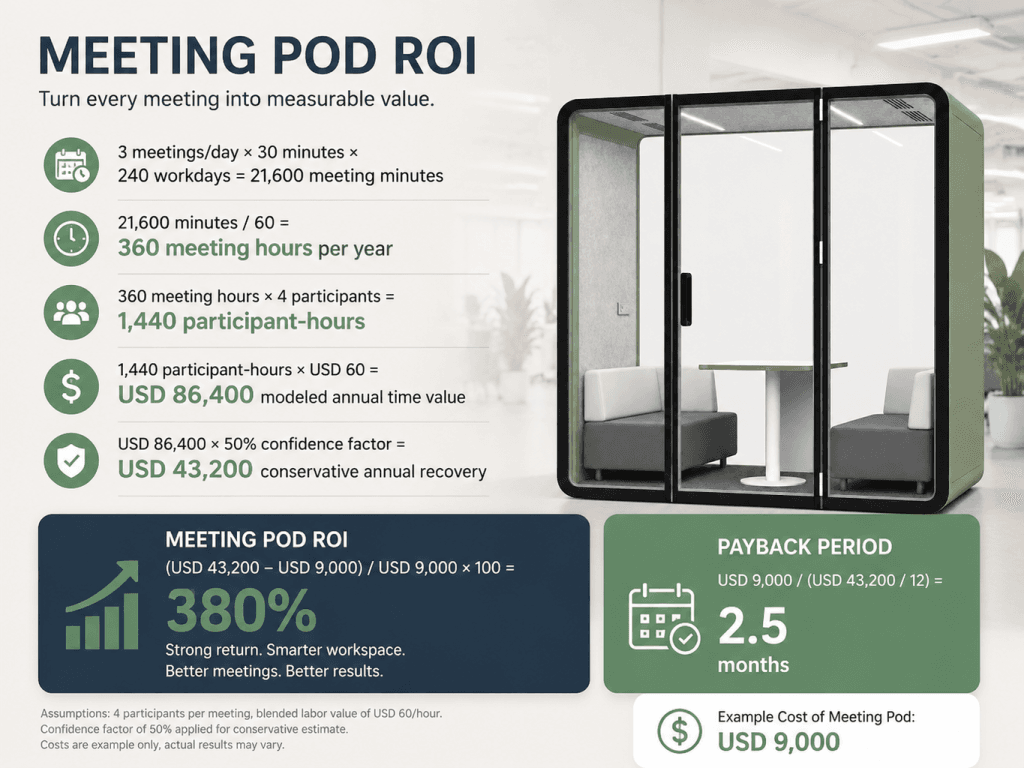
The example uses:
- 3 occupied meetings per day;
- 30 minutes per meeting;
- 240 workdays per year;
- 4 participants per meeting;
- a blended labor value of USD 60 per hour;
- a 50% confidence factor for the modeled value;
- an example meeting pod cost of USD 9,000.
USD 9,000 is an example for the calculation, not a B&H price list or quote. The final B&H price depends on the delivery address, furniture selection, final configuration, quantity, delivery terms, access conditions, and project scope. Confirm the live project price with B&H.
The calculation is:
3 vergaderingen/dag x 30 minuten x 240 werkdagen = 21.600 vergaderminuten
21.600 minuten / 60 = 360 vergaderuren per jaar

360 vergaderuren x 4 deelnemers = 1.440 deelnemersuren
1.440 deelnemersuren x 60 USD = 86.400 USD gemodelleerde jaarlijkse tijdswaarde
86.400 USD x 50%-betrouwbaarheidsfactor = 43.200 USD conservatieve jaarlijkse opbrengst
Using the example cost:
Simple ROI = (USD 43,200 - USD 9,000) / USD 9,000 x 100 = 380%

Payback period = USD 9,000 / (USD 43,200 / 12) = 2.5 months
Swap in the buyer’s meeting frequency, meeting length, participant count, finance-approved value, and confirmed quote before presenting the case.
Model Utilization as a Range
The example uses three occupied meetings per day. Build three cases for the target team:
| Scenario | How to define it | Decision use |
|---|---|---|
| Laag | Conservative occupied-session count during quieter periods | Downside case |
| Base | Observed average for the target area | Approval case |
| Hoog | Repeated peak pattern supported by booking or observation data | Upside case |
Use the base case as the headline, show the high case as upside, and let the low case reflect the quiet periods in the observation data.
Use the average meeting length that appears in the calendar or observation data, including cancellations and early finishes in the sample.
What Can Count as Meeting-Pod Value?
Small-Group Meeting Recovery
Count recurring two-to-four-person meetings that currently occupy a larger room or move into an open area because the right-sized rooms are unavailable. The value is clearest when the larger room is needed by another team or the open setting creates a real privacy or interruption problem.
Important One-to-One Conversations
A 4-person pod can also support an important one-to-one conversation when a phone booth is too small and an open desk area is unsuitable. Examples include interviews, manager conversations, sensitive project reviews, and client discussions. Count those sessions when they replace a room booking, a recurring search for privacy, or a documented workflow problem.
Avoided Build-Out
Include the cost of avoided construction when a huddle room, small meeting room, contractor scope, or renovation project was under consideration. If no build-out was planned, enter zero.
Flexibility Value
Relocation, redeployment, and future layout flexibility matter in a changing lease or workplace plan. Keep them as qualitative value unless finance has an approved monetary method.
Keep These Out of the Base Case
- vague productivity gains;
- every informal conversation on the floor;
- theoretical resale value;
- tax benefits without finance or tax-advisor review;
- construction savings when no construction project existed;
- a full daily schedule that the team has not observed.
Use Elite-L as the B&H Planning Example
B&H Ergonomics lists Elite-L as a 4-person meeting pod. It is a practical starting point for enclosed small-group meetings, hybrid discussions, and important one-to-one conversations that need more room than a phone booth.
Start with Elite-L, then confirm the target group size, table and screen requirements, location, circulation, ventilation, power, delivery route, and meeting duration before requesting the final configuration.
Request a configured quote for the project so the financial model uses the same scope as the purchase decision.
DDP, Delivery, and Installation Boundaries
For the agreed B&H DDP scope, transport and unloading are included. Installation is a separate line item unless the quote says otherwise.
The modular design supports straightforward assembly. Before approval, assign each responsibility:
| Project responsibility | What the quote should show |
|---|---|
| Transport | Destination, delivery term, and included freight scope |
| Uitladen | Whether unloading at the agreed delivery point is included |
| Interne beweging | Who moves packaged components from the delivery point to the final room |
| Montage | Who assembles the modular pod and what tools or labor are required |
| Final placement | Who positions and levels the pod in the approved location |
| Testing and handover | Who checks power, ventilation, lighting, doors, and accessories |
| Packaging removal | Whether removal is included or assigned to the buyer |
Compare like with like: add assembly and installation to the pod quote before comparing it with a fully installed construction budget.
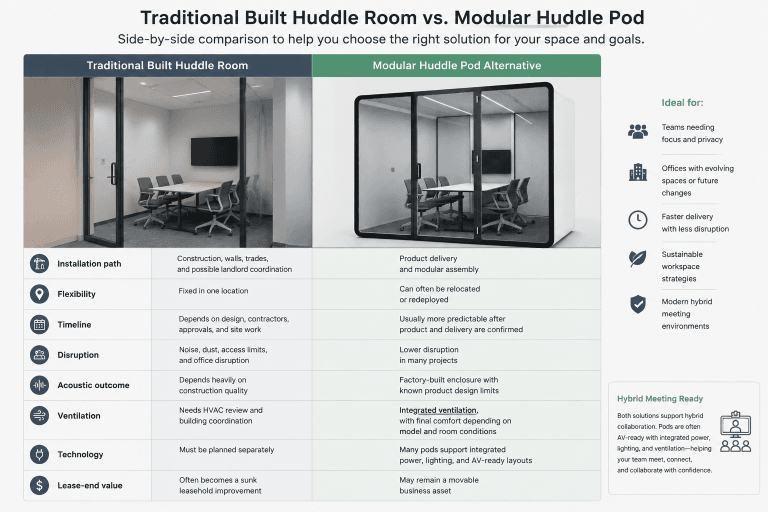
Compare It With a Huddle-Room Build-Out
Compare the two options on the same project basis:
| Beslissingsgebied | Vergaderruimte | Huddle-room build-out |
|---|---|---|
| Initial scope | Product configuration, delivery, unloading, and any separately quoted services | Design, materials, contractors, equipment, and project management |
| Installatie | Separate line item; modular assembly is straightforward | Included in the construction scope, with more coordination |
| Verstoring | Delivery, assembly, and site access planning | Demolition, noise, dust, access restrictions, and phased work |
| Future layout | Modular asset may support relocation or redeployment | Fixed to the building layout unless remodeled |
| Cost model | Use the complete quoted scope | Use the complete construction and soft-cost budget |
If a huddle-room build-out is not part of the plan, set avoided construction to zero. For broader huddle-room planning, see the B&H huddle room guide.
The Pattern That Makes a Pod Pay Back
The case is strongest when several of these conditions line up:
- small groups regularly occupy oversized rooms;
- important one-to-one conversations lack a suitable private space;
- huddle rooms are overbooked or unavailable;
- the proposed pod is near the teams that create the demand;
- the buyer has observed use data;
- the quote clearly separates transport, unloading, installation, and site responsibilities;
- the workplace needs enclosed capacity without committing to permanent construction.
When to Pause the Project
Pause and gather better data when:
- small-group meeting demand is infrequent;
- the proposed location is inconvenient;
- existing rooms already meet the observed demand;
- the model assumes daily full-load use;
- the buyer counts unverified productivity gains;
- delivery or installation responsibility is unclear;
- the pod is being purchased mainly for appearance.
If the low-utilization case fails, revisit the location, capacity, or purchase timing before committing the budget.
CFO and Facility Manager Approval Checklist
Documenteer vóór goedkeuring:
- The number of occupied small-group and important one-to-one meetings.
- Typical meeting length and participant count.
- The observation period and how cancellations or empty periods were handled.
- The proposed location and the teams expected to use the pod.
- The complete quote and delivery destination.
- What DDP transport and unloading include.
- Who is responsible for internal movement, assembly, installation, testing, and packaging removal.
- Whether an actual huddle-room build-out was being considered.
- Low, base, and high utilization calculations.
- The finance-approved hourly value and the date for reviewing actual use after installation.
Eindaanbeveling
Build the case from observed behavior, then let the quote and the utilization range do the work. The example above shows the math; the live approval case should use the final B&H amount and the meeting pattern at the proposed location.
FAQ
Wat is een ROI-calculator voor vergaderpods?
Een ROI-calculator voor een vergaderpod vergelijkt de totale projectkosten van de pod met de gemodelleerde jaarlijkse terugverdienwaarde op basis van geobserveerde vergaderingen in kleine groepen, belangrijke één-op-één-gesprekken, gedocumenteerde vervanging van vergaderruimten en eventuele geverifieerde vermeden bouwkosten.
Waarom is de benuttingsgraad belangrijker dan de maximale capaciteit?
De maximale capaciteit geeft aan hoeveel mensen de pod tegelijk kunnen gebruiken. Bezettingsgraad geeft aan hoe vaak de pod bezet is. De terugverdientijd hangt samen met de bezettingsgraad. Gebruik daarom geobserveerde gebruikssessies en houd rekening met rustige periodes.
Wanneer kan ik de vermeden bouwkosten meenemen?
Neem dit op wanneer er daadwerkelijk een project voor een overleg- of kleine vergaderruimte werd overwogen en de kosten daarvan zijn gedocumenteerd. Voer nul in voor een theoretische ruimte.
Is installatie inbegrepen bij B&H DDP?
De overeengekomen DDP-omvang omvat transport en lossen. Installatie is een aparte post, tenzij in de offerte anders staat vermeld. De pod is modulair, dus de montage is eenvoudig; wijs vóór goedkeuring de montage en definitieve plaatsing toe.
Is Elite-L geschikt voor elke vergadering met 4 personen?
Elite-L is een B&H-uitgangspunt voor besloten vergaderingen met 4 personen. Controleer het meubilair, scherm, de ventilatie, stroomvoorziening, circulatie, vergaderduur en locatieomstandigheden aan de hand van de plattegrond.