
Snel antwoord
Useful office air quality testing starts with a clear question about the office indoor air quality problem. Are people reporting headaches or eye irritation? Did complaints begin after new furniture, a renovation, a cleaning change, or a smoke event? Does a particular zone feel stale when occupancy rises? The answer determines what to measure and when to measure it.
Before hiring a provider, collect the complaint history, floor plan, occupancy pattern, HVAC schedule, recent fit-out information, and any moisture or odor records. Ask for a sampling plan that names the locations, timing, instruments or laboratory methods, outdoor comparison points, quality controls, and reporting format.
Read the result in context. Use CO2 to understand ventilation and occupancy, then pair it with the HVAC record, outdoor-air condition, and other measurements. OSHA exposure limits apply to specified workplace hazards; office comfort and project decisions often require a separate ventilation or indoor-environment reference. A useful report connects each finding to a practical action and names the follow-up check.
Last Updated: October 9, 2026 | Author: Richard | Estimated Reading Time: 10 minutes
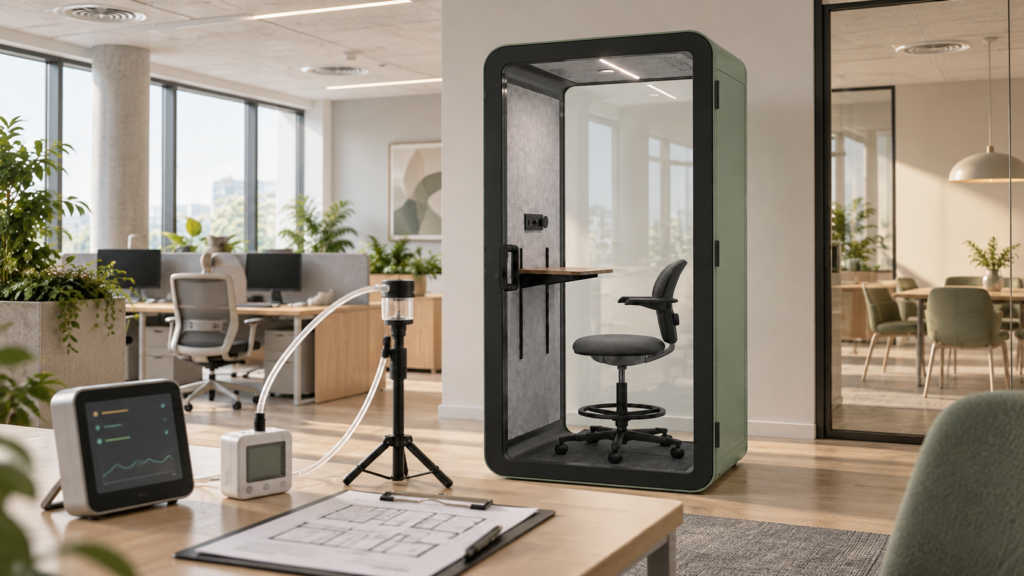
When Office Air Quality Testing Is Worthwhile
Testing is most useful when it can answer a defined building question. Common triggers include:
- Repeated reports of dry eyes, headaches, unusual odors, throat irritation, or discomfort in the same area.
- Complaints that change with occupancy, weather, HVAC schedules, or time of day.
- New carpet, furniture, paint, flooring, cleaning chemicals, pest treatment, or other fit-out work.
- Visible dampness, water damage, recurring condensation, or a musty smell.
- Outdoor smoke or traffic pollution entering through the building’s air intake.
- A ventilation upgrade, controls change, or space reconfiguration that may have changed airflow.
Treat these signs as investigation triggers. Record the complaint, location, time, activity, weather, and HVAC condition so the investigation can test a pattern; medical questions belong with the appropriate health professional.
Define the Question Before You Buy a Test
A broad request to “test the air” often produces a long list of numbers without a clear decision. Start with the problem you need to solve.
| Vraag | Bruikbare gegevens | Timing to discuss with the provider |
|---|---|---|
| Does ventilation keep up when the office fills? | CO2 trend, occupancy, outdoor-air context, HVAC or BAS data | A normal busy period and a lower-occupancy period |
| Is wildfire smoke or outdoor pollution entering? | PM2.5 or PM10, outdoor intake reading, filter and HVAC operating state | During the event or a comparable smoke-affected period |
| Did new finishes or furniture create an odor? | Product and chemical inventory, targeted VOC or formaldehyde plan, ventilation state | After the space is operating normally and at the time complaints occur |
| Is moisture contributing to a musty area? | Visual moisture inspection, building history, targeted material or air sampling when justified | During or soon after the complaint; inspect the source before relying on sampling |
| Is one zone different from the rest of the floor? | Matched readings across zones plus outdoor intake data | At the same time and under comparable HVAC conditions |
My rule for a useful brief is simple: every measurement needs a decision attached. Ask the provider why each item is included and what action it will support, then keep the first phase focused on those decisions.
Prepare the Office for Sampling
The best preparation makes the test represent normal operation. Gather the following before the site visit:
- Complaint log. Record the exact wording, location, date, time, activity, and whether the issue improves after leaving the space.
- Floor plan and zones. Mark work areas, meeting rooms, enclosed rooms, supply and return grilles, outdoor air intakes, kitchens, printers, storage, and recent construction areas.
- Occupancy pattern. Note normal headcount, peak periods, meeting schedules, cleaning times, and areas that are usually empty.
- HVAC information. Collect schedules, setpoints, recent maintenance, filter changes, ventilation complaints, and available building automation system (BAS) or building management system (BMS) trend data.
- Recent changes. List new finishes, furniture, adhesives, paint, cleaning products, pest control, water events, and changes to space layout.
- Outdoor conditions. Note wildfire smoke, traffic pollution, nearby construction, unusual odors, temperature, and humidity when relevant.
- Access and safety arrangements. Confirm which rooms can be entered, who can access BAS data, and how the provider will work around employees and sensitive areas.
Ask the building team to keep normal operations during the visit. Keep fan settings, doors, room use, and occupancy representative of the period being investigated; schedule an unusual condition only when the provider is deliberately studying it.
This matters in buildings with variable air volume (VAV) systems and demand-controlled ventilation (DCV). Airflow changes with occupancy, temperature, and control signals, so the sampling plan should include more than one operating condition and the relevant BAS or BMS trend. ASHRAE’s Standard 62.1 and 62.2 resources provide useful ventilation context when the provider explains the comparison basis.
How to Commission an IAQ Provider
For a complex office investigation, use a certified industrial hygienist (CIH) or another professional whose qualifications and scope match the problem. Compare proposals by the work described and the decisions it supports; analyte count is only one part of the scope.
Ask each provider to state:
- The complaint or decision the investigation is designed to answer.
- The measurements, inspections, or laboratory analyses included, and why each one is relevant.
- Sample locations, sample height, duration, frequency, and whether readings are continuous or single-point.
- The HVAC, occupancy, weather, and outdoor-air conditions to be recorded with each sample.
- Instrument calibration, quality assurance and quality control (QA/QC), laboratory qualifications, and chain-of-custody procedures where samples go to a lab.
- The comparison basis: an applicable regulation, a design or ventilation reference, a project requirement, or a professional interpretation.
- The report format, photographs or field notes, limitations, recommended actions, and retest terms.
- Any hazards that require a different specialist, such as asbestos, lead, combustion safety, or a regulated industrial contaminant.
A strong proposal states the boundary of each test. A short VOC sample can identify a source pattern; pair it with the product inventory, ventilation record, and site inspection before assigning a cause or responsibility.
What Common Measurements Tell You
Carbon dioxide (CO2)
CO2 is a ventilation and occupancy indicator. It shows how a space changes as people arrive and whether outdoor-air delivery responds as expected. Pair it with other measurements and an HVAC review when the investigation covers broader indoor air quality.
Ask for CO2 data alongside occupancy, time, zone, outdoor reference, and HVAC or BAS status. A single value without that context is difficult to interpret.
Temperature and relative humidity
Temperature and relative humidity add comfort and moisture context. A complaint that appears to be “stale air” may also involve heat, dry air, condensation, or an uneven zone. These readings become more useful when they are matched to the complaint location and operating conditions.
Particles, including PM2.5 and PM10
Fine particles can come from outdoor smoke, traffic, construction, cooking, cleaning activity, or other indoor sources. Compare indoor readings with the outdoor air intake and check the filter type, condition, pressure, and operating state. If outdoor smoke is entering, the response may involve filtration, intake management, or temporary operating controls rather than a new interior finish.
Carbon monoxide (CO)
Treat CO as a combustion-safety issue. When a reading is elevated or a combustion source is suspected, follow the building’s emergency and professional-response procedures before continuing a broader IAQ investigation.
Volatile organic compounds (VOCs) and formaldehyde
VOCs and formaldehyde can be associated with products, finishes, furnishings, cleaning chemicals, and other sources. The useful investigation combines the result with a product inventory, ventilation state, sample timing, and an inspection of likely sources.
OSHA exposure limits address specific workplace hazards and conditions. When a regulated limit is relevant, use the current OSHA regulations for that contaminant and jurisdiction, then explain how it differs from a project, design, or indoor-environment benchmark.
Moisture and mold indicators
A musty odor or water history calls for source investigation. Check leaks, condensation, drainage, wall and ceiling materials, and HVAC components. Sampling answers a narrow question; removing the moisture source and repairing damaged materials remains the central response.
How to Read an Office Air Quality Report
I read an IAQ report in this order:
- What question did the investigation answer? The conclusion should relate to the complaint or decision that defined the scope.
- Where and when were samples taken? Check room, zone, height, date, time, duration, occupancy, weather, and HVAC state.
- What method and unit were used? Look for the instrument or laboratory method, unit, averaging time, detection limit, and quality-control notes.
- What is the comparison basis? A legal exposure limit, an ASHRAE ventilation reference, an EPA recommendation, a project requirement, and a comfort guideline do different jobs. The report should name which one it uses.
- What is missing? Note unavailable BAS data, unusual occupancy, changed HVAC settings, inaccessible areas, or a sample that fails to represent the complaint period.
- What action follows? Each material finding should have an owner, a proposed correction, a timeframe, and a way to check whether the correction worked.
A useful report shows the pattern across zones and times alongside the operating condition. Ask the provider to connect the conclusion to the complaint period, the HVAC record, and the next action rather than presenting only the highest or lowest number.
For U.S. projects, use the EPA guide to indoor air quality in offices and other large buildings for building-operation context. Use the ASHRAE resource above when the provider explains ventilation design, outdoor-air delivery, and the comparison basis.
From Results to Better Office Air
Use the report to improve office air quality by working through the likely source in a practical order:
- Control the source. Remove, isolate, repair, or replace the material, process, leak, or combustion source that the evidence identifies.
- Correct HVAC operation. Check schedules, outdoor-air delivery, dampers, controls, filters, and maintenance. Review the BAS trend when the issue changes with occupancy or temperature.
- Improve filtration or air cleaning where appropriate. Match the filter and equipment to the building system and the contaminant. Check airflow, maintenance, noise, and placement before adding a device.
- Manage fit-out and cleaning. Coordinate low-emitting products, curing time, ventilation, isolation, and re-entry conditions with the landlord and project team.
- Communicate temporary controls. Tell occupants what area is affected, what has changed, and when the next check will happen.
- Retest under comparable conditions. Repeat the relevant measurements with similar occupancy, HVAC mode, weather, and source conditions.
Separate landlord and tenant responsibilities
Responsibility is easier to discuss when the report compares the outdoor intake with indoor zones. If the intake already shows the problem, the building’s filtration or outdoor-air path deserves attention. If the intake is acceptable but one tenant area is elevated, investigate the tenant’s finishes, furniture, equipment, cleaning products, moisture, and local airflow.
This comparison gives the landlord, tenant, and project team a shared technical starting point. It also directs the next inspection to the part of the system most likely to explain the result.
Check enclosed spaces separately
An enclosed room or pod has its own airflow path and operating conditions. Review the model’s airflow, intake and exhaust locations, fan noise, service access, and expected use period. If your project is evaluating kantoorpods, treat the pod’s ventilation evidence as a model-specific comfort and usability check alongside the building HVAC assessment. For a single-person call space, the Handleiding voor de ventilatie van telefooncellen op kantoor explains the airflow and fan-noise details to request from the supplier.
FAQ
Bewijst een CO2-meting dat de lucht op kantoor veilig is?
CO2 laat zien hoe de ventilatie verandert met de bezetting. Lees deze waarde in samenhang met de bezetting, buitenlucht, de status van HVAC of BAS en de andere bevindingen in het rapport.
Wat moet een luchtkwaliteitstest op kantoor omvatten?
De reikwijdte moet aansluiten bij de vraag. Een bruikbare opdrachtomschrijving vermeldt doorgaans de klacht, locaties, tijdstippen, bezetting, HVAC-status, vergelijking met buiten, metingen of inspecties, methoden, kwaliteitscontroles, rapportagevelden, beperkingen en een plan voor hertesting. Voeg gespecialiseerd onderzoek alleen toe wanneer de geschiedenis van het gebouw of de inspectie dit ondersteunt.
Should testing happen during a complaint or on a normal day?
Plan for both when the problem changes over time. A complaint-period sample can capture the condition people are reporting; a normal-period sample can show the baseline. Record the operating conditions for each so the results can be compared honestly.
Are OSHA limits the same as office air quality standards?
OSHA limits address specific occupational hazards and exposure conditions. Office air quality decisions may also use ventilation references, environmental guidance, project requirements, and professional interpretation. The report should identify the purpose and jurisdiction of each benchmark.
Who is responsible when outdoor air is clean but an indoor zone is not?
The evidence points toward sources or conditions inside that zone. Use the outdoor-intake comparison, product inventory, moisture history, and HVAC data to assign the next inspection, then apply the lease, fit-out scope, equipment, and maintenance obligations to the responsibili
