Snel antwoord
Werkpods voor neurodiversiteit kunnen een inclusiever kantoor ondersteunen door mensen meer controle te geven over afleiding door spraak, visuele blootstelling, verlichting, luchtstroom en privacy. Ze werken het best als een gedeelde voorziening voor concentratie die beschikbaar is voor iedereen die behoefte heeft aan een ruimte met minder prikkels. Een pod moet individuele ondersteuning op de werkplek aanvullen, niet een ondersteuningsproces vervangen of een medisch resultaat of productiviteitsresultaat beloven.
Laatst bijgewerkt: 22 juli 2026 | Auteur: Richard | Geschatte leestijd: 10 minuten
Begin met het sensorische probleem, niet met het product
Een project voor een stilteruimte moet beginnen met de omstandigheden die medewerkers proberen te beheersen. In een open kantoor of gedeelde openbare ruimte kan het probleem bestaan uit een aanhoudend mechanisch gezoem, gesprekken in de buurt, beweging in het perifere zicht, felle verlichting, een sterke geur of een interieurelement dat onaangenaam aanvoelt.
Deze prikkels beïnvloeden niet iedereen op dezelfde manier. De ene persoon heeft mogelijk minder afleiding door spraak nodig, terwijl een andere persoon zachter licht of minder visuele blootstelling nodig heeft. Sommige medewerkers zullen een diagnose melden; anderen hebben er misschien geen, willen deze misschien niet melden of verbergen mogelijk de inspanning die nodig is om te werken in een omgeving met veel prikkels. De praktische ontwerpvraag is daarom niet: “Voor welke diagnose is deze pod bedoeld?” De vraag is: “Welke omgevingsregelingen moet deze werkplek bieden?”
Het Employer Assistance and Resource Network on Disability Inclusion biedt bredere richtlijnen over neurodiversiteit op de werkplek. Productselectie is slechts één onderdeel van die aanpak op de werkplek. Beleid, keuzevrijheid voor medewerkers, gedrag van managers en toegang tot andere vormen van ondersteuning blijven belangrijk.
Waarom een “stille zone” toch kan tekortschieten
Veel kantoren creëren een stille zone door een bordje te veranderen of enkele bureaus te verplaatsen. Dat kan sociale onderbrekingen verminderen, maar beheerst niet noodzakelijk de fysieke omgeving.
| Bron van hinder | Waarom een open stille zone dit mogelijk niet oplost | Wat te onderzoeken |
|---|---|---|
| Spraak- en telefoongeluid | Gesprekken kunnen zich over een open werkvloer verspreiden, zelfs wanneer mensen proberen zacht te spreken | Of een afgesloten ruimte nuttige vermindering van spraakgeluid biedt voor de daadwerkelijke locatie |
| Mechanisch gezoem | HVAC, verlichtingsapparatuur, printers en andere systemen kunnen hoorbaar blijven | Plaatsing van de pod, ventilatiegeluid en het omringende geluidsprofiel |
| Visuele beweging | Mensen blijven door het perifere zicht van de gebruiker lopen | Omhulling, zichtlijnen, beglazing en optioneel matglas |
| Hard of oncomfortabel licht | De zone kan dezelfde plafondverlichting gebruiken als de rest van het kantoor | Gebruikerscontrole over helderheid en kleurtemperatuur |
| Gevoeligheid voor geuren | Geuren van parfums en schoonmaakmiddelen kunnen zich via gedeelde lucht verspreiden | Plaatsing, schoonmaakbeleid, beoordeling van materialen en locatie van de ventilatie-inlaat |
| Tactiel ongemak | Een stoel, bureaubladrand, wandafwerking of stof kan een specifieke gebruiker afleiden | Afwerkingsstalen en een fysieke producttest vóór een grote bestelling |
Daarom kan een slecht gespecificeerde pod hetzelfde probleem in een kleinere ruimte veroorzaken. Een afgesloten werkruimte met een storende ventilator, vast ingesteld hard licht, oncomfortabele oppervlakken of overmatige visuele blootstelling is niet automatisch sensorisch vriendelijk.
Wat een werkpod wel en niet kan beheersen
Een werkpod kan een duidelijkere scheiding creëren tussen geconcentreerd werk en het omringende kantoor. Afhankelijk van de configuratie kan deze afleiding door spraak verminderen, bewegingen in het perifere zicht beperken, visuele privacy bieden en de gebruiker directe controle geven over verlichting en ventilatie.
Een werkpod kan niet elk geluid wegnemen, alle geuren voorkomen of garanderen dat iedere werknemer zich comfortabel voelt in een afgesloten ruimte. Ook kan deze niet bepalen of iemand een formele werkplekaanpassing nodig heeft. Deze grenzen moeten vóór de inkoop worden vermeld, zodat het product wordt beoordeeld als een beheersbare werkruimte en niet als een universele oplossing.
Wanneer het project klaar is om huidige modellen, afwerkingen, akoestische prioriteiten en installatievereisten te vergelijken, bekijk B&H Ergonomics’ werkpods collectie.
Selectiematrix voor sensorisch vriendelijke werkpods
De sterkste specificatie koppelt elk werkplekprobleem aan een eigenschap die de koper kan verifiëren.
| Trigger of behoefte op de werkplek | Te beoordelen podfunctie | Verificatievraag voor de koper | Important Boundary |
|---|---|---|---|
| Nearby speech | Complete enclosure, door seals, glazing, ventilation path, acoustic evidence | Was the complete model tested, under which method, and in which configuration? | Do not compare unrelated decibel figures as if they measure the same thing |
| Visuele beweging | Enclosure depth, glazing layout, frosted-glass option | Can the user reduce visual exposure without making the space feel unsafe or closed off? | Preferences differ; some users want more visibility, not less |
| Lighting discomfort | Dimming and adjustable color temperature | Can the user change brightness and color temperature from inside the pod? | Do not claim flicker-free performance without verified product documentation |
| Fan or airflow discomfort | Ventilation settings, fan sound, intake and exhaust location | Can the user change the ventilation setting, and is it comfortable during the intended session length? | Confirm current model data rather than using a generic airflow claim |
| Odor or material sensitivity | Interior finish, cleaning products, material samples | Can the buyer review finishes and cleaning requirements before ordering? | An enclosure cannot guarantee an odor-free environment |
| Longer focus sessions | Desk depth, chair fit, power, lighting, airflow, entry and exit | Is the setup usable for the tasks and session lengths employees actually need? | A compact call booth may not suit sustained laptop work |
| Shared access | Location, booking, occupied indicator, cleaning ownership | Can employees use the space without disclosing a medical condition? | Universal access does not cancel individual accommodation responsibilities |
Review Acoustic Evidence Precisely
“Soundproof” is too broad to guide a purchase. Buyers should ask what was tested, whether the result applies to the complete enclosure, and whether the tested configuration matches the product being quoted.
ISO 23351-1 addresses measurement of speech level reduction for furniture ensembles and enclosures. That makes it more relevant to a complete work pod than a material-only rating, but the model, configuration, result, and test documentation still need to match.
B&H Ergonomics identifies Elite-M as achieving ISO 23351-1 Class A acoustic performance. Buyers should request the current report and confirm that the tested configuration matches the product being quoted, including any glass or finish options. Acoustic results vary by test method, installation, site conditions, surrounding noise, and measurement setup.
Give Users Meaningful Lighting and Privacy Choices
An adjustable light is useful only when the control is easy to reach and the available settings are comfortable for the person using the pod. Brightness and color temperature should be reviewed separately. Frosted glass can reduce visual exposure, but it should be offered as a choice rather than treated as the default preference for every user.
The same principle applies to ventilation. A user-adjustable setting can provide more control, but facilities teams should still evaluate fan sound, airflow direction, heat, session length, and maintenance requirements.
B&H Project Insight: An Elite-M Focus Oasis
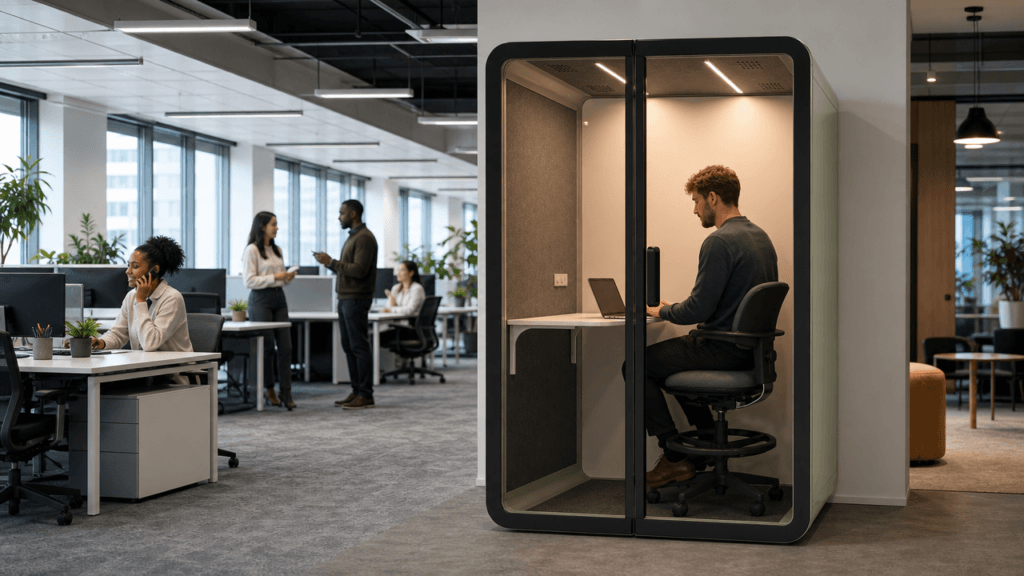
In one B&H Ergonomics project, the buyer selected an Elite-M work pod with frosted glass and adjustable color temperature. The project goal was to create a calmer focus area within an open office, giving employees a place to step away from surrounding speech and visual activity without leaving the workplace.
The value of this example is not that one configuration will suit every neurodivergent employee. It shows how a buyer can translate a workplace problem into specific choices: stronger acoustic evidence, reduced visual exposure, and direct control over the lighting environment.
For another project, clear glass or a different interior finish may be more comfortable. A short product trial and employee feedback are more useful than assuming that a feature labeled “sensory-friendly” will work for everyone.
Make the Pod a Universal Focus Resource
A pod is less likely to create stigma when it is introduced as a normal workplace resource rather than a space that employees can use only after proving a medical need. Writers, analysts, developers, managers, and other employees may all need lower-interruption space for concentrated work.
| Policy Decision | More Inclusive Approach | Waarom het helpt |
|---|---|---|
| Who may use the pod? | Anyone with a legitimate focus, privacy, or lower-stimulation task | Reduces disclosure pressure and normalizes use |
| How is it described? | Focus resource or focus room | Avoids labeling the space around a diagnosis |
| How is access managed? | Simple booking or clear occupied/vacant status | Prevents informal ownership by one team or seniority level |
| What is appropriate use? | Focused work, reading, writing, analysis, or a private video call | Keeps the pod available for tasks that benefit from enclosure |
| How is feedback collected? | Anonymous or low-friction comments about light, airflow, privacy, and comfort | Improves the space without asking employees to disclose medical details |
| What happens when a person needs more support? | Route the individual request through the appropriate HR process | Keeps universal design and individual accommodation working together |
A universal policy does not mean every request must be handled identically. If an employee needs a specific adjustment, HR and the employee should review it separately. The Job Accommodation Network is one starting resource for employers and individuals considering workplace accommodation options.
Pilot the Space Before Scaling
There is no credible universal rule that every office needs one pod for a fixed number of employees. Demand depends on job roles, attendance patterns, meeting behavior, floor layout, existing rooms, and how long people use the space.
Use a pilot to establish a project-specific ratio:
- Record the main problems the pilot is intended to address, such as speech distraction, visual movement, or lack of adjustable lighting.
- Choose a location near the intended users without blocking circulation, accessible routes, exits, or building systems.
- Test one unit or a small mixed configuration before committing to a large rollout.
- Collect usage, wait-time, session-length, comfort, cleaning, and maintenance feedback without asking employees to disclose diagnoses.
- Review whether users change the lighting, ventilation, or privacy settings and whether those controls are easy to understand.
- Adjust placement, policy, configuration, or quantity before expanding to other departments or sites.
Do not reduce the pilot to a speculative productivity or employee-retention calculation. Usage patterns and specific employee feedback provide a more defensible basis for the next purchasing decision.
Know When a Work Pod Is Not the Complete Answer
A work pod may be a useful part of a neuroinclusive office plan, but it is not always the right or only intervention.
- If the main need is recurring group collaboration, a meeting pod or room may be more appropriate.
- If the task is mainly a short phone call, a smaller phone booth may use space more efficiently.
- If a user finds enclosed spaces uncomfortable, consider another quieter workstation, scheduling option, remote-work arrangement, or environmental change.
- If the concern involves an individual accommodation, follow the appropriate HR and legal process rather than treating the pod as automatic compliance.
- If placement affects accessibility, egress, fire protection, electrical work, or building operations, involve the relevant site professionals before ordering.
The best outcome is not the largest number of pods. It is a workplace where employees can choose an environment that fits the task, and where the organization can explain what each space does and does not provide.
FAQ
Zijn werkpods alleen voor neurodivergente medewerkers?
Nee. Een werkpod moet doorgaans beschikbaar zijn voor iedereen die behoefte heeft aan geconcentreerd werken, visuele privacy, minder afleiding door gesprekken of een gecontroleerde omgeving voor een privégesprek. Universele toegang kan stigma en de druk om persoonlijke informatie te delen verminderen, terwijl individuele verzoeken om aanpassingen afzonderlijk kunnen worden behandeld.
Kan een werkpod alle kantoorgeluiden elimineren?
Nee. Een werkpod kan afleiding door spraak en omgevingsgeluid verminderen, maar mag niet worden omschreven als een oplossing die volledige stilte creëert. Controleer de exacte akoestische testmethode, modelconfiguratie, installatieomstandigheden en het omgevingsgeluid op kantoor.
Welke kenmerken zijn het belangrijkst voor sensorische controle?
Start with the user’s actual friction points. Common review areas include acoustic evidence, visual privacy, adjustable brightness, adjustable color temperature, ventilation settings, interior finishes, desk comfort, and easy-to-use controls.
Vervangt een werkpod een proces voor werkplekaanpassingen?
Nee. Een gedeelde voorziening voor concentratie kan het aanbod aan omgevingen voor werknemers verbeteren, maar vervangt geen gesprek over individuele aanpassingen of de toepasselijke juridische en HR-beoordeling.
Hoeveel werkpods moet een kantoor hebben?
Begin met een pilot in plaats van een vaste verhouding tussen medewerkers en pods. Meet de vraag, wachttijd, sessieduur, gebruikersfeedback en de beschikbaarheid van andere rustige ruimtes, en schaal vervolgens op op basis van gegevens uit de daadwerkelijke werkomgeving.