Szybka odpowiedź
Kalkulator ROI budki telefonicznej do biura powinien porównywać całkowity koszt zakupu i dostawy z możliwym do odzyskania czasem rozmów prowadzonych na korytarzach, nieefektywnym wykorzystaniem sal spotkań przez jedną osobę, możliwymi do uniknięcia kosztami adaptacji oraz konserwatywnie oszacowanym odzyskaniem koncentracji. Dla wielu zespołów odpowiedzialnych za obiekty najsilniejszym argumentem nie jest ogólny wzrost produktywności. Jest nim przeniesienie powtarzających się rozmów na korytarzach do jednego, przewidywalnego miejsca na prywatne rozmowy.
Ostatnia aktualizacja: 15 czerwca 2026 | Autor: Richard | Szacowany czas czytania: 8 minut
Dlaczego ROI zaczyna się od odzyskania czasu rozmów na korytarzach
Kiedy analizuję okres zwrotu projektu, nie zaczynam od abstrakcyjnego twierdzenia o produktywności. Zaczynam od zachowań, za które biuro już ponosi koszty.
W wielu miejscach pracy najczęstszy sygnał zapotrzebowania jest prosty: pracownicy wychodzą na korytarze, klatki schodowe, do kącików przy aneksach kuchennych, holi przy windach lub pustych pomieszczeń, aby odebrać rozmowę. Wygląda to niegroźnie, dopóki zespoły ds. obiektów i operacji nie przełożą tego na kategorie kosztów:
- ciągi komunikacyjne stają się nieoficjalnymi strefami rozmów;
- poufne rozmowy odbywają się w niekontrolowanych miejscach;
- małe sale są rezerwowane przez jedną osobę;
- pobliskie zespoły są narażone na możliwe do uniknięcia rozpraszanie mową;
- menedżerowie wciąż próbują rozwiązać problem projektowania przestrzeni poprzez przypominanie o zasadach etykiety.
Dlatego dedykowana biurowa budka telefoniczna może być łatwiejsza do uzasadnienia niż szeroki argument dotyczący “ROI budki biurowej”. Kupujący nie próbuje udowodnić, że jedna zabudowana przestrzeń w magiczny sposób poprawia funkcjonowanie całej firmy. Udowadnia natomiast, że powtarzający się, widoczny problem w organizacji pracy zyskuje teraz mierzalne miejsce docelowe.
Formuła zwrotu z inwestycji w biurową budkę telefoniczną
Traktuj to jako praktyczny model planowania, a nie uniwersalną zasadę księgową:
ROI budki telefonicznej do biura =
(roczne modelowane korzyści - całkowity koszt budki) / całkowity koszt budki x 100

Okres zwrotu w miesiącach =
całkowity koszt budki / miesięczne modelowane korzyści
W przypadku jednoosobowej jednostki do prywatnych rozmów zazwyczaj dzielę roczne modelowane korzyści na cztery kategorie:
| Kategoria zwrotu z inwestycji (ROI) | Co należy uwzględnić | Czego należy unikać |
|---|---|---|
| Odzyskanie czasu rozmów na korytarzach | Czas zaoszczędzony, gdy pracownicy przestają szukać miejsca na prywatne rozmowy | Traktowanie każdej rozmowy jako pełnego zysku produktywności |
| Przywrócenie sprawności sali konferencyjnej | Uwolnienie małych sal, gdy spotkania jednoosobowe zostają przeniesione do jednostki | Twierdzenie, że sala jest “zaoszczędzona”, gdy zapotrzebowanie jest już niskie |
| Unikanie prac budowlanych | Planned drywall rooms, contractor work, or relocation disruption that the booth replaces | Adding construction savings when no room was planned |
| Wartość elastyczności | Relocation, redeployment, and future layout changes | Treating resale or reuse as guaranteed cash |
The model becomes more credible when each input can be checked by facilities, finance, or department leaders.
Dane, które menedżerowie obiektów powinni gromadzić
Before comparing vendors, collect the numbers below. The goal is to make the model auditable enough for a CFO, procurement lead, or workplace director to challenge without dismissing it.
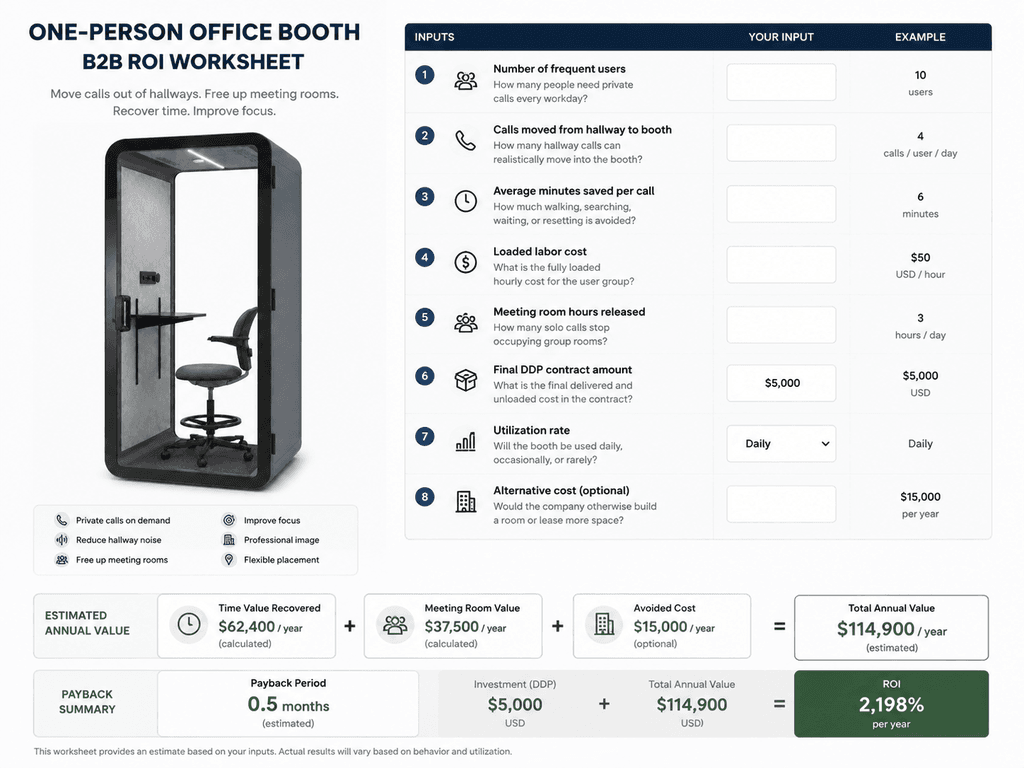
| Dane wejściowe | Jak to oszacować | Dlaczego to ma znaczenie |
|---|---|---|
| Daily corridor sessions | Count observed calls or ask teams for a one-week sample | Shows whether the asset solves a real behavior |
| Średni czas trwania sesji | Use calendar data, phone logs, or a simple survey | Converts behavior into recoverable time |
| Users affected | Count frequent call-takers and nearby interrupted employees separately | Prevents inflated assumptions |
| Loaded hourly labor cost | Use finance-approved internal labor cost assumptions | Keeps the model aligned with company math |
| Meeting-room displacement | Track one-person bookings in small rooms | Shows whether the booth can release room capacity |
| Całkowity koszt z dostawą | Korzystaj z podpisanej wyceny projektu, a nie z kwoty podanej w broszurze | Pozwala uniknąć niespodziewanych kosztów transportu, dostawy i montażu |
| Zakładane wykorzystanie | Oszacuj realistyczną liczbę sesji dziennie dla każdej jednostki | Okres zwrotu zależy bardziej od wykorzystania niż od deklarowanych parametrów produktu |
W przypadku projektów B&H wycenionych na warunkach DDP dane dotyczące kosztu są łatwiejsze do wykorzystania. Jeśli uzgodniona wycena B&H jest na warunkach DDP, kwota umowna jest kwotą końcową dla uzgodnionego zakresu: dostawa pod drzwi wraz z rozładunkiem, bez późniejszego doliczania ukrytych kosztów transportu, cła importowego, odprawy celnej ani rozładunku. W takim przypadku liczba podana w podpisanej umowie jest liczbą, którą kupujący powinien wprowadzić do kalkulatora. Przed zatwierdzeniem tej wartości skorzystaj z przewodnika po kosztach budki telefonicznej aby porównać założenia dotyczące FOB, DDP, konfiguracji i dostawy na tej samej podstawie.
Konserwatywna wersja formuły opracowana przez dyrektora finansowego
Na potrzeby wewnętrznej akceptacji przedstawiłbym obok siebie model optymistyczny i konserwatywny. Wersja konserwatywna zmniejsza licznik, zanim ktokolwiek zarzuci firmie zawyżanie korzyści z produktywności:
Konserwatywny roczny zwrot =
(modelowana liczba chronionych godzin × zatwierdzona przez dział finansowy wartość godziny pracy × współczynnik pewności)
+ zaakceptowana wartość ograniczenia wykorzystania sal konferencyjnych
+ zaakceptowana wartość unikniętych kosztów budowy
Współczynnik pewności to stosowane przez zespół finansowy obniżenie wartości uwzględniające niepewność. Jeśli dane dotyczące miejsca pracy są wiarygodne, współczynnik może być wyższy. Jeśli dane opierają się na wywiadach lub obserwacjach, a nie na danych systemowych, należy zastosować niższy współczynnik. Dzięki temu rozmowa koncentruje się na założeniach, zamiast przeradzać kalkulator w debatę na temat tego, czy prywatność zawsze oznacza większą produktywność.
Hipotetyczny model ROI dla Elite-S
Poniższy przykład wykorzystuje model Elite-S jako punkt odniesienia do planowania, ponieważ jest to najbardziej odpowiedni model B&H dla tego scenariusza ROI dla jednej osoby. Podane liczby to hipotetyczne dane wejściowe, a nie ceny produktu, wycena ani obietnica uzyskania zwrotu finansowego.
Aby uniknąć sugerowania konkretnej ceny budki, użyj jednostek indeksowych:
- Kwota umowna all-in dla Elite-S DDP: 100 jednostek kosztu
- Liczba dni roboczych w roku: 240
- Średnia liczba sesji prywatnych rozmów telefonicznych w ciągu dnia pracy: 10
- Średni użyteczny czas zabezpieczony podczas jednej sesji: 8 minut
- Zatwierdzona przez dział finansowy wartość godziny pracy wraz ze wszystkimi kosztami: 1 jednostka wartości
- Meeting-room displacement value: optional, only if one-person calls currently consume small rooms
The basic hallway-call recovery model would be:
10 sessions/day x 8 protected minutes x 240 workdays = 19,200 protected minutes
19,200 minutes / 60 = 320 protected hours per year
320 protected hours x 1 value unit = 320 annual value units
If the cost input is 100 cost units and the modeled annual recovery is 320 value units, the payback looks very strong. A more conservative finance team may discount the recovery by 50%, 70%, or more. Even then, the model can remain attractive if the asset is used every day and replaces real hallway-call behavior.
The important part is not the exact hypothetical number. The important part is the method: model actual behavior first, then test whether the payback still works after finance applies a conservative discount.
| Współczynnik pewności | Annual recovery after discount | Payback readout against 100 cost units |
|---|---|---|
| 100% | 320 value units | Very strong if the observed behavior is real |
| 50% | 160 value units | Still defensible for daily utilization |
| 25% | 80 value units | Needs meeting-room recovery or construction avoidance to strengthen the case |
This sensitivity table is often more persuasive than a single optimistic result. It shows the decision-maker what has to be true for the purchase to make financial sense.
Why Factory-Direct Pricing Changes the Payback Curve
Many U.S. buyers first see pricing through domestic dealers, distributors, or resellers. That can be useful for quick purchasing, but it often adds margin layers, warehousing cost, and bundled service assumptions.
B&H is different because the project is typically factory-direct. For comparable product scope, B&H pricing is often 40% or more lower than common U.S. dealer pricing. That does not mean every project will show the same gap, and it should not be treated as a guaranteed discount claim. It means facility teams should compare the final landed scope, not just a headline product category.
This matters for ROI because payback is highly sensitive to the denominator. If the all-in cost is materially lower while the same hallway-call problem is being solved, the payback period shortens.
DDP Cost Clarity: Why Hidden Costs Matter
ROI can break down when the cost side is incomplete. A quote that looks attractive can become hard to defend if the buyer later discovers separate charges for ocean freight, customs clearance, port fees, delivery coordination, liftgate service, unloading, or project handling.
For B&H projects quoted under DDP terms, those surprises should not be part of the model. The DDP contract number is the final payable amount for the agreed scope, delivered to the door with unloading included. That gives facility managers a cleaner cost input:
| Cost question | Weak quote | B&H DDP quote approach |
|---|---|---|
| Is freight included? | Sometimes unclear | Included in the agreed DDP scope |
| Are import duties included? | Often excluded or vague | Included in the agreed DDP scope |
| Is unloading included? | Often a separate local cost | Included when quoted as part of the DDP project scope |
| Can finance model the final cost? | Harder | Easier because the contract amount is the final amount |
Always verify the signed quote language, product scope, site access assumptions, and delivery conditions. ROI should be based on the contract, not a sales conversation.
Kiedy argumenty przemawiające za zwrotem z inwestycji są najsilniejsze
The calculator usually produces the strongest case when at least three of these conditions are true:
- employees frequently leave the open office for calls;
- small meeting rooms are often used by one person;
- sales, HR, recruiting, customer success, or management teams handle sensitive calls;
- the office has no easy way to add fixed rooms without construction;
- the lease term, floor plan, or growth plan makes flexibility valuable;
- the quote is a clear all-in landed cost instead of a partial product price;
- the unit can sit close to the teams that need it most.
In that setting, the purchase is not just furniture. It becomes a small piece of call infrastructure with a measurable workflow job.
When ROI Is Weak or Needs a Different Pod Type
The case is weaker when call volume is low, employees already have enough enclosed rooms, or the unit would be placed far from the teams that need it. It is also the wrong model if the main problem is collaborative meetings rather than one-person calls.
Use this distinction:
| Buyer problem | Better content and product path |
|---|---|
| One-person calls, video calls, confidential conversations | Office phone booth ROI |
| Two to six people occupying rooms for recurring meetings | Meeting pod ROI |
| Broad workplace flexibility, mixed pod sizes, portfolio planning | Office pod ROI |
| Deep focus work with longer sessions | Work pod or office pod planning |
This is why I would treat “office pod ROI” as the upper framework, not the primary target for this page. This article should own the one-person payback model. A separate meeting pod ROI page should focus on team-room replacement, meeting-room scarcity, and collaboration space economics.
A Simple Worksheet for Your ROI Model
Use this worksheet before you request a quote:
- Count hallway calls for five workdays.
- Estimate the average duration of those calls.
- Identify which departments create the most demand.
- Count how often one-person calls occupy small meeting rooms.
- Ask finance for a loaded hourly labor assumption.
- Ask whether construction avoidance should be included or set to zero.
- Use the all-in DDP contract amount as the cost input if your B&H quote is DDP.
- Run the model at 100%, 50%, and 25% recovery assumptions.
- Choose placement based on actual call demand, not open floor space alone.
How to Present the Business Case
For internal approval, keep the case short and conservative:
- Problem: too many private calls happen in hallways or small meeting rooms.
- Solution: one-person private call units located near high-call teams.
- Cost input: signed all-in landed cost, preferably DDP where available.
- Recovery model: hallway-call time, meeting-room release, and any avoided construction.
- Risk control: conservative utilization assumptions and no guaranteed productivity claim.
- Vendor reason: factory-direct pricing can often be 40% or more lower than common U.S. dealer pricing for comparable scope.
For U.S. buyers, tax treatment may also affect the after-tax economics, but it should be reviewed by a qualified tax advisor. Our 2026 office pod Section 179 guide summarizes the questions to take to that advisor, while Publikacja IRS 946 remains the primary starting point for depreciation and Section 179 discussions. The correct treatment depends on asset classification, timing, business use, and current tax rules.
Utilization Risk Still Matters
ROI is not only a spreadsheet. If employees do not trust the privacy, comfort, or availability of the space, they will go back to hallways or meeting rooms.
For procurement, ask for model-specific acoustic evidence instead of relying on generic words like “soundproof.” ISO 23351-1 is commonly used to compare speech level reduction for furniture ensembles and enclosures, and product-specific test reports are more useful than unsupported decibel claims. Acoustic results can vary by test method, installation, site conditions, placement, and surrounding noise.
For Elite-S project review, B&H can provide relevant acoustic documentation where applicable. Treat that documentation as a utilization input. If people believe the unit works for calls, they use it. If they do not, the payback model weakens.
Ostateczne zalecenie
For a facility manager, the best office phone booth ROI model is narrow, practical, and behavior-based. Do not try to prove every office pod benefit on one page. Start with the most common use case: replacing hallway calls with a dedicated one-person private call space.
Elite-S is the right B&H example for this model because it fits the one-person call problem, supports a clear DDP landed-cost calculation, and benefits from B&H’s factory-direct pricing structure. If the unit is placed near the teams that actually need private calls, the ROI story becomes much easier to defend.
FAQ
Jaki jest optymalny okres zwrotu inwestycji w budkę telefoniczną do biura?
Dobry okres zwrotu zależy od stopnia wykorzystania oraz kosztu przyjętego przez zespół finansowy. Jeśli przestrzeń jest używana codziennie jako rzeczywista alternatywa dla prowadzenia rozmów na korytarzu, okres zwrotu może wyglądać korzystnie nawet przy ostrożnych założeniach. Jeśli jest rzadko używana, nawet niski koszt zakupu nie przełoży się na dobry zwrot z inwestycji.
Czy w kalkulatorze zwrotu z inwestycji dla budki telefonicznej uwzględnić oszczędności wynikające ze wzrostu produktywności?
Tak, ale należy przyjąć ostrożne założenia. Przed formułowaniem szerokich twierdzeń dotyczących produktywności uwzględniłbym czas chroniony na rozmowy, ograniczenie czasu poświęcanego na szukanie wolnych pomieszczeń oraz mniejszą liczbę rezerwacji sal konferencyjnych przez jedną osobę. Zespoły finansowe zazwyczaj bardziej ufają konkretnym danym opartym na zachowaniach niż ogólnym wskaźnikom procentowym produktywności.
Czy wycena DDP poprawia zwrot z inwestycji?
Ceny DDP zwiększają wiarygodność modelu ROI, ponieważ dane dotyczące kosztów są bardziej przejrzyste. W przypadku projektów B&H wycenianych na warunkach DDP kwota wskazana w podpisanej umowie jest ostateczną kwotą do zapłaty za uzgodniony zakres, z dostawą pod wskazany adres i rozładunkiem w cenie, bez ukrytych kosztów transportu lub importu doliczanych później.
Dlaczego warto wykorzystać Elite-S jako przykład ROI?
Elite-S lepiej odpowiada potrzebom jednej osoby prowadzącej prywatne rozmowy niż większy moduł do spotkań. Nadaje się do prywatnych rozmów, wideorozmów i wymagającej skupienia pracy telefonicznej, dzięki czemu kalkulator pozostaje związany z zastąpieniem rozmów prowadzonych na korytarzu, zamiast rozszerzać się na szerszą analizę ekonomiczną sal spotkań.
Czy zwrot z inwestycji w kabinę telefoniczną do biura jest taki sam jak w przypadku kabiny do spotkań?
Nie. ROI budki telefonicznej dotyczy przede wszystkim rozmów jednoosobowych, prywatności, zastępowania pomieszczeń oraz sposobu prowadzenia rozmów. ROI podu do spotkań zwykle wiąże się z możliwością organizowania spotkań grupowych, zastępowaniem sal konferencyjnych i sprawnym przebiegiem współpracy. Oba te aspekty należy uwzględniać w ramach szerszej strategii ROI dla podów biurowych, ale modele powinny pozostać odrębne.