Szybka odpowiedź
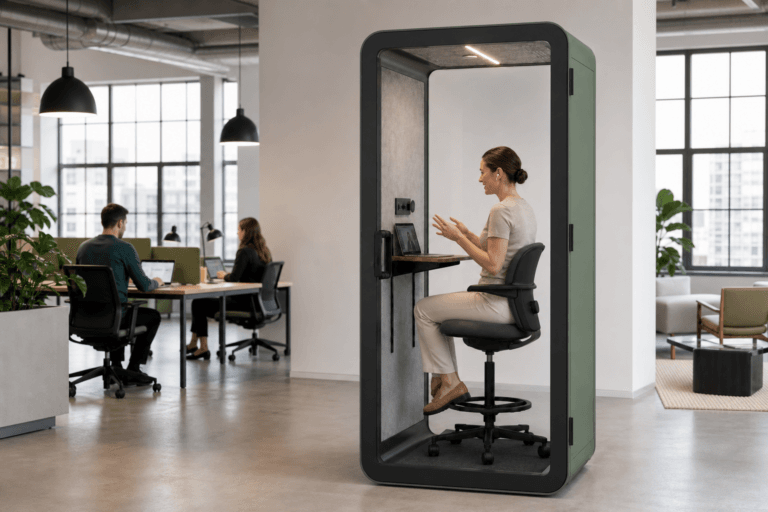
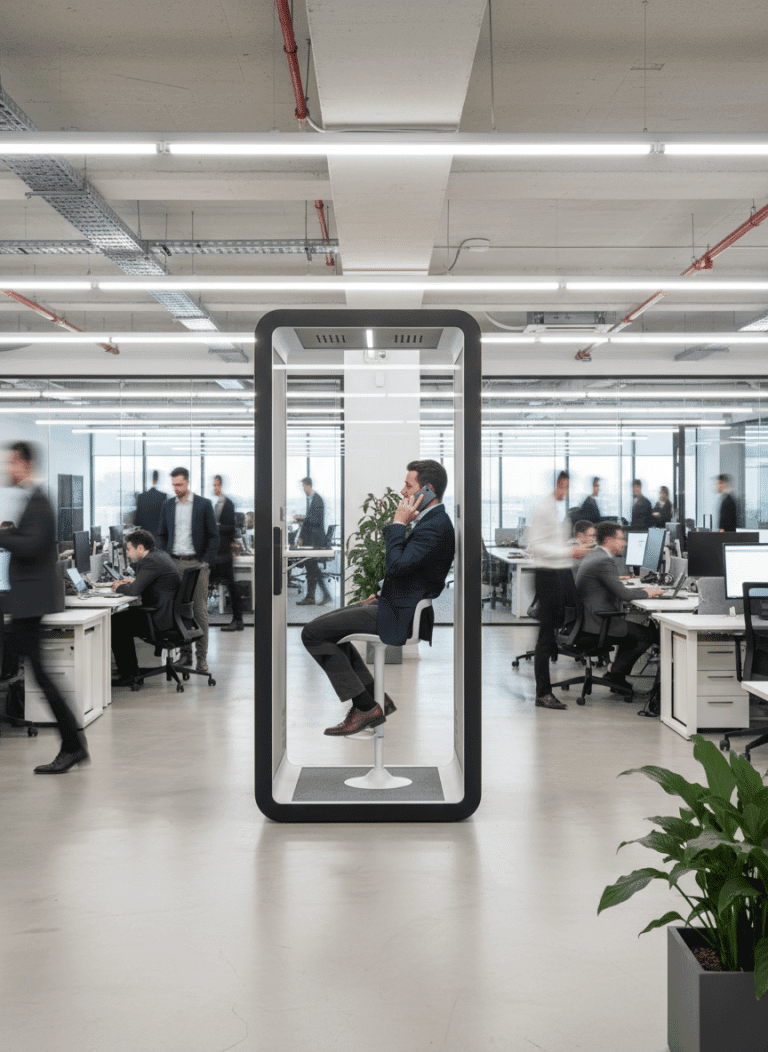
A standing phone booth is usually the better fit for short private calls, quick video check-ins, limited floor space, and high user turnover. It can still include an ergonomic stool—B&H Ergonomics commonly configures Elite-S, Flex-S, and Oasis-S this way—so “standing” does not mean the user can never sit down.
For longer laptop-based sessions, sustained seated work, or tasks that need more desk space and room to move, choose a work pod or focus pod instead. The real sitting vs. standing phone booth decision is therefore not simply whether a chair fits. It is whether the office needs a compact call station or a more spacious private workspace.
Last Updated: July 14, 2026 | Author: Richard | Estimated Reading Time: 9 minutes
A Standing Phone Booth and a Work Pod Solve Different Problems
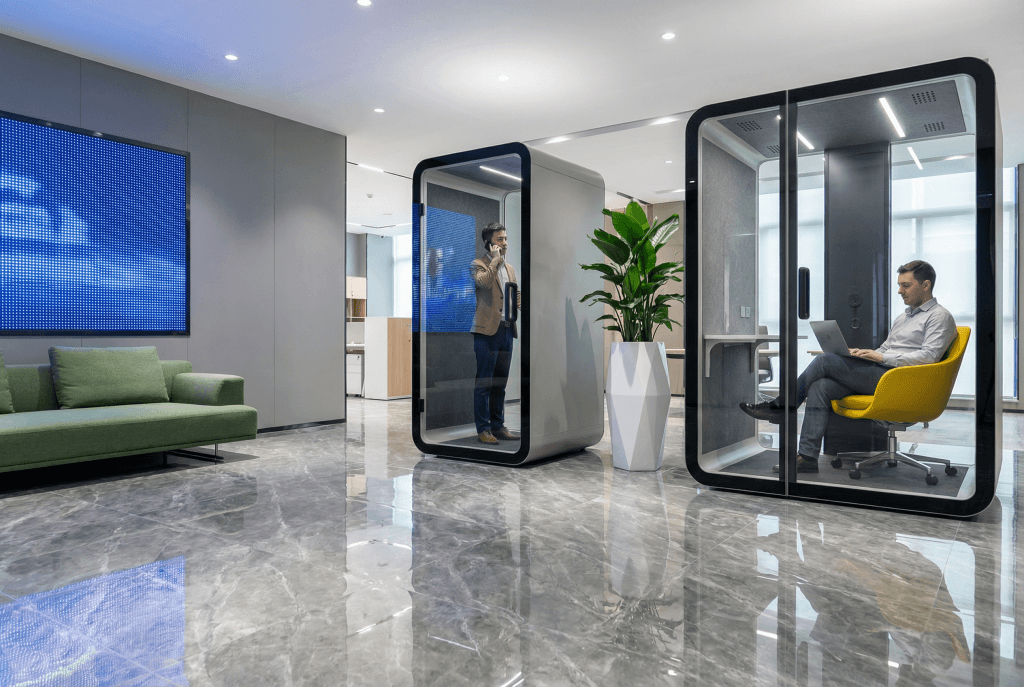
The terms can be misleading. A buyer may hear “standing phone booth” and imagine a booth that forces every user to stand. Another may hear “sitting phone booth” and assume that adding a chair creates the same experience as a larger private workspace.
In practice, the main difference is the enclosure’s size and intended use.
- A standing phone booth is a compact, one-person space primarily planned for private calls and brief meetings.
- A work pod or focus pod provides more usable interior space for seated laptop work, longer video meetings, focused tasks, or compact one-to-one conversations, depending on the model.
Furniture matters, but it does not change the product category by itself. A stool can make a standing booth more flexible for occasional sitting. It does not create the desk depth, legroom, movement space, or longer-session comfort of a work pod.
Standing Phone Booth vs. Seated Work Pod
| Czynnik decyzyjny | Standing Phone Booth | Seated Work Pod or Focus Pod |
|---|---|---|
| Praca podstawowa | Prywatne rozmowy i szybkie spotkania wideo | Focused work, longer video meetings, interviews, and private one-to-one work |
| Typical occupancy pattern | Shorter sessions with faster turnover | Longer sessions with slower turnover |
| Interior format | Compact one-person enclosure | Larger enclosure with more usable workspace |
| Powierzchnia robocza | Standing-height counter or compact shelf | Larger desk surface for laptop-based work |
| Siedzenia | Can include an ergonomic stool or compatible seat | Planned around a more complete seated setup |
| Best task type | Calling, speaking, checking in, and short meetings | Typing, reviewing documents, focused work, and longer screen-based sessions |
| Floor-space priority | Higher booth density in a limited area | More comfort and function per enclosed space |
| Department fit | Sales, support, recruiting screens, and shared call zones | Management, HR, hybrid work, specialist work, and focus-heavy teams |
| All-day workstation | Nie | A better category for longer work, but still specify the pod and furniture for the actual duty cycle |
| Dostępność | B&H standing phone booth configurations are not accessible configurations | Accessibility must be raised as a separate project requirement and verified for the selected product and layout |
This comparison is a planning framework, not a rule that every call must happen standing or every work pod session must be long. The useful question is which activity the enclosure should support most often.
Can You Sit in a Standing Phone Booth?
Yes. A standing phone booth can include a seat, and B&H Ergonomics commonly configures Elite-S, Flex-S, and Oasis-S with an ergonomic stool. This gives users the option to perch or sit during a call without increasing the booth to work-pod dimensions.
That flexibility is useful, but three boundaries matter:
- A stool does not enlarge the work surface. If the user needs a laptop, notebook, mouse, documents, and other equipment at the same time, a compact counter may become the limiting factor.
- A stool does not create work-pod legroom. Occasional sitting and sustained seated work are different requirements.
- A stool does not change the booth’s operating role. The enclosure is still primarily a shared call resource rather than a private office for one person.
I would treat the stool as a flexibility feature, not as a reason to specify a compact booth for work that really needs a larger seated environment.
When a Standing Phone Booth Fits Best
A standing phone booth fits when the office needs private communication capacity without giving every call the footprint of a work room.
Short Private Calls and Quick Meetings
The strongest use case is a person stepping away from an open desk for a call, a short video check-in, or a private conversation. The user enters, completes the communication task, and returns to the main workspace.
This operating pattern matters because a booth that turns over frequently can serve more people during the day than an enclosure occupied for long work blocks.
Call-Heavy Departments
Sales teams are the clearest example. In many sales offices, most enclosed capacity can be standing phone booths because the recurring need is a private place to speak, not a second individual workstation.
Customer support, customer success, and recruiting teams may have similar call demand. The final mix should still reflect whether users only speak or also conduct longer interviews, demonstrations, screen-sharing sessions, or documentation work.
Offices With Limited Floor Space
When floor area is constrained, compact booths can distribute private-call capacity across the office without consuming the area required by larger focus spaces. They can be positioned near the teams that generate call demand, subject to circulation, door clearance, power, and site planning.
If this is your main requirement, compare B&H Ergonomics biurowe budki telefoniczne by acoustic priority, model, project budget, and placement needs.
When a Work Pod Is the Better Choice
A work pod is the better category when the user needs to do more than complete a call.
Longer Laptop-Based Work
Typing, reviewing documents, analysing information, coding, writing, and working across several applications require a more complete workstation. The user benefits from additional desk space, a fuller seated posture, and more room for equipment and movement.
This does not mean a work pod should automatically become someone’s permanent office. It means the category is better aligned with longer private work than a standard one-person phone booth.
Detailed Video Meetings and Interviews
A quick video check-in can fit a phone booth. A longer session involving notes, documents, screen sharing, interviews, or detailed client discussion is usually better served by a work pod. The larger format makes it easier to plan the seat, screen, camera position, work surface, and personal space as one setup.
Focus-Heavy Roles
Managers, HR teams, designers, engineers, analysts, and other knowledge workers may need an enclosure for focused work as well as communication. Their usage pattern often justifies a smaller number of larger seated spaces alongside the office’s call booths.
Buyers comparing this type of environment should review the B&H Ergonomics work pod and focus pod collection rather than trying to turn a compact phone booth into a full workstation.
Plan the Mix by Department, Session Type, and Turnover
Many offices should not choose only one format. A mixed plan often works better because departments create different types of demand.
| Department or Zone | Likely Starting Mix | Planning Reason | Co należy sprawdzić |
|---|---|---|---|
| Sales floor | Mostly standing phone booths, with limited seated pod capacity | Frequent calls and high turnover usually dominate | Longer demos, proposal work, coaching, and peak simultaneous call demand |
| Customer support or success | Standing-led mixed plan | Many calls may be short, but complex cases can run longer | Call duration patterns, documentation needs, and headset/laptop use |
| HR and recruiting | Mixed or work-pod-led | Interviews and confidential conversations often need more time and workspace | Whether sessions are one-person calls or in-person one-to-one meetings |
| Management and leadership | Work-pod-led mixed plan | Private video meetings and document review may require a fuller seated setup | Confidentiality level, session length, and need for one-to-one use |
| Engineering, design, finance, or analysis teams | Work-pod-led | Focused screen-based work is more important than rapid call turnover | Equipment, monitor, desk, power, and sustained-work requirements |
| Shared reception, corridor, or touchdown zone | Standing phone booths | Provides quick privacy without allocating a larger room | Traffic flow, noise exposure, door clearance, and visibility |
These are starting points, not fixed ratios. Two sales teams of the same size can need different booth quantities if one makes frequent short calls while the other runs long demonstrations and account reviews.
The Most Overlooked Inputs: Usage Duration and Turnover
Customers often start with headcount: “We have 80 employees. How many booths do we need?” Headcount helps, but it does not reveal demand on its own.
I usually look at two operational inputs first:
- Usage duration: Is the enclosure used mainly to complete a call, or to continue working for an extended session?
- Zmiana użytkownika: How quickly does one user leave so another person can use the space?
A compact booth can be a poor investment if people occupy it as a personal office. A larger work pod can also be an inefficient use of floor space if almost every session is a brief call. The right quantity depends on peak simultaneous demand and how long each type of space stays occupied.
A Simple Quantity-Planning Method
- List the departments that need enclosed space.
- Separate brief calls from longer meetings and focused work.
- Estimate peak simultaneous use for each task type.
- Decide which demand belongs in a standing phone booth and which belongs in a work pod.
- Check whether existing meeting rooms are being consumed by solo calls or solo work.
- Plan placement near the teams that create the demand.
- If the usage pattern is uncertain, begin with a mixed pilot and review booking or occupancy data before scaling.
This method is more reliable than applying one booth-to-employee ratio across every department.
Common Planning Mistakes
Treating “Standing” as “No Sitting Allowed”
This can cause buyers to reject a compact booth even when an ergonomic stool would provide enough flexibility for their actual call pattern. Evaluate the configuration, not just the label.
Treating a Stool as a Substitute for a Work Pod
The opposite mistake is more costly. If the task needs sustained typing, a larger desk, longer seated comfort, or additional equipment, adding a stool does not solve the space problem.
Ignoring Peak Turnover
Average daily use can hide the real constraint. A sales floor may have a sharp call peak when many people need privacy at once. A focus-heavy team may have fewer sessions, but each one may occupy a pod for much longer.
Planning Every Department the Same Way
Procurement is simpler when every unit matches, but utilization may suffer. Standardise product families and finishes where useful, while allowing the standing-to-work-pod mix to follow departmental tasks.
Using a Standard Phone Booth as an All-Day Office
A one-person phone booth is not intended to replace a full-day workstation. Its compact interior and call-first work surface should be matched to short communication tasks and occasional laptop use, not continuous desk work.
Assuming Accessibility From the Product Label
B&H standing phone booth configurations are not accessible configurations. If accessibility is required, include it at the beginning of the project brief instead of trying to address it after a standard booth has already been selected. The selected product, approach, entry, interior clearances, controls, and surrounding layout all need project-specific verification.
Co należy przygotować przed złożeniem wniosku o wycenę
The quality of the recommendation depends on the quality of the usage brief. Prepare:
- Department names and approximate headcount
- Peak number of simultaneous private calls
- Whether sessions are mainly brief calls, longer meetings, or focused work
- Whether users need a stool, task chair, laptop, monitor, documents, or other equipment
- Preferred mix of standing phone booths and work pods, if already known
- Floor plan and proposed placement zones
- Door, corridor, elevator, ceiling-height, and final placement access
- Power and cable-routing requirements
- Acoustic privacy priority
- Accessibility requirements, stated separately and early
- Quantity, destination, project schedule, finish preferences, and installation expectations
For an office-wide plan, the most useful request is not “price one booth.” It is “help us match compact call capacity and longer-work capacity to each department’s real demand.” B&H Ergonomics can then recommend a model mix and quote based on usage, layout, quantity, destination, and project requirements.
FAQ
Czy stojąca budka telefoniczna może być wyposażona w siedzisko?
Tak. Stojąca budka telefoniczna może być wyposażona w ergonomiczny stołek lub inne odpowiednie siedzisko, jeśli pozwala na to konfiguracja budki. B&H Ergonomics często konfiguruje modele Elite-S, Flex-S i Oasis-S z ergonomicznym stołkiem. Budka nadal pozostaje kompaktową przestrzenią przeznaczoną przede wszystkim do rozmów, a nie pełnowymiarowym podiem do pracy.
Czy siedząca budka telefoniczna to to samo co kabina do pracy?
Niekoniecznie, ale w przypadku większej, siedzącej kabiny “kabina do pracy” jest zwykle bardziej jednoznacznym określeniem zakupowym. Kompaktowa budka telefoniczna ze stołkiem nadal pozostaje budką telefoniczną. Kabina do pracy lub kabina do skupionej pracy zazwyczaj zapewnia więcej miejsca wewnątrz i przestrzeni roboczej do dłuższego korzystania z laptopa.
Czy jednoosobowa budka telefoniczna nadaje się do całodziennej pracy?
Nie. Standardowa jednoosobowa budka telefoniczna nie powinna być określana jako stanowisko pracy do całodziennego użytkowania. Należy używać jej do prywatnych rozmów, krótkich spotkań wideo i okazjonalnych, krótkich zadań. Gdy użytkownicy potrzebują dłuższej pracy w pozycji siedzącej, należy wybrać kabinę do pracy lub inne odpowiednio zaplanowane stanowisko pracy.
Czy dział sprzedaży powinien wybrać budki do pracy w pozycji stojącej czy siedzącej?
Większość biur sprzedaży może zacząć od miksu z przewagą stanowisk do pracy na stojąco, ponieważ najczęściej głównymi potrzebami są częste rozmowy wymagające prywatności i szybka rotacja użytkowników. Boksy do pracy warto dodać w miejscach, w których pracownicy działu sprzedaży prowadzą dłuższe prezentacje, szczegółowo omawiają konta klientów, uczestniczą w sesjach coachingowych lub przygotowują oferty. Ostateczną liczbę należy ustalić na podstawie szczytowego jednoczesnego zapotrzebowania, a nie wyłącznie liczby pracowników.
Are B&H standing phone booths accessible?
No. The B&H standing phone booth configurations discussed here are not accessible configurations. If the project has accessibility requirements, identify them before product selection so B&H Ergonomics and the project team can review a different product and layout approach.