Kurzantwort
Akustikpaneele für Büros verringern Echo, Nachhall und reflektierten Schall an Arbeitsplätzen mit harten Oberflächen. Schallpaneele für Büroräume können Besprechungsräume, Räume mit Glaswänden und offene Kollaborationsbereiche ruhiger wirken lassen, schaffen für sich allein jedoch keine verlässliche Vertraulichkeit von Gesprächen. Wenn Menschen Gespräche in der Nähe weiterhin verstehen können, betrifft das Problem die Schalldämmung oder die Vertraulichkeit von Gesprächen, nicht nur die Schallabsorption.
Letzte Aktualisierung: 16. Juli 2026 | Autor: William | Prüfung: Richard | Geschätzte Lesezeit: 9 Minuten
Was sind Akustikpaneele für Büros?
Akustikpaneele für Büros sind schallabsorbierende Materialien, die dazu dienen, reflektierten Schall innerhalb eines Arbeitsplatzes zu kontrollieren. Sie können als Wandpaneele, Deckenbaffeln, Tischtrennwände, hängende Raumteiler oder freistehende Akustikschirme installiert werden.
Das Schlüsselwort lautet absorbierend. Ein Paneel hilft, Schallenergie zu verringern, nachdem der Schall es erreicht hat. Es dichtet keinen Raum ab, blockiert nicht jeden Ausbreitungsweg von Schall und verwandelt ein offenes Büro nicht in einen privaten Raum.
Diese Unterscheidung ist wichtig, weil Beschwerden über Bürolärm anfangs oft ähnlich klingen. Ein Besprechungsraum mit Glaswänden, der scharf und hallig wirkt, kann von Akustik-Wandpaneelen profitieren. Ein Finanzmanager, der vertrauliche Anrufe in einem offenen Bereich führt, benötigt eine andere Art von Lösung.
Was Akustikpaneele für Büros gut leisten
Akustikpaneele fürs Büro funktionieren am besten, wenn das Hauptproblem Schallreflexionen sind – häufig in Räumen mit Glaswänden, offenen Decken, Betonböden, Metallmöbeln oder großen Tischen. Wenn neben Paneelen auch Vorhänge in Betracht gezogen werden, prüfen Sie, was diese schallschluckende Vorhänge leisten können und was nicht. Vergleichen Sie ihre Eignung für die jeweilige Oberfläche und das Raumproblem, ohne einen Absorber oder Vorhang als Beleg dafür zu betrachten, dass Gespräche in der Nähe privat werden.
Sie sind nützlich, wenn Mitarbeitende sagen:
- “Dieser Raum hallt.”
- “Videogespräche klingen harsch.”
- “Das Büro wirkt laut, obwohl niemand schreit.”
- “Der Schall wird vom Glas reflektiert.”
- “Am Ende des Tages wirkt der Raum ermüdend.”
In diesen Situationen können schallabsorbierende Paneele für Büroräume den akustischen Komfort verbessern, indem sie den Nachhall verringern und Sprache innerhalb des behandelten Bereichs klarer klingen lassen. Sie sind besonders nützlich in Besprechungsräumen, Schulungsräumen, Empfangsbereichen, Kollaborationszonen und offenen Büros mit harten Oberflächen.
Was Akustikpaneele für Büros nicht leisten können
Akustikpaneele für Büros machen ein Büro nicht schalldicht. Sie verhindern auch nicht zuverlässig, dass sich Sprache zwischen Schreibtischen, Räumen oder offenen Arbeitsbereichen ausbreitet.
Dies ist der erste Beschaffungsfehler, auf den ich achten würde: Ein Team fügt immer mehr weiches Material hinzu, obwohl das eigentliche Problem nicht Echo ist. Das eigentliche Problem besteht darin, dass Menschen Gespräche verstehen können, die sie nicht hören sollten.
Schallabsorption und Schalldämmung erfüllen unterschiedliche Aufgaben:
| Akustischer Begriff | Was es bedeutet | Beispiel aus dem Büro |
|---|---|---|
| Schallabsorption | Verringert reflektierten Schall innerhalb eines Raums | Wandpaneele verringern Echo in einem Besprechungsraum mit Glaswänden |
| Nachhallkontrolle | Verkürzt, wie lange Schall in einem Bereich nachklingt | Ein Raum mit harten Oberflächen wirkt nach der Behandlung weniger scharf |
| Schalldämmung | Verringert die Schallübertragung zwischen Bereichen | Ein Raum oder eine Einhausung begrenzt Schallleckagen |
| Sprachprivatsphäre | Macht Gespräche außerhalb des vorgesehenen Bereichs schwerer verständlich | Sensible Anrufe sind in der Nähe nicht verständlich |
Wenn die Beschwerde lautet “Der Raum klingt zu hallig”, können Akustikpaneele für Büros der richtige erste Schritt sein. Wenn die Beschwerde lautet “Ich kann jedes Wort hören”, werden Paneele allein das eigentliche Problem wahrscheinlich nicht lösen; nutzen Sie den Vergleich zwischen schallgedämmter Kabine und Bürokabine bei der Entscheidung, ob eine Trennwand oder eine vollständige Einhausung den Anforderungen an die Privatsphäre entspricht.
Matrix: Symptome von Bürolärm und Lösungsansätze
Ermitteln Sie vor dem Kauf von Akustikpaneelen das tatsächliche Lärmproblem. Die passende akustische Lösung für das Büro hängt davon ab, was Mitarbeitende erleben, und nicht allein davon, wie laut der Bereich wirkt.
| Symptom am Arbeitsplatz | Wahrscheinliches akustisches Problem | Bessere erste Richtung |
|---|---|---|
| Der Besprechungsraum hallt | Reflektierter Schall | Akustikpaneele für Büros, Deckenbaffeln, weiche Oberflächen |
| Anrufe klingen scharf oder ermüdend | Nachhall und harte Oberflächen | Akustik-Wandpaneele sowie Überprüfung von Mikrofon und Raumaufteilung |
| Gespräche in der Nähe unterbrechen die Konzentration | Sprachverständlichkeit | Zonierung, Abstand, Verhaltensregeln oder geschlossener Bereich für konzentriertes Arbeiten |
| Private Anrufe finden an Schreibtischen statt | Fehlende Vertraulichkeit von Gesprächen | Eigener geschlossener Bereich für Anrufe |
| Die gesamte Etage wirkt laut | Gemischtes Problem des akustischen Komforts | Paneele, Zonierung der Raumaufteilung, Schallmaskierung und gezielt ausgewählte geschlossene Bereiche |
| Menschen verlassen das Büro, um Anrufe entgegenzunehmen | Kein verlässlicher Rahmen für private Anrufe | Geschlossene Telefon- oder Fokusbereiche vor einer weiteren Wandabdeckung |
Diese Matrix verhindert, dass das falsche Produkt zu viel gekauft wird. Paneele sind wertvoll, wenn der Raum selbst zu stark reflektiert. Sie sind weniger wirksam, wenn das Büro Trennung, Vertraulichkeit oder einen kontrollierten Ort für Anrufe benötigt.
Akustikpaneele im Vergleich zu Schalldämmung und Bürokabinen
Akustikpaneele reduzieren Reflexionen innerhalb eines Raums, während Schalldämmung und geschlossene Arbeitsbereiche die Trennung zwischen Räumen gewährleisten. Nutzen Sie den Vergleich zwischen Privacy Booths und Akustikpaneelen wenn bei der Kaufentscheidung zu klären ist, ob die allgemeine Raumakustik verbessert, ein privater Rahmen für Telefonate geschaffen oder beides kombiniert werden soll. Die richtige Spezifikation beginnt mit dieser Aufgabe; eine einzelne Produktbezeichnung oder akustische Kennzahl kann nicht alle drei Fragen beantworten.
Deshalb sollten diese Produkte nicht nach derselben Kennzahl beurteilt werden. Akustikpaneele werden üblicherweise anhand von Daten zur Schallabsorption bewertet. ASTM C423 ist beispielsweise eine Norm zur Messung der Schallabsorption in einem Hallraum und ist für den Vergleich der Absorptionsleistung von Materialien relevant. Geschlossene Möbelsysteme werden eher als vollständige akustische Umgebungen bewertet, bei denen Verglasung, Dichtungen, Wandaufbau, Lüftungswege und Installation das Ergebnis beeinflussen. ISO 23351-1 wird zur Messung der Sprachpegeldämpfung von Möbelensembles und Einhausungen verwendet, nicht für einen einzelnen Wandabsorber oder eine Deckenbaffel.
| Option | Besonders geeignet für | Weniger geeignet für | Typische Nutzung im Büro |
|---|---|---|---|
| Akustikpaneele für Büros | Echo und reflektierten Schall verringern | Private Gespräche ermöglichen | Besprechungsräume, Büros mit Glaswänden, Bereiche mit harten Oberflächen |
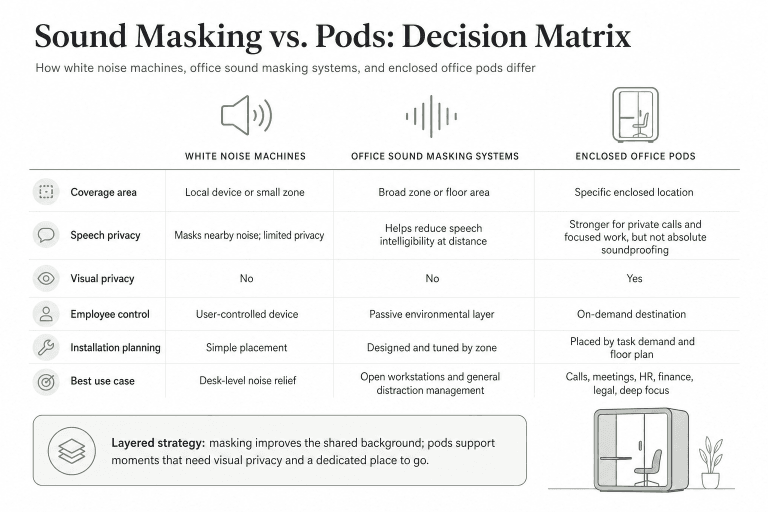
| Schallmaskierung | Sprache durch Hintergrundschall weniger ablenkend machen | Physische Trennung schaffen | Offene Büros mit mäßiger Ablenkung durch Sprache |
| Zonierung der Raumaufteilung | Laute und ruhige Aktivitäten trennen | Nachhall in Räumen mit harten Oberflächen allein lösen | Telefonzonen, Fokuszonen, Kollaborationszonen |
| Geschlossene Bürokabinen | Einen speziellen Ort für private Anrufe, konzentriertes Arbeiten oder Besprechungen in kleinen Gruppen schaffen | Den Nachhall im gesamten Raum behandeln | Private Anrufe, hybride Besprechungen, konzentriertes Arbeiten |
Für Teams, die private Anrufe, Videobesprechungen oder Bereiche für konzentriertes Arbeiten benötigen, Akustische Büro-Pods sind diese in der Regel besser geeignet, als von Paneelen zu erwarten, dass sie wie ein geschlossener Raum funktionieren.
B&H Ergonomics Elite-S erreichte eine akustische Leistung der Klasse A nach ISO 23351-1 mit einer Sprachpegeldämpfung von 33 dB. Bei Werkstests von B&H unter kontrollierten Bedingungen zeigte Elite-S eine Schallpegeldifferenz von etwa 40 dB. Akustische Ergebnisse variieren je nach Testmethode, Installation, Standortbedingungen und Messaufbau.
Wo Akustikpaneele für Büros in der Regel am besten funktionieren
Akustikpaneele für Büros eignen sich gut, wenn der Raum reflektierende Oberflächen aufweist und Komfort, Klarheit oder geringere akustische Ermüdung das Ziel sind.
Geeignete Bereiche sind unter anderem:
- Besprechungsräume mit Glaswänden
- Kollaborationsbereiche mit offener Decke
- Schulungsräume
- Empfangs- und Wartebereiche
- Konferenzräume mit harten Oberflächen
- gemeinsam genutzte offene Bereiche mit zu starkem Nachhall
- Wandabschnitte in der Nähe störender Reflexionspunkte
Die Platzierung ist wichtig. Ein kleines dekoratives Paneel an einer Wand verändert den Raum möglicherweise nicht ausreichend. Ein besserer Plan berücksichtigt Raumgröße, Deckenhöhe, harte Oberflächen, Positionen der Sprechenden, Schreibtischanordnung und die Stellen, an denen Schall reflektiert wird.
Welche Daten Sie vor dem Kauf von Schallpaneelen für Büroräume anfordern sollten
Genehmigen Sie Akustikpaneele für Büros nicht allein aufgrund von Farbe, Stoff oder einer vagen Aussage zur “Lärmreduzierung”. Fordern Sie Daten an, die zum Produkt und zu der vorgesehenen Art der Installation passen.
Nutzen Sie diese Checkliste vor dem Kauf:
- Welche akustische Kennzahl wird für das Paneelmaterial angegeben?
- Wurde die Kennzahl für dieselbe vorgeschlagene Dicke und Montagemethode gemessen?
- Bezieht sich die Aussage auf Schallabsorption und nicht auf Schalldämmung?
- Erläutert der Lieferant, wo die Paneele angebracht werden sollten?
- Werden Decke, Bodenbelag, Glas, Möbel und Raumaufteilung ebenfalls berücksichtigt?
- Sind Anforderungen an Brandschutz, Reinigung, Montage und Wartung für den Arbeitsplatz dokumentiert?
- Wird das Ergebnis nach der Installation überprüft?
Für Aussagen zur Schallabsorption können NRC- oder SAA-Daten beim Vergleich von Materialien helfen, doch diese Werte beweisen nicht, dass Gespräche privat werden. Wenn Privatsphäre das Ziel ist, benötigt das Büro einen separaten Plan für die Vertraulichkeit von Gesprächen oder die Schalldämmung.
Wenn Paneele für die Vertraulichkeit von Gesprächen nicht ausreichen
Paneele reichen nicht aus, wenn das Büro vertrauliche Gespräche, geschützte Zeit für konzentriertes Arbeiten oder eine stärker kontrollierte Trennung von den Aktivitäten in der Umgebung benötigt.
Möglicherweise benötigen Sie eine stärkere Lösung, wenn:
- Anrufe aus HR, Finanzwesen, Rechtsabteilung oder Führung an offenen Schreibtischen stattfinden
- Mitarbeitende regelmäßig die Etage verlassen, um Anrufe entgegenzunehmen
- Videobesprechungen benachbarte Teams stören
- Führungskräfte sensible Gespräche vermeiden, weil das Büro zu exponiert ist
- Mitarbeitende sich beschweren, dass sie jeden Anruf in der Nähe verstehen können
- hybride Besprechungen statt einer freien Ecke einen verlässlichen Rahmen benötigen
In diesen Fällen lautet die bessere Frage nicht “Wie viele weitere Paneele brauchen wir?”, sondern “Wo sollte private Arbeit stattfinden?”
Viele Büros benötigen beide Ebenen. Paneele können den gemeinsam genutzten Raum beruhigen. Geschlossene Bereiche können verlässliche Orte für Anrufe, konzentriertes Arbeiten und Besprechungen in kleinen Gruppen schaffen.
Praktische Empfehlung
Ich würde Akustikpaneele für Büros als gezielte Verbesserung des akustischen Komforts betrachten, nicht als universelle Lösung für Bürolärm.
Wählen Sie Paneele, wenn der Raum hart, reflektierend, hallig oder ermüdend in der Nutzung ist. Fordern Sie Daten zur Schallabsorption an, bestätigen Sie die Platzierung und stellen Sie sicher, dass der Installationsplan zu den tatsächlichen problemverursachenden Oberflächen passt.
Wählen Sie Paneele nicht als Hauptlösung, wenn das Problem vertrauliche Sprache, ständige Anrufe an Schreibtischen oder fehlender privater Arbeitsraum ist. Beginnen Sie in dieser Situation mit dem Arbeitsverhalten: Wer benötigt Privatsphäre, wie oft, wie lange und ob diese Personen einen Raum für Einzelanrufe, eine Fokusbox oder eine kleine geschlossene Besprechungseinheit benötigen.
Für eine umfassendere Planung offener Büros kann es außerdem helfen, Paneele mit Zonierung und Schallmaskierung zu vergleichen, bevor entschieden wird, wo geschlossene Bereiche hingehören. Ein mehrschichtiger Plan funktioniert in der Regel besser, als von einem Produkt zu erwarten, jede Art von Lärm zu lösen.
FAQ
Machen Akustikpaneele ein Büro schalldicht?
Nein. Akustikpaneele für Büros verringern reflektierten Schall innerhalb eines Raums, schaffen jedoch keine abgedichtete akustische Grenze. Sie können einen Raum ruhiger klingen lassen, sollten aber nicht als Lösung zur Schalldämmung angesehen werden.
Eignen sich Schallpaneele für Büroräume für offene Büros?
Ja, wenn das offene Büro Echo, harte Oberflächen oder akustische Ermüdung aufweist. Weniger wirksam sind sie, wenn das Hauptproblem darin besteht, dass Sprache mitgehört wird. In diesem Fall können eine räumliche Trennung, Schallmaskierung oder ein geschlossener privater Arbeitsbereich erforderlich sein.
Verbessern Akustik-Wandpaneele die Vertraulichkeit von Gesprächen?
Nur begrenzt. Akustik-Wandpaneele können Reflexionen verringern, durch die ein Raum laut wirkt, sie verhindern jedoch nicht zuverlässig, dass Personen in der Nähe Sprache verstehen. Für die Vertraulichkeit von Gesprächen sind in der Regel Abstand, Trennung, Einhausung, Maskierung oder ein umfassenderer Akustikplan erforderlich.
Wo sollten Akustikpaneele im Büro installiert werden?
Sie sollten dort angebracht werden, wo reflektierter Schall Probleme verursacht, etwa an Glaswänden, in Besprechungsräumen mit harten Oberflächen, an Bereichen mit offener Decke oder in Kollaborationszonen. Die Platzierung sollte zur Raumform, zu den Oberflächenmaterialien, zur Deckenhöhe und zur akustischen Beschwerde passen.
Können Akustikpaneele für Büros und Bürokabinen zusammen eingesetzt werden?
Ja. Paneele können die gemeinsame akustische Umgebung verbessern, während Bürokabinen spezielle Bereiche für private Anrufe, konzentriertes Arbeiten und Besprechungen in kleinen Gruppen bieten. Sie lösen unterschiedliche Teile des Lärmproblems am Arbeitsplatz.