Quick Answer
Office acoustic panels reduce echo, reverberation, and reflected sound in workplaces with hard surfaces. Sound panels for office spaces can make meeting rooms, glass rooms, and open collaboration areas feel calmer, but they do not create reliable speech privacy by themselves. If people can still understand nearby conversations, the problem is sound isolation or speech privacy, not just sound absorption.
Last Updated: July 16, 2026 | Author: William | Review: Richard | Estimated Reading Time: 9 minutes
What Are Office Acoustic Panels?
Office acoustic panels are sound-absorbing materials used to control reflected sound inside a workplace. They may be installed as wall panels, ceiling baffles, desk screens, hanging dividers, or freestanding acoustic screens.
The key word is absorbing. A panel helps reduce sound energy after sound reaches it. It does not seal a room, block every path sound can travel through, or turn an open office into a private room.
That distinction matters because office noise complaints often sound similar at first. A glass meeting room that feels sharp and echoey may benefit from acoustic wall panels. A finance manager taking confidential calls in an open area needs a different kind of solution.
What Office Acoustic Panels Do Well
Office acoustic panels work best when the main problem is reflected sound, often in spaces with glass walls, exposed ceilings, concrete floors, metal furniture, or large tables. If curtains are being considered alongside panels, check what sound absorbing curtains can and cannot do. Compare their suitability for the surface and room problem without treating either an absorber or a curtain as proof that nearby conversations will become private.
They are useful when employees say:
- “This room echoes.”
- “Video calls sound harsh.”
- “The office feels loud even when people are not shouting.”
- “Sound bounces off the glass.”
- “The room feels tiring by the end of the day.”
In these situations, sound absorbing panels for office spaces can improve acoustic comfort by reducing reverberation and making speech sound clearer inside the treated area. They are especially useful in meeting rooms, training rooms, reception areas, collaboration zones, and hard-surface open offices.
What Office Acoustic Panels Cannot Do
Office acoustic panels do not make an office soundproof. They also do not reliably stop speech from traveling between desks, rooms, or open work areas.
This is the buying mistake I would watch for first: a team keeps adding soft material when the real problem is not echo. The real problem is that people can understand conversations they should not hear.
Sound absorption and sound isolation are different jobs:
| Acoustic Term | What It Means | Office Example |
|---|---|---|
| Sound absorption | Reduces reflected sound inside a room | Wall panels reduce echo in a glass meeting room |
| Reverberation control | Shortens how long sound lingers in a space | A hard room feels less sharp after treatment |
| Sound isolation | Reduces sound transmission between spaces | A room or enclosure limits sound leakage |
| Speech privacy | Makes conversations harder to understand outside the intended area | Sensitive calls are not intelligible nearby |
If the complaint is “the room sounds too live,” office acoustic panels may be the right first step. If the complaint is “I can hear every word,” panels alone are unlikely to solve the real issue; use the soundproof cubicle vs. office pod comparison when deciding whether a partition or full enclosure matches the privacy requirement.
Office Noise Symptom-to-Solution Matrix
Before buying acoustic panels, identify the actual noise problem. The right office acoustic solution depends on what employees are experiencing, not only on how loud the space feels.
| Workplace Symptom | Likely Acoustic Problem | Better First Direction |
|---|---|---|
| The meeting room echoes | Reflected sound | Office acoustic panels, ceiling baffles, soft finishes |
| Calls sound sharp or tiring | Reverberation and hard surfaces | Acoustic wall panels plus microphone and room layout review |
| Nearby conversations break focus | Speech intelligibility | Zoning, distance, behavior rules, or enclosed focus space |
| Private calls happen at desks | Lack of speech privacy | Dedicated enclosed space for calls |
| The whole floor feels noisy | Mixed acoustic comfort issue | Panels, layout zoning, sound masking, and selected enclosure points |
| People leave the office to take calls | No reliable private call setting | Enclosed phone or focus areas before more wall coverage |
This matrix prevents overbuying the wrong product. Panels are valuable when the room itself is too reflective. They are weaker when the office needs separation, confidentiality, or a controlled place for calls.
Acoustic Panels vs Soundproofing vs Office Pods
Acoustic panels reduce reflections within a room, while sound isolation and enclosed workspaces address separation between spaces. Use the privacy booth versus acoustic panels comparison when the purchasing decision is whether to improve general room acoustics, provide a private call setting, or combine both. The right specification starts with that task; one product label or acoustic number cannot answer all three questions.
That is why these products should not be judged by the same metric. Acoustic panels are usually evaluated through absorption-related data. For example, ASTM C423 is a standard used to measure sound absorption in a reverberation room, which is relevant when comparing material absorption performance. Enclosed furniture systems are evaluated more like complete acoustic environments, where glazing, seals, wall construction, ventilation paths, and installation all affect the result. ISO 23351-1 is used for speech level reduction of furniture ensembles and enclosures, not for a single wall absorber or ceiling baffle.
| Option | Best At | Weak At | Typical Office Use |
|---|---|---|---|
| Office acoustic panels | Reducing echo and reflected sound | Creating private conversations | Meeting rooms, glass offices, hard-surface zones |
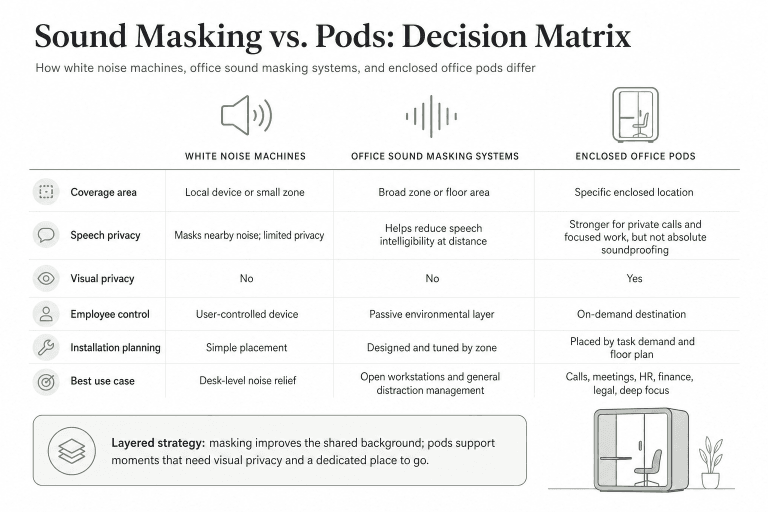
| Sound masking | Making speech less distracting through background sound | Creating physical separation | Open offices with moderate speech distraction |
| Layout zoning | Separating loud and quiet activity | Solving hard-room reverberation alone | Call zones, focus zones, collaboration zones |
| Enclosed office pods | Creating a dedicated place for private calls, focus, or small meetings | Treating the whole room’s echo | Private calls, hybrid meetings, focused work |
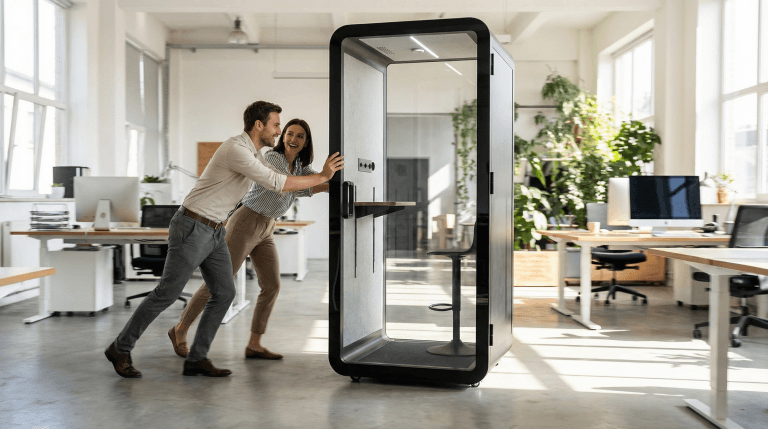
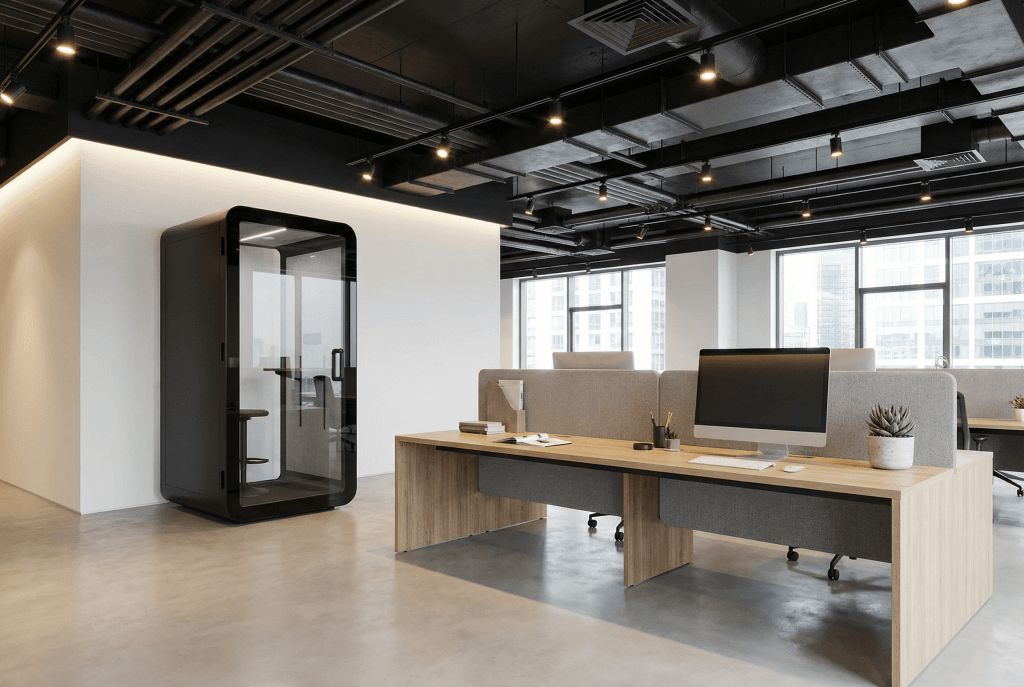
For teams that need private calls, video meetings, or focused work areas, acoustic office pods are usually a better fit than expecting panels to perform like an enclosed room.
B&H Ergonomics Elite-S achieved ISO 23351-1 Class A acoustic performance with 33 dB speech level reduction. In B&H factory testing under controlled conditions, Elite-S showed approximately 40 dB sound level difference. Acoustic results vary by test method, installation, site conditions, and measurement setup.
Where Office Acoustic Panels Usually Work Best
Office acoustic panels are a strong fit when the space has reflective surfaces and the goal is comfort, clarity, or lower acoustic fatigue.
Good locations include:
- glass meeting rooms
- exposed-ceiling collaboration areas
- training rooms
- reception and waiting areas
- hard-surface conference rooms
- shared open areas with too much reverberation
- wall sections near noisy reflection points
Placement matters. A small decorative panel on one wall may not change the room enough. A better plan looks at room size, ceiling height, hard surfaces, speaker locations, desk layout, and where sound is bouncing.
What Data to Ask for Before Buying Sound Panels for Office Spaces
Do not approve office acoustic panels based only on color, fabric, or a vague “noise reduction” claim. Ask for the data that matches the product and the way it will be installed.
Use this checklist before purchase:
- What acoustic rating is provided for the panel material?
- Was the rating measured for the same thickness and mounting method being proposed?
- Is the claim about sound absorption, not soundproofing?
- Does the supplier explain where the panels should be placed?
- Are ceiling, flooring, glass, furniture, and layout also being considered?
- Are fire, cleaning, mounting, and maintenance requirements documented for the workplace?
- Will the result be reviewed after installation?
For absorption claims, NRC or SAA data can help compare materials, but those numbers do not prove that conversations will become private. If privacy is the target, the office needs a separate speech privacy or sound isolation plan.
When Panels Are Not Enough for Speech Privacy
Panels are not enough when the office needs confidential conversations, protected focus time, or more controlled separation from surrounding activity.
You may need a stronger solution when:
- HR, finance, legal, or leadership calls happen at open desks
- employees regularly leave the floor to take calls
- video meetings disturb nearby teams
- managers avoid sensitive conversations because the office is too exposed
- staff complain that they can understand every nearby call
- hybrid meetings need a predictable setting instead of a spare corner
In those cases, the better question is not “How many more panels do we need?” It is “Where should private work happen?”
Many offices need both layers. Panels can calm the shared room. Enclosed spaces can create reliable destinations for calls, focused work, and small meetings.
Practical Recommendation
I would treat office acoustic panels as a targeted acoustic comfort upgrade, not a universal office noise fix.
Choose panels when the room is hard, reflective, echoey, or tiring to use. Ask for absorption data, confirm placement, and make sure the installation plan matches the actual surfaces causing the problem.
Do not choose panels as the main answer when the problem is confidential speech, constant desk calls, or lack of private workspace. In that situation, start with the work behavior: who needs privacy, how often, for how long, and whether they need a one-person call space, a focus pod, or a small meeting enclosure.
For broader open-office planning, it may also help to compare panels with zoning and sound masking before deciding where enclosed spaces belong. A layered plan usually works better than asking one product to fix every kind of noise.
FAQ
Do office acoustic panels make an office soundproof?
No. Office acoustic panels reduce reflected sound inside a room, but they do not create a sealed acoustic boundary. They can make a room sound calmer, but they should not be treated as a soundproofing solution.
Are sound panels for office spaces good for open offices?
Yes, when the open office has echo, hard surfaces, or acoustic fatigue. They are less effective when the main problem is overheard speech. In that case, layout separation, sound masking, or enclosed private workspace may be needed.
Do acoustic wall panels improve speech privacy?
Only in a limited way. Acoustic wall panels may reduce reflections that make a room feel loud, but they do not reliably stop nearby listeners from understanding speech. Speech privacy usually requires distance, separation, enclosure, masking, or a broader acoustic plan.
Where should office acoustic panels be installed?
They should be placed where reflected sound is causing problems, such as glass walls, hard meeting rooms, exposed ceiling areas, or collaboration zones. Placement should match the room shape, surface materials, ceiling height, and acoustic complaint.
Can office acoustic panels and office pods be used together?
Yes. Panels can improve the shared acoustic environment, while office pods provide dedicated spaces for private calls, focused work, and small meetings. They solve different parts of the workplace noise problem.