Resposta rápida
Os painéis acústicos para escritório reduzem o eco, a reverberação e o som refletido em ambientes de trabalho com superfícies rígidas. Os painéis acústicos para espaços de escritório podem tornar salas de reunião, salas envidraçadas e áreas abertas de colaboração mais tranquilas, mas não proporcionam privacidade confiável para conversas por si só. Se as pessoas ainda conseguem entender conversas próximas, o problema é o isolamento acústico ou a privacidade da fala, não apenas a absorção sonora.
Última atualização: 16 de julho de 2026 | Autor: William | Revisão: Richard | Tempo estimado de leitura: 9 minutos
O que são painéis acústicos para escritórios?
Os painéis acústicos para escritório são materiais absorventes de som usados para controlar o som refletido dentro de um ambiente de trabalho. Eles podem ser instalados como painéis de parede, defletores de teto, divisórias de mesa, divisórias suspensas ou telas acústicas independentes.
A palavra-chave é absorção. Um painel ajuda a reduzir a energia sonora depois que o som o atinge. Ele não veda uma sala, bloqueia todos os caminhos pelos quais o som pode se propagar nem transforma um escritório aberto em uma sala privativa.
Essa distinção é importante porque as reclamações sobre ruído no escritório costumam parecer semelhantes no início. Uma sala de reunião envidraçada que parece estridente e ecoante pode se beneficiar de painéis acústicos de parede. Um gerente financeiro que faz ligações confidenciais em uma área aberta precisa de outro tipo de solução.
O que os painéis acústicos de escritório fazem bem
Os painéis acústicos para escritório funcionam melhor quando o principal problema é o som refletido, frequentemente em espaços com paredes de vidro, tetos expostos, pisos de concreto, mobiliário metálico ou mesas grandes. Se estiver a considerar cortinas juntamente com painéis, verifique o que cortinas de absorção de som podem e não podem fazer. Compare a adequação de cada opção à superfície e ao problema da sala, sem considerar que um material absorvente ou uma cortina comprova que as conversas nas proximidades se tornarão privadas.
São úteis quando os empregados dizem:
- “Esta sala tem eco.”
- “As videochamadas soam estridentes.”
- “O escritório parece barulhento mesmo quando as pessoas não estão a gritar.”
- “O som reflecte-se no vidro.”
- “A sala fica cansativa no fim do dia.”
Nessas situações, os painéis absorventes de som para espaços de escritório podem melhorar o conforto acústico ao reduzir a reverberação e tornar a fala mais nítida dentro da área tratada. Eles são especialmente úteis em salas de reunião, salas de treinamento, áreas de recepção, zonas de colaboração e escritórios abertos com superfícies rígidas.
O que os painéis acústicos de escritório não podem fazer
Os painéis acústicos de escritório não tornam um escritório insonorizado. Também não impedem, de forma fiável, que a voz se desloque entre secretárias, salas ou áreas de trabalho abertas.
Este é o erro de compra que eu observaria primeiro: a equipe continua adicionando materiais macios quando o problema real não é o eco. O problema real é que as pessoas conseguem entender conversas que não deveriam ouvir.
A absorção e o isolamento do som são tarefas diferentes:
| Termo acústico | O que significa | Exemplo de escritório |
|---|---|---|
| Absorção sonora | Reduz o som refletido no interior de uma divisão | Os painéis de parede reduzem o eco em uma sala de reunião envidraçada |
| Controlo de reverberação | Reduz o tempo de permanência do som num espaço | Uma sala rígida parece menos estridente após o tratamento |
| Isolamento acústico | Reduz a transmissão de som entre espaços | Uma sala ou estrutura fechada limita o vazamento de som |
| Privacidade do discurso | Torna as conversas mais difíceis de entender fora da área pretendida | As chamadas sensíveis não são inteligíveis nas proximidades |
Se a reclamação é “a sala parece muito reverberante”, os painéis acústicos para escritório podem ser o primeiro passo certo. Se a reclamação é “consigo ouvir cada palavra”, é improvável que os painéis, sozinhos, resolvam o problema real; use a comparação entre cabine à prova de som e cabine de escritório ao decidir se uma divisória ou uma estrutura totalmente fechada atende ao requisito de privacidade.
Matriz de sintomas de ruído no ambiente de trabalho e soluções
Antes de comprar painéis acústicos, identifique o problema real de ruído. A solução acústica certa para o escritório depende do que os funcionários estão vivenciando, não apenas de quão barulhento o espaço parece.
| Sintoma no ambiente de trabalho | Provável problema acústico | Melhor primeira orientação |
|---|---|---|
| A sala de reuniões tem eco | Som refletido | Painéis acústicos para escritório, baffles de teto e acabamentos macios |
| As chamadas soam estridentes ou cansativas | Reverberação e superfícies duras | Painéis acústicos de parede, além de uma revisão do microfone e da disposição da sala |
| Conversas próximas interrompem a concentração | Inteligibilidade da fala | Zoneamento, distância, regras de comportamento ou espaço fechado para concentração |
| As chamadas privadas acontecem nas secretárias | Falta de privacidade da fala | Espaço fechado dedicado para chamadas |
| Todo o piso parece ruidoso | Questão de conforto acústico misto | Painéis, zoneamento da disposição, mascaramento sonoro e pontos de fechamento selecionados |
| As pessoas saem do escritório para fazer chamadas | Nenhum local privado confiável para chamadas | Áreas fechadas para chamadas ou concentração antes de aumentar a cobertura das paredes |
Esta matriz evita a compra excessiva do produto errado. Os painéis são valiosos quando a própria sala é demasiado reverberante. São menos eficazes quando o escritório precisa de separação, confidencialidade ou de um local controlado para fazer chamadas.
Painéis acústicos vs. isolamento acústico vs. pods de escritório
Os painéis acústicos reduzem as reflexões dentro de uma sala, enquanto o isolamento acústico e os espaços de trabalho fechados tratam da separação entre espaços. Utilize a comparação entre cabines de privacidade e painéis acústicos quando a decisão de compra for melhorar a acústica geral da sala, proporcionar um ambiente privado para chamadas ou combinar ambas as soluções. A especificação correta começa por essa necessidade; uma designação de produto ou um valor acústico não pode responder às três questões.
É por isso que estes produtos não devem ser avaliados pela mesma métrica. Os painéis acústicos são normalmente avaliados através de dados relacionados com a absorção. Por exemplo, a ASTM C423 é uma norma utilizada para medir a absorção sonora numa câmara reverberante, o que é relevante ao comparar o desempenho de absorção dos materiais. Os sistemas de mobiliário fechado são avaliados mais como ambientes acústicos completos, nos quais os envidraçados, as vedações, a construção das paredes, os percursos de ventilação e a instalação influenciam o resultado. A ISO 23351-1 é utilizada para a redução do nível de fala de conjuntos de mobiliário e estruturas fechadas, e não para um único absorvedor de parede ou baffle de teto.
| Opção | Melhor em | Menos eficaz em | Utilização típica no escritório |
|---|---|---|---|
| Painéis acústicos para escritórios | Redução do eco e do som refletido | Criar espaços para conversas privadas | Salas de reunião, escritórios envidraçados, zonas com superfícies rígidas |
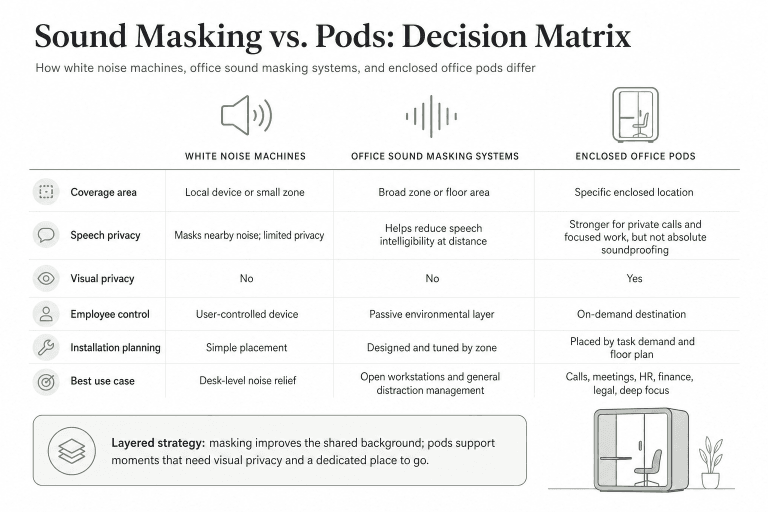
| Mascaramento de som | Tornar a fala menos perturbadora através de som de fundo | Criar separação física | Escritórios abertos com distração moderada causada pela fala |
| Zoneamento do layout | Separar atividades ruidosas e silenciosas | Resolver isoladamente a reverberação de salas com superfícies rígidas | Zonas para chamadas, zonas de foco, zonas de colaboração |
| Pods de escritório fechados | Criar um espaço dedicado para chamadas privadas, foco ou pequenas reuniões | Tratar o eco de toda a sala | Chamadas privadas, reuniões híbridas, trabalho concentrado |
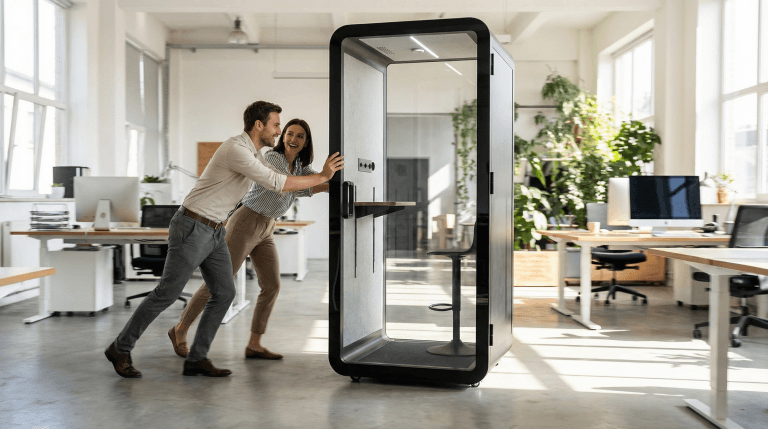
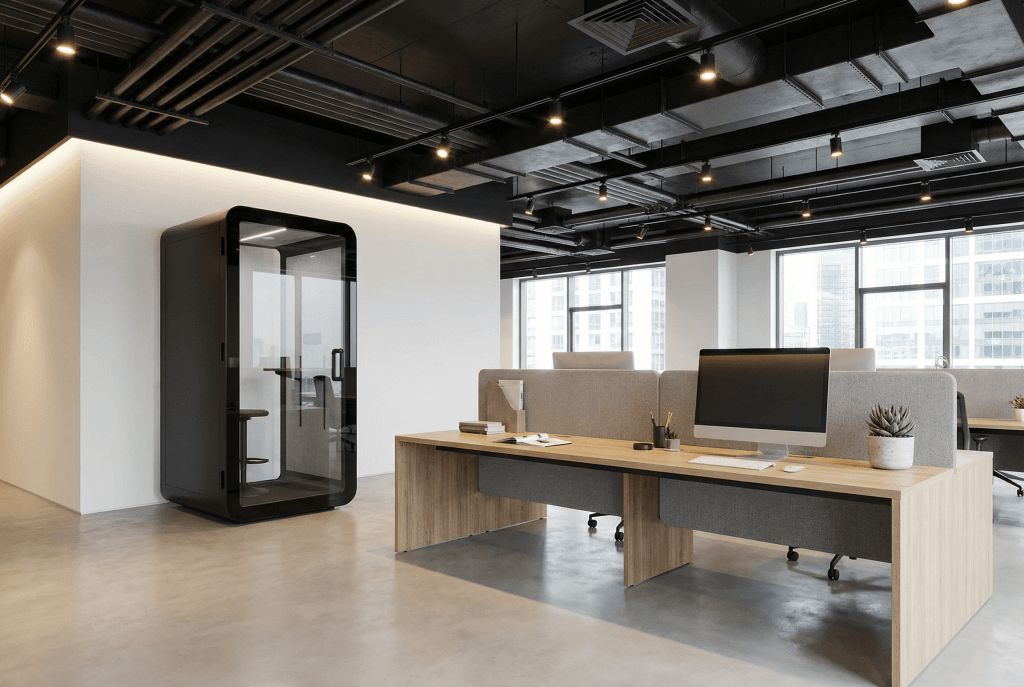
Para equipas que necessitam de chamadas privadas, reuniões por vídeo ou áreas de trabalho concentrado, cápsulas acústicas para escritórios são geralmente mais adequados do que esperar que os painéis funcionem como uma sala fechada.
O Elite-S B&H Ergonomics alcançou o desempenho acústico de Classe A da ISO 23351-1, com uma redução de 33 dB no nível de fala. Em testes de fábrica B&H realizados em condições controladas, o Elite-S apresentou uma diferença de nível sonoro de aproximadamente 40 dB. Os resultados acústicos variam consoante o método de ensaio, a instalação, as condições do local e a configuração de medição.
Onde os painéis acústicos para escritório costumam funcionar melhor
Os painéis acústicos para escritório são uma excelente opção quando o espaço tem superfícies refletoras e o objetivo é melhorar o conforto e a clareza ou reduzir a fadiga acústica.
Os locais adequados incluem:
- salas de reunião envidraçadas
- áreas de colaboração com teto exposto
- salas de formação
- áreas de receção e espera
- salas de conferência com superfícies rígidas
- áreas abertas partilhadas com reverberação excessiva
- trechos de parede próximos de pontos de reflexão sonora ruidosos
A localização é importante. Um pequeno painel decorativo numa parede pode não alterar suficientemente a sala. Um plano mais eficaz considera o tamanho da sala, a altura do teto, as superfícies rígidas, a localização dos oradores, a disposição das secretárias e os pontos onde o som é refletido.
Que dados deve solicitar antes de comprar painéis acústicos para espaços de escritório
Não aprove painéis acústicos para escritório apenas com base na cor, no tecido ou numa alegação vaga de “redução do ruído”. Solicite os dados correspondentes ao produto e à forma como será instalado.
Utilize esta lista de verificação antes da compra:
- Que classificação acústica é fornecida para o material do painel?
- A classificação foi medida para a mesma espessura e o mesmo método de montagem propostos?
- A alegação refere-se à absorção sonora, e não ao isolamento acústico?
- O fornecedor explica onde os painéis devem ser colocados?
- O teto, o pavimento, o vidro, o mobiliário e a disposição do espaço também estão a ser considerados?
- Os requisitos de resistência ao fogo, limpeza, montagem e manutenção estão documentados para o local de trabalho?
- O resultado será avaliado após a instalação?
Para alegações de absorção, os dados de NRC ou SAA podem ajudar a comparar materiais, mas esses valores não comprovam que as conversas se tornarão privadas. Se o objetivo for a privacidade, o escritório precisa de um plano separado de privacidade da fala ou de isolamento acústico.
Quando os painéis não são suficientes para a privacidade das conversas
Os painéis não são suficientes quando o escritório necessita de conversas confidenciais, de tempo de concentração protegido ou de uma separação mais controlada da atividade circundante.
Pode ser necessária uma solução mais forte quando:
- As chamadas de RH, financeiras, jurídicas ou de liderança são efectuadas em secretárias abertas
- os empregados saem regularmente do local de trabalho para atender chamadas
- reuniões por vídeo perturbam equipas próximas
- os gestores evitam conversas sensíveis porque o escritório está demasiado exposto
- os funcionários queixam-se de que conseguem perceber todas as chamadas próximas
- as reuniões híbridas precisam de um ambiente previsível, em vez de um canto livre
Nesses casos, a melhor pergunta não é: “De quantos painéis mais precisamos?”. É “Onde é que o trabalho privado deve ser feito?”
Muitos escritórios precisam de ambas as camadas. Os painéis podem tornar o ambiente partilhado mais calmo. Os espaços fechados podem criar locais fiáveis para chamadas, trabalho concentrado e pequenas reuniões.
Recomendação prática
Eu consideraria os painéis acústicos para escritórios uma melhoria direcionada do conforto acústico, e não uma solução universal para o ruído no escritório.
Escolha painéis quando a sala for demasiado dura, refletora, com eco ou cansativa de utilizar. Peça dados de absorção, confirme a colocação e certifique-se de que o plano de instalação corresponde às superfícies reais que estão a causar o problema.
Não escolha painéis como resposta principal quando o problema são conversas confidenciais, chamadas constantes nas secretárias ou falta de espaço de trabalho privado. Nessa situação, comece pelo comportamento de trabalho: quem precisa de privacidade, com que frequência, durante quanto tempo e se precisa de um espaço individual para chamadas, de uma cabine de concentração ou de um pequeno espaço fechado para reuniões.
Para um planeamento mais abrangente de escritórios abertos, também pode ser útil comparar os painéis com o zoneamento e a mascaragem sonora antes de decidir onde os espaços fechados se enquadram. Um plano em camadas geralmente funciona melhor do que pedir a um único produto que resolva todos os tipos de ruído.
FAQ
Os painéis acústicos de escritório tornam um escritório insonorizado?
Não. Os painéis acústicos para escritórios reduzem o som refletido no interior de uma sala, mas não criam uma fronteira acústica selada. Podem tornar uma sala mais calma, mas não devem ser tratados como uma solução de insonorização.
Os painéis acústicos para escritórios são adequados para escritórios abertos?
Sim, quando o escritório aberto apresenta eco, superfícies rígidas ou fadiga acústica. São menos eficazes quando o principal problema é ouvir conversas alheias. Nesse caso, pode ser necessário separar os espaços, utilizar mascaramento sonoro ou criar uma área de trabalho privativa fechada.
Os painéis acústicos de parede melhoram a privacidade das conversas?
Apenas de forma limitada. Os painéis acústicos de parede podem reduzir as reflexões que fazem com que um ambiente pareça barulhento, mas não impedem de forma fiável que pessoas próximas compreendam a fala. A privacidade da fala geralmente requer distância, separação, enclausuramento, mascaramento ou um plano acústico mais abrangente.
Onde devem ser instalados os painéis acústicos para escritórios?
Devem ser colocados onde o som refletido está a causar problemas, como em paredes de vidro, salas de reunião com superfícies rígidas, áreas com teto exposto ou zonas de colaboração. A colocação deve corresponder à configuração da sala, aos materiais das superfícies, à altura do teto e à queixa acústica.
Os painéis acústicos para escritório e as cabines de escritório podem ser usados em conjunto?
Sim. Os painéis podem melhorar o ambiente acústico partilhado, enquanto as cabines de escritório proporcionam espaços dedicados para chamadas privadas, trabalho concentrado e pequenas reuniões. Resolvem diferentes aspetos do problema do ruído no local de trabalho.