Snel antwoord
Afleidingen op kantoor zijn meestal afkomstig uit vier bronnen: gesprekken in de buurt, visuele bewegingen, onverwachte onderbrekingen en het wisselen tussen digitale apparaten. De beste oplossing bestaat niet uit één regel of één product. Begin met het vaststellen van het soort afleiding en combineer vervolgens zone-indeling, gedragsregels, telefooncellen, werkcellen, vergaderruimtes en kantoorruimtes waar de taak echte privacy of concentratie vereist.
Laatst bijgewerkt: 9 juli 2026 | Auteur: Richard | Geschatte leestijd: 11 minuten
Waarom afleidingen op kantoor een oplossing op het gebied van ruimteplanning vereisen
Een druk kantoor kan er productief uitzien, terwijl het stilletjes de concentratie ondermijnt. Verkoopgesprekken lopen door tot in de werkruimtes. Gesprekken met HR voelen alsof ze voor iedereen hoorbaar zijn. Ontwikkelaars verliezen tijd die ze nodig hebben om zich volledig op hun werk te concentreren, omdat gesprekken in de buurt hun aandacht steeds weer afleiden. Vergaderruimtes worden bezet door videogesprekken van één persoon, waardoor kleine teams geen plek meer hebben om bijeen te komen.
Daarom moet afleiding op de werkplek worden beschouwd als een probleem op het gebied van ruimte-indeling, en niet alleen als een gedragsprobleem. Mensen hebben nog steeds behoefte aan samenwerking, maar ze hebben ook plekken nodig waar telefoongesprekken, vertrouwelijke gesprekken, korte vergaderingen en geconcentreerd werk niet om dezelfde open werkplek hoeven te strijden.
Als u al verschillende oplossingen voor afgesloten werkplekken met elkaar vergelijkt, begin dan met B&H Ergonomics kantoorpods zoals de bredere categorie ‘privacy en concentratie’. Voor één-op-één-gesprekken, intensief werken en discussies in kleine groepen kan telkens een meer gespecialiseerde ruimte nodig zijn.
Wat wordt op kantoor als afleiding beschouwd?
Afleidingen op kantoor zijn terugkerende situaties die de aandacht verstoren, de privacy aantasten of mensen dwingen om van taak te wisselen voordat ze daar klaar voor zijn.
De meest voorkomende voorbeelden zijn onder meer:
- lokale telefoongesprekken;
- nevengesprekken naast de bureaus;
- mensen die door aandachtsgebieden lopen;
- korte vragen die het geconcentreerd werken onderbreken;
- videovergaderingen aan open werkplekken;
- meldingen via chat en e-mail;
- vergaderruimtes die worden gebruikt voor individuele telefoongesprekken;
- vertrouwelijke gesprekken die plaatsvinden op plekken waar anderen ze kunnen afluisteren.
Niet elke afleiding brengt dezelfde kosten met zich mee. Een kortstondig achtergrondgeluid kan vervelend zijn, maar een onderbreking die iemand dwingt om te stoppen, zich opnieuw te oriënteren en de concentratie weer op te bouwen, kan veel kostbaarder zijn.
Onderzoek naar open werkplekken, gepubliceerd door de Koninklijke Vereniging stelde vast dat de persoonlijke interactie afnam nadat werknemers waren overgestapt op meer open werkplekken, terwijl de elektronische communicatie toenam. Het onderzoek van Gloria Mark naar onderbrekingen, aangehaald door UC Irvine, wordt vaak aangehaald om te laten zien hoe lang het kan duren voordat mensen weer aan een taak kunnen werken nadat ze zijn onderbroken.
De praktische les is simpel: als de inrichting van het kantoor mensen blijft dwingen tot onbedoeld wisselen van context, zal het probleem niet worden opgelost door iedereen te vragen zich “nog meer te concentreren”.”
De vier belangrijkste soorten afleidingen op de werkplek
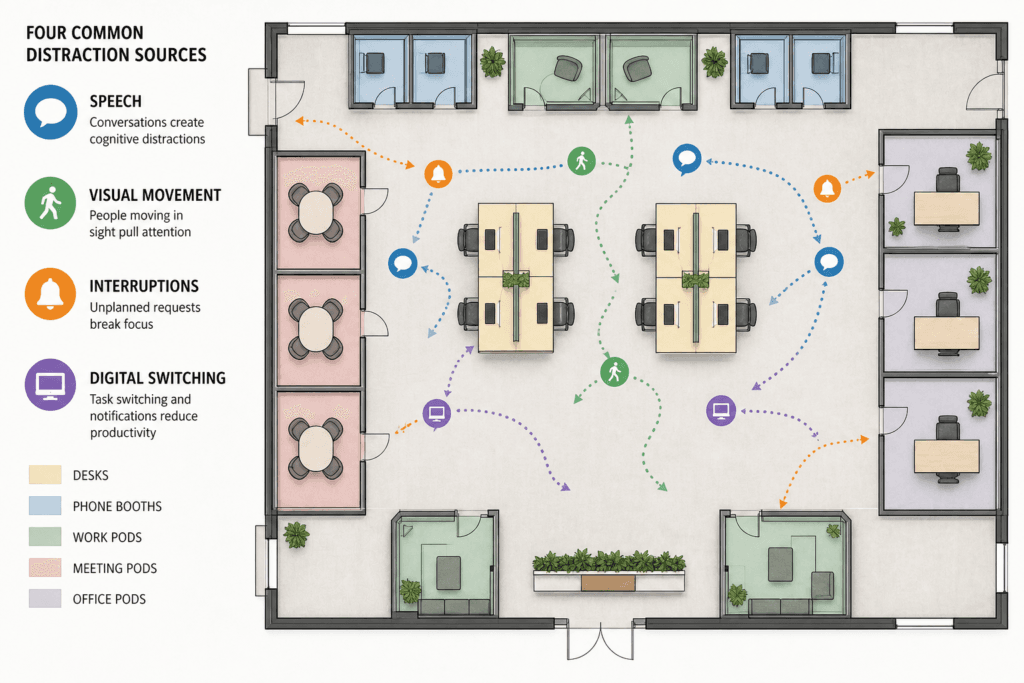
De meeste afleidingen op de werkplek vallen onder vier categorieën. Het is belangrijk om te weten om welke categorie het gaat, omdat elke categorie een andere oplossing vereist.
| Type afleiding | Hoe het eruit ziet | Waarom het het werk belemmert | Beste eerste reactie |
|---|---|---|---|
| Afleiding van spraak | telefoongesprekken, nevengesprekken, vergaderingen in de buurt | begrijpelijke woorden leiden de aandacht af | verplaats telefoongesprekken en gesprekken naar afgesloten ruimtes |
| Visuele afleiding | mensen die langs bureaus lopen, beweging in de buurt van werkplekken | de hersenen blijven de omgeving in de gaten houden | aparte looproutes vanaf de focusbureaus |
| Onderbreking afleiding | een tikje op de schouder, “snelle vragen”, spontane contactmomenten | onderbreekt de continuïteit van de taak | stel regels voor stilte op en richt zichtbare concentratiezones in |
| Digitale afleiding | chatmeldingen, overschakelen naar e-mail, herinneringen voor vergaderingen | de aandacht verspreidt over verschillende hulpmiddelen | teamregels vaststellen voor dringende versus niet-dringende berichten |
Als ik naar problemen met afleiding op kantoor kijk, begin ik meestal met gepraat en onderbrekingen. Die worden het gemakkelijkst onderschat, omdat ze op dat moment onbeduidend lijken. Maar als ze zich de hele dag herhalen, veranderen ze de manier waarop mensen het kantoor gebruiken.
Waarom afleiding in open kantoren moeilijker te beheersen is
Een open kantoorruimte is niet per definitie een slechte kantooropstelling. Het probleem ontstaat pas wanneer van diezelfde open ruimte wordt verwacht dat deze geschikt is voor elke manier van werken.
Een verkoper moet tijdens telefoongesprekken duidelijk spreken. Een HR-manager moet misschien over beloning praten. Een programmeur heeft wellicht twee uur ononderbroken concentratie nodig. Een projectteam heeft misschien een korte vergadering nodig zonder daarvoor de grootste vergaderzaal te hoeven reserveren. Als al die taken op dezelfde werkplek plaatsvinden, wordt afleiding een structureel probleem.
Open kantoren versterken afleiding doorgaans op drie manieren:
- Ze heffen grenzen op. Taal, beweging en activiteit verspreiden zich over de vloer.
- Ze combineren taken die niet samengaan. Telefoongesprekken, geconcentreerd werken en snelle samenwerking vinden plaats in één gezamenlijke omgeving.
- Ze verhullen de vraag naar een privéruimte. Vergaderruimten worden gebruikt voor individuele gesprekken omdat er niet genoeg kleinere privéopties zijn.
Daarom benadrukken brede richtlijnen voor de werkomgeving, zoals GSA-middelen voor het herinrichten van werkplekken, vaak flexibiliteit en modulariteit in plaats van één vaste indeling voor elke taak. Een beter kantoor biedt mensen keuze uit verschillende werkomgevingen.
De matrix voor het diagnosticeren van kantoordistracties
Voer een diagnose uit van het belangrijkste probleem voordat u producten aanschaft of kantoorregels herschrijft. De verkeerde oplossing kan activiteit uitstralen zonder veel te veranderen.
| Wat werknemers zeggen | Waarschijnlijke hoofdoorzaak | Veelvoorkomende afdeling | Beste eerste zet | Wanneer een afgesloten ruimte nodig is |
|---|---|---|---|---|
| “Ik hoor de hele dag telefoongesprekken.” | spraakafleiding door telefoongesprekken aan bureaus | verkoop, support, recruitment | verplaats gesprekken weg van bureaus | gebruik telefoonpods voor terugkerende gesprekken en videogesprekken |
| “Mensen kunnen vertrouwelijke gesprekken horen.” | geringe spraakprivacy | HR, financiën, directie | gebruik geen open werkplekken meer voor vertrouwelijke onderwerpen | gebruik telefoonpods of kleine vergaderpods |
| “Ik krijg geen geconcentreerd werk gedaan.” | spraak, beweging en onderbrekingen overlappen | engineering, ontwerp, analisten | creëer stille zones en regels voor ongestoord werken | gebruik werkpods voor beschermd focuswerk |
| “Vergaderruimtes zijn altijd bezet.” | grote ruimtes die worden gebruikt voor individuele gesprekken | gemengde kantoorteams | scheid individuele gesprekken van de behoefte aan groepsvergaderingen | gebruik telefoonbooths voor individuele gesprekken en vergaderpods voor kleine teams |
| “Overal op kantoor word je afgeleid.” | geen zonering op basis van activiteiten | teams in open kantoorruimtes | breng luidruchtige, stille en private werkvormen in kaart | gebruik kantoorpods als een bredere laag voor privacy en focus |
[Insert image: open office distraction diagnosis map with labeled zones and solution paths]
Afbeeldingsprompt: Professionele B2B-plattegrond van een kantoor met vier bronnen van afleiding: spraak, visuele beweging, onderbrekingen en digitaal schakelen, met gelabelde zones voor bureaus, telefoonbooths, werkpods, vergaderpods en kantoorpods, strakke redactionele stijl, accurate verhoudingen, geen verzonnen certificeringen, geen overdreven claims over geluidsisolatie.
Het doel is niet om het kantoor stil te maken. Het doel is om het kantoor eerlijk in te richten. Een samenwerkingsruimte mag levendig zijn. Een verkoopafdeling mag de energie van telefoongesprekken hebben. Een focusruimte moet concentratie beschermen. Een vertrouwelijk gesprek mag niet midden op de werkvloer plaatsvinden.
Koppel het probleem aan het juiste type kantoorpod
Een veelgemaakte inkoopfout is om elke afgesloten ruimte als hetzelfde te beschouwen. Het is beter om de productcategorie af te stemmen op de daadwerkelijke werkvorm.
Telefoonbooths voor gesprekken en videovergaderingen
Gebruik een telefoonbooth wanneer het probleem spraak van één persoon betreft: verkoopgesprekken, klantenservicegesprekken, wervingsgesprekken, gesprekken met leveranciers en videovergaderingen.
Een telefooncel op kantoor helpt omdat het gesprekken weg verplaatst uit de directe omgeving van bureaus. Het beschermt ook de capaciteit van vergaderruimten. Als één persoon een videogesprek van 20 minuten voert, heeft die doorgaans geen vergaderruimte voor vier personen nodig.
Telefooncabines zijn vooral nuttig wanneer:
- gesprekken meerdere keren per dag plaatsvinden;
- teams in de buurt klagen over afgeluisterde gesprekken;
- videogesprekken een rustigere achtergrond nodig hebben;
- vergaderruimten worden gebruikt voor individuele gesprekken.
Werkpods voor geconcentreerd werken en focus
Gebruik een werkpod wanneer geconcentreerd werken het belangrijkste probleem is. Dit komt vaak voor bij programmeurs, analisten, ontwerpers, schrijvers en iedereen die lange blokken ononderbroken denktijd nodig heeft.
A werkcapsule moet niet worden beschouwd als een beloningsruimte. Het is een hulpmiddel om te werken. Het biedt medewerkers een afgebakende plek om zich terug te trekken van gesprekken, beweging en informele onderbrekingen wanneer de taak continuïteit vereist.
Werkpods zijn een betere keuze wanneer:
- medewerkers sessies voor geconcentreerd werken nodig hebben;
- onderbrekingen schadelijker zijn dan algemeen omgevingsgeluid;
- het team binnen kantoor een mogelijkheid voor focus nodig heeft;
- thuiswerken de enige manier wordt waarop mensen hun concentratie kunnen beschermen.
Meetingpods voor kleine vergaderingen
Gebruik meetingpods wanneer kleine teams privacy nodig hebben zonder grote vergaderruimten te bezetten. Dit is vooral relevant voor gesprekken tussen managers en medewerkers, projectbesprekingen, hybride gesprekken, gesprekken met leidinggevenden en korte teamoverleggen.
A vergadercapsule is niet alleen een kleinere ruimte. Het is een manier om de omvang van de ruimte af te stemmen op de omvang van de vergadering. Wanneer de mix van pods goed is samengesteld, blijven grote vergaderruimten beschikbaar voor grotere groepen.
Kantoorpods voor een bredere planning van privacy en focus
Gebruik kantoorpods als bredere categorie wanneer het kantoor behoefte heeft aan een mix van privacy-, focus-, bel- en kleinschalige samenwerkingsruimten. Bij veel projecten is het uiteindelijke antwoord niet één type cabine. Het is een geplande mix.
De handleiding voor kantoorpods is de betere volgende stap wanneer u nog bepaalt hoeveel afgesloten ruimtes, welke formaten en welke gebruikssituaties in het plan horen.
Planning van de podmix per afdeling: één verhouding past niet bij elk team
Een van de gemakkelijkste fouten is voor elke afdeling dezelfde podverhouding aanschaffen. Verschillende teams veroorzaken en ervaren afleidingen op verschillende manieren.
Een salesteam heeft mogelijk meer belcabines nodig vanwege het hoge belvolume. HR heeft mogelijk besloten ruimte nodig voor gesprekken over salarissen, sollicitatiegesprekken en gesprekken met medewerkers. Engineering heeft mogelijk meer afgeschermde focusruimte nodig. Een leidinggevend team of operationeel team heeft mogelijk capaciteit voor kleine vergaderingen nodig.
Gebruik deze planningsmatrix als uitgangspunt.
| Afdeling of team | Belangrijkste afleidingsprobleem | Betere podprioriteit | Nota planning |
|---|---|---|---|
| Verkoop | te veel telefoongesprekken aan bureaus | telefooncellen | tel het dagelijkse belvolume, niet alleen het aantal medewerkers |
| HR / Personeel | gesprekken over salarissen, sollicitaties en medewerkers worden afgeluisterd | belcabines en meetingpods | de behoefte aan privacy kan minder groot zijn in volume, maar groter in gevoeligheid |
| Engineering / Programmeren | diep werk wordt onderbroken door spraak en beweging | werkpods | plan voor langere focussessies, niet alleen voor korte gesprekken |
| Klantenservice | terugkerende gesprekken en achtergrondgeluid | telefooncellen | plaats booths dicht genoeg bij zodat ze kunnen worden gebruikt zonder werkprocessen te verstoren |
| Projectteams | kleine besprekingen in grote ruimtes | vergaderpods | maak grote ruimtes vrij door kleine teams een ruimte van passend formaat te bieden |
| Algemeen open kantoor | gemengde behoeften aan bellen, concentratie en privacy | kantoorpods | gebruik een evenwichtige mix in plaats van één producttype |
[Insert image: department-based office pod planning matrix for different teams]
Afbeeldingsprompt: zakelijke infographic die de planning van kantoorpods per afdeling toont voor sales, HR, engineering, klantenservice en projectteams, met belbooths, werkpods, vergaderpods en bredere kantoorpods afgestemd op de behoeften van elke afdeling, strakke zakelijke stijl, geen verzonnen logo's, geen ongefundeerde productiviteitsclaims.
Als u een realistische verhouding wilt bepalen, begin dan met werkpatronen. Hoeveel mensen bellen dagelijks? Welke teams voeren gevoelige gesprekken? Hoe vaak worden vergaderruimtes bezet door gesprekken van één persoon? Welke afdelingen hebben behoefte aan diep geconcentreerd werk op kantoor in plaats van thuis?
Die antwoorden zijn belangrijker dan een universele formule voor het aantal pods per medewerker.
Gebruik akoestisch bewijs, geen algemene claims over geluidsisolatie
Minder afleiding hangt af van de taak, de ruimte, het product en de installatie. Daarom moeten akoestische claims specifiek zijn.
Bij kantoorpods en booths moeten inkopers vragen:
- Welke akoestische testmethode wordt gebruikt?
- Heeft het bewijs betrekking op het complete product, en niet alleen op een materiaal?
- Is het doel spraakprivacy, concentratie, vergaderkwaliteit of algemeen geluidscomfort?
- Hoe gaat het product om met ventilatie, glas, afdichtingen en het sluiten van de deur?
- Welke omstandigheden op locatie kunnen de prestaties beïnvloeden?
De ISO 23351-1 standard is especially relevant because it addresses speech level reduction for furniture ensembles and enclosures. That makes it more useful for office pods and booths than vague “soundproof” language.
For example, Elite-S achieved ISO 23351-1 Class A acoustic performance with 33 dB speech level reduction. In B&H factory testing under controlled conditions, Elite-S showed approximately 40 dB sound level difference. Acoustic results vary by test method, installation, site conditions, and measurement setup.
That wording matters. A good pod can improve speech privacy and reduce distraction, but it should not be described as total silence or complete sound blocking.
U.S. Project Note: Sprinkler and Fire Coordination
For some U.S. projects, especially larger enclosed pods or room-in-room installations, buyers should review fire, egress, electrical, and sprinkler coordination early.
UL Solutions guidance on modular rooms discusses issues such as egress doors, fire detection, suppression, ceiling type, and emergency lighting. NFPA describes NFPA 13 as the standard for sprinkler system installation.
For projects that require it, B&H Ergonomics can discuss sprinkler head integration as an optional configuration. Final approval should still be coordinated with the local AHJ, sprinkler contractor, landlord, and project team.
This is not a detail to leave until the end. If the pod plan affects fire protection or building coordination, it should be part of the specification conversation before purchase.
A 30-Day Plan to Reduce Distractions in the Office
You do not need to redesign the whole office at once. Start with a focused audit and solve the highest-friction work modes first.
Week 1: Identify the Main Distraction Types
Walk the office and record:
- where calls happen;
- where people go for privacy;
- which meeting rooms are used by one person;
- which departments complain most about focus;
- where walk-by movement crosses focus desks;
- which conversations should not happen in the open.
Do not start with the question, “How many pods should we buy?”
Start with, “Which work modes are currently homeless?”
Week 2: Map Distractions by Department
Separate teams by work pattern.
Sales and support may need more call capacity. HR may need private conversation space. Engineering may need protected focus time. Managers may need compact spaces for one-on-one conversations. Mixed teams may need broader office pods that support several work modes.
This step prevents the common mistake of buying a visually balanced mix that does not match actual demand.
Week 3: Pilot Rules and Placement
Before finalizing the full layout, test simple changes:
- move call-heavy seats away from focus desks;
- create quiet blocks for deep work;
- reserve phone booths for calls and video meetings;
- move solo calls out of large meeting rooms;
- discourage long conversations beside desk banks;
- place pods where people will actually use them.
Good placement is part of adoption. If a booth is too far away, people keep taking calls at their desks.
Week 4: Review Demand and Request a Quote
After the pilot, review what changed.
Are meeting rooms easier to book? Are sales calls less disruptive? Does HR have a private place for sensitive conversations? Do programmers have a realistic focus option inside the office?
Once you know the pattern, you can request a quote with better information: departments, headcount, primary distractions, desired pod types, floor plan constraints, acoustic priorities, sprinkler needs, and target use cases.
When Office Pods Are the Right Next Step
Office pods are usually worth considering when the office has recurring privacy and focus problems that layout changes alone cannot solve.
They are a strong fit when:
- calls happen at desks because there is nowhere else to go;
- meeting rooms are overloaded by solo calls;
- HR, finance, leadership, or recruiting conversations need privacy;
- employees leave the office to do deep work;
- the workplace needs flexible enclosed space without a full renovation;
- different departments need different privacy and focus settings.
They are not the first answer for every problem. If the main issue is echo or background noise, start with an geluidsreductieplan open kantoor. If the issue is poor team adjacency, fix the layout. If the issue is notification overload, set digital norms. But if the task itself needs enclosure, an open desk cannot do that job.
Laatste afhaalmaaltijd
Distractions in the office are not only a productivity issue. They are a design, privacy, and work-mode problem.
The strongest solution starts with diagnosis. Identify whether the main issue is speech, movement, interruption, digital switching, meeting room misuse, or confidential work in the open. Then match the solution to the task: phone booths for calls, work pods for deep focus, meeting pods for small group privacy, and office pods for broader workplace privacy and focus planning.
If your team is ready to compare options, request a quote from B&H Ergonomics with your department mix, floor plan constraints, call volume, focus needs, and sprinkler requirements. The better the diagnosis, the better the pod plan.
FAQ
Wat zijn de meest voorkomende afleidingen op kantoor?
De meest voorkomende afleidingen op kantoor zijn gesprekken in de buurt, telefoongesprekken, videovergaderingen, mensen die langs bureaus lopen, onverwachte vragen, lawaai tijdens vergaderingen en digitale meldingen. In open kantoren zijn afleiding door gesprekken en onderbrekingen vaak het schadelijkst, omdat ze de concentratie verstoren en mensen dwingen om opnieuw aan complexe taken te beginnen.
Hoe kun je afleiding in een open kantoorruimte verminderen?
Om afleiding in een open kantoorruimte te verminderen, moet je eerst de belangrijkste bron ervan opsporen. Maak een indeling voor luidruchtig en stil werk, voer telefoongesprekken in telefooncellen, creëer ruimte voor geconcentreerd werken met werkcabines of stille zones, gebruik vergadercabines voor korte besprekingen en stel regels op voor onderbrekingen en digitale meldingen. Een gelaagd plan werkt beter dan één enkel product.
Zijn kantoorcabines een goede oplossing tegen afleiding op de werkplek?
Kantoorcabines zijn handig wanneer er vanwege afleiding een fysieke afscheiding nodig is. Ze zijn met name nuttig voor telefoongesprekken, videovergaderingen, vertrouwelijke gesprekken, geconcentreerd werk en kleine vergaderingen. Bij de keuze hiervoor moet rekening worden gehouden met het soort taak, de akoestische eigenschappen, de plaatsing, de ventilatie en de vraag vanuit de afdelingen, in plaats van ze te beschouwen als een algemene verbetering van de kantooromgeving.
Wat is het verschil tussen een telefooncel, een werkcabine en een vergadercabine?
Een telefooncel is het meest geschikt voor telefoongesprekken en videovergaderingen met één persoon. Een werkpod is beter voor geconcentreerd werken, focus en langere taken die je alleen uitvoert. Een vergaderpod is ontworpen voor discussies in kleine groepen, hybride vergaderingen en besloten samenwerking. Met ‘kantoorpods’ wordt vaak de bredere categorie bedoeld van afgeschermde werkplekken die privacy en focus bieden.
Hoeveel kantoorcabines heeft een team nodig?
Er bestaat geen algemene verhouding. Een verkoopteam heeft wellicht meer telefooncellen nodig omdat het aantal telefoongesprekken hoog is. De HR-afdeling heeft misschien minder ruimtes nodig, maar wel meer privacy. De technische afdeling heeft wellicht meer ruimte nodig om zich te concentreren. Breng eerst de werkpatronen, de frequentie van telefoongesprekken, de druk op vergaderruimtes, de behoefte aan privacy en de behoefte aan ongestoord werken per afdeling in kaart voordat u een offerte aanvraagt.