There is no federal regulation that sets a required office temperature in the United States. OSHA’s published guidance recommends keeping office temperature between 68°F and 76°F (20–24°C) and relative humidity between 20% and 60%, according to the agency’s 2003 interpretation letter on office temperature and humidity. For most offices, a setpoint near the middle of that band, around 71–73°F (22–23°C), is a sensible starting point. Adjust it by season, by what people actually wear, and by what your complaint log shows, rather than by whoever is loudest at the thermostat.
The range is the easy part. Most of the work is in handling complaints: one person is cold under a supply diffuser while another is warm beside a sunny window, and both are right about their own spot. The rest of this guide covers what OSHA does and does not require, how to choose a setpoint, a complaint process you can run with a thermometer and a spreadsheet, and why small enclosed rooms need their own checks.
Last Updated: October 10, 2026 | Author: Richard | Estimated Reading Time: 8 minutes
What OSHA actually requires for office temperature
OSHA has no standard that specifically addresses office temperature or humidity. The 2003 letter states this directly and treats office temperature and humidity as comfort issues. The 68–76°F range comes from the OSHA Technical Manual and is a recommendation, not an enforceable limit.
The same letter explains why discomfort alone does not trigger enforcement. OSHA can use the General Duty Clause only when a recognized hazard is likely to cause death or serious physical harm and a feasible way to correct it exists. An office that feels too cold or too warm generally does not meet that test, so the agency does not cite employers for personal discomfort.
That does not make temperature an HR-only matter. OSHA’s indoor air quality FAQ lists comfortable temperature and humidity as part of good indoor air quality, and persistent complaints can be an early sign of a ventilation or HVAC problem. Some states also have their own workplace heat or comfort rules, so check your state plan before treating the federal position as the whole answer.
Ideal vs optimal office temperature
People search for an “ideal” or “optimal” office temperature as if a single number exists. It does not, because comfort depends on more than the air temperature on the thermostat.
ASHRAE Standard 55, the thermal comfort standard that OSHA’s letter also points to, names six factors: air temperature, thermal radiation, humidity and air speed in the space, plus each person’s activity level and clothing. It sets out conditions that a majority of occupants should find acceptable, not conditions everyone will like. The current 2023 edition also assesses the vertical temperature difference between head and ankle height, which is why a room can read 72°F at the thermostat and still leave people with cold feet.
In practice, those factors translate into a few decisions:
| Factor | What changes the setpoint | Practical choice |
|---|---|---|
| Clothing | Suits and jackets in winter, lighter clothing in summer | Run slightly cooler in winter and slightly warmer in summer, within 68–76°F |
| Activiteit | Seated desk work vs walking between rooms | Desk-heavy zones usually need the warmer side of the band |
| Radiant heat | Sun through glass, cold exterior walls | Fix with blinds or seat moves before changing the whole-floor setpoint |
| Air speed | Seats under or near supply diffusers | Redirect or rebalance the diffuser; a lower setpoint will not fix a draft |
| Humidity | Dry winter air, humid summer air | Keep it within OSHA’s 20–60% range; measure before assuming |
The optimal office temperature is the setpoint that produces the fewest complaints in your space with your occupants, inside the recommended band. You find it by measuring and adjusting, not by picking a number from a headline.
How to handle hot and cold complaints
Treat temperature complaints as data. A consistent process stops the thermostat war, shows facilities where the real problem is, and gives employees a clear answer instead of a shrug.
Step 1: Log every complaint the same way
Ask for the same details each time so patterns show up. A shared form or spreadsheet is enough.
| Veld | Example entry |
|---|---|
| Date and time | Oct 6, 2:30 pm |
| Locatie | 3rd floor, desk 3-14, west windows |
| Klacht | Too warm |
| Measured temperature | 77°F (25°C) |
| Measured humidity | 38% RH |
| Opmerkingen | Direct afternoon sun, blinds open |
Step 2: Measure at the person, not the thermostat
Thermostats are often mounted on interior walls far from the problem seat. Take readings at desk height where the person sits, and at ankle height if they mention cold feet. An inexpensive digital thermometer-hygrometer is enough to tell a real deviation from a preference.
Step 3: Look for the pattern before changing anything
After one or two weeks of logs, sort by location and time. Complaints tend to cluster in a few recognizable ways:
- Same seats, every afternoon: solar gain on one side of the building.
- Same seats, all day: a diffuser blowing directly on people, or a zone that is out of balance.
- Whole floor in the morning: the HVAC schedule starts too late after a night or weekend setback.
- Meeting rooms and small enclosed rooms late in the day: heat from people and equipment building up faster than the room’s airflow removes it.
Step 4: Fix the cheapest cause first
Start with changes that cost little and do not shift the problem onto someone else. Close blinds, redirect or rebalance diffusers, move a desk out of a draft, and correct the HVAC start time. Ask facilities to check thermostat calibration and zoning. Allow layers, desk fans and dress code flexibility for individual differences, since a setpoint that suits the majority will still leave some people outside their comfort zone.
Change the whole-floor setpoint only when the logs show most complaints going the same direction. Move it by one degree at a time and give it a week before judging the result.
Step 5: Close the loop with the person who complained
Tell people what you measured, what you changed and when you will check again. People who feel ignored tend to keep adjusting the thermostat themselves. A measured response with a follow-up date gives them a reason to wait for the fix.
Small rooms and office pods run warmer
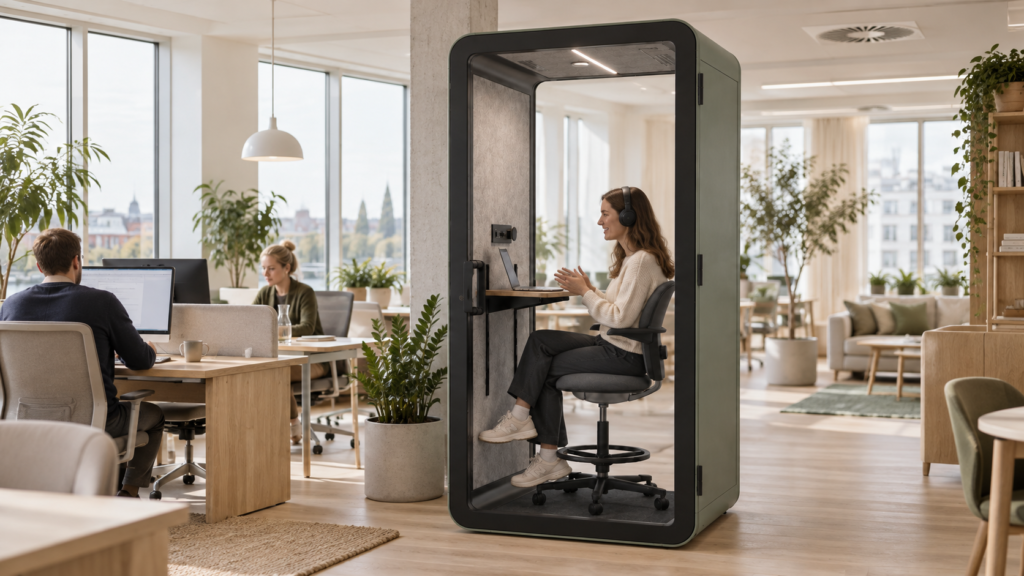
Small enclosed spaces heat up faster than open floors. Each occupant, laptop and display adds heat to a small air volume, and an enclosed room exchanges air with the main floor more slowly than an open desk area. A meeting room or phone booth can be comfortable at 10 am and stuffy by the end of a long call.
If complaints come from enclosed rooms, check three things:
- The room or pod has its own mechanical ventilation, and the fan is running whenever it is occupied.
- The surrounding office is within the recommended temperature range. A ventilated room draws in air from the office around it, so it cannot be cooler than that air.
- The occupancy matches the room size, and long meetings are not being held in spaces meant for short calls.
For freestanding kantoorpods from B&H Ergonomics, the fan airflow is the same across the Elite Series, Flex Series and Oasis Series for each size: 102 CFM for S, 108 CFM for M, 216 CFM for L1, 324 CFM for L2 and 432 CFM for XL. B&H lists an air exchange of about once every 90 seconds, which works out to roughly 40 air changes per hour. Because the pod uses air from the surrounding office, keeping the main floor inside 68–76°F matters as much as the pod’s own airflow. For a model-by-model look at airflow paths and HVAC planning, see this guide to meeting pod ventilation and CFM.
When temperature complaints signal an air quality issue
Some “temperature” complaints are really air quality complaints. People describe a stuffy room as too warm, and dry winter air as uncomfortable even when the temperature is fine. Look beyond the thermostat when complaints include headaches, drowsiness, odors or dry eyes, when a room feels stuffy even at a normal temperature reading, or when humidity readings fall outside 20–60%.
Those signs point to ventilation rates, outdoor air supply or contaminant sources rather than the setpoint. The next step is a structured assessment; this guide to testen van de luchtkwaliteit op kantoor explains how to prepare, what to ask a consultant and how to read the results.
FAQ
Wat is de wettelijke minimumtemperatuur voor een kantoor in de VS?
There is no federal minimum office temperature. OSHA recommends 68–76°F as guidance and treats office temperature as a comfort issue rather than an enforceable standard. Check your state’s rules, since some states regulate workplace temperature more directly than federal OSHA does.
Wat is de beste kantoortemperatuur voor productiviteit?
Gebruik de instelling die binnen 68–76 °F in uw eigen ruimte de minste klachten oplevert. Begin rond 71–73 °F en pas deze vervolgens aan op basis van uw klachtenregistratie. Kleding, activiteit, blootstelling aan zonlicht en luchtcirculatie bepalen de juiste instelling sterker dan welk universeel getal dan ook.
Waarom hebben sommige werknemers het koud terwijl anderen het warm hebben bij dezelfde instelling?
Kleding, activiteitsniveau, stofwisseling en de plek waar mensen zitten, beïnvloeden allemaal hoe een bepaalde luchttemperatuur aanvoelt. Tocht van luchtroosters, koude wanden en zonlicht door ramen kunnen ervoor zorgen dat twee bureaus met dezelfde thermostaatinstelling heel verschillend aanvoelen. Registreer en meet bij elke zitplaats voordat u de ingestelde temperatuur wijzigt.