Não existe regulamentação federal que estabeleça uma temperatura obrigatória para escritórios nos Estados Unidos. As orientações publicadas pela OSHA recomendam manter a temperatura do escritório entre 68°F e 76°F (20–24°C) e a humidade relativa entre 20% e 60%, de acordo com a agência carta de interpretação de 2003 sobre a temperatura e a humidade nos escritórios. Para a maioria dos escritórios, um ponto de ajuste próximo do centro desse intervalo, entre 71–73°F (22–23°C), é um ponto de partida sensato. Ajuste-o em função da estação do ano, do que as pessoas realmente vestem e do que o registo de reclamações indica, e não em função de quem fala mais alto junto ao termóstato.
O intervalo é a parte fácil. A maior parte do trabalho consiste em lidar com as reclamações: uma pessoa sente frio sob um difusor de insuflação, enquanto outra sente calor junto a uma janela exposta ao sol, e ambas têm razão relativamente ao seu próprio local. O restante deste guia aborda o que a OSHA exige e não exige, como escolher um ponto de ajuste, um processo de gestão de reclamações que pode executar com um termómetro e uma folha de cálculo, e porque é que as salas pequenas e fechadas necessitam das suas próprias verificações.
Última atualização: 10 de outubro de 2026 | Autor: Richard | Tempo estimado de leitura: 8 minutos

O que a OSHA realmente exige relativamente à temperatura nos escritórios
A OSHA não tem nenhuma norma que aborde especificamente a temperatura ou a humidade nos escritórios. A carta de 2003 afirma-o diretamente e considera a temperatura e a humidade nos escritórios como questões de conforto. O intervalo de 68–76°F resulta do Manual Técnico da OSHA e é uma recomendação, não um limite aplicável por lei.
A mesma carta explica porque é que o desconforto, por si só, não desencadeia medidas de fiscalização. A OSHA só pode recorrer à Cláusula de Dever Geral quando um risco reconhecido é suscetível de causar morte ou lesões físicas graves e existe uma forma viável de o corrigir. Um escritório que pareça demasiado frio ou demasiado quente geralmente não cumpre esse critério, pelo que a agência não sanciona empregadores por desconforto pessoal.
Isso não torna a temperatura uma questão exclusiva dos RH. As FAQ sobre qualidade do ar interior da OSHA incluem temperatura e humidade confortáveis como parte de uma boa qualidade do ar interior, e reclamações persistentes podem ser um sinal precoce de um problema de ventilação ou HVAC. Alguns estados também têm as suas próprias regras sobre calor ou conforto no local de trabalho, por isso verifique o plano do seu estado antes de considerar a posição federal como a resposta completa.
Temperatura ideal vs. ótima no escritório
As pessoas procuram uma temperatura de escritório “ideal” ou “ótima” como se existisse um único valor. Não existe, porque o conforto depende de mais do que a temperatura do ar indicada no termóstato.
Norma ASHRAE 55, a norma de conforto térmico também indicada pela carta da OSHA, identifica seis fatores: temperatura do ar, radiação térmica, humidade e velocidade do ar no espaço, além do nível de atividade e do vestuário de cada pessoa. Define condições que a maioria dos ocupantes deverá considerar aceitáveis, não condições de que todos irão gostar. A atual edição de 2023 também avalia a diferença vertical de temperatura entre a altura da cabeça e dos tornozelos, razão pela qual uma sala pode indicar 72°F no termóstato e, ainda assim, deixar as pessoas com os pés frios.
Na prática, estes fatores traduzem-se em algumas decisões:
| Fator | O que altera o ponto de ajuste | Escolha prática |
|---|---|---|
| Vestuário | Fatos e casacos no inverno, roupa mais leve no verão | Run slightly cooler in winter and slightly warmer in summer, within 68–76°F |
| Atividade | Seated desk work vs walking between rooms | Desk-heavy zones usually need the warmer side of the band |
| Radiant heat | Sun through glass, cold exterior walls | Fix with blinds or seat moves before changing the whole-floor setpoint |
| Air speed | Seats under or near supply diffusers | Redirect or rebalance the diffuser; a lower setpoint will not fix a draft |
| Humidity | Dry winter air, humid summer air | Keep it within OSHA’s 20–60% range; measure before assuming |
The optimal office temperature is the setpoint that produces the fewest complaints in your space with your occupants, inside the recommended band. You find it by measuring and adjusting, not by picking a number from a headline.
How to handle hot and cold complaints
Treat temperature complaints as data. A consistent process stops the thermostat war, shows facilities where the real problem is, and gives employees a clear answer instead of a shrug.
Step 1: Log every complaint the same way
Ask for the same details each time so patterns show up. A shared form or spreadsheet is enough.
| Campo | Example entry |
|---|---|
| Date and time | Oct 6, 2:30 pm |
| Localização | 3rd floor, desk 3-14, west windows |
| Reclamação | Too warm |
| Measured temperature | 77°F (25°C) |
| Measured humidity | 38% RH |
| Notas | Direct afternoon sun, blinds open |
Step 2: Measure at the person, not the thermostat
Thermostats are often mounted on interior walls far from the problem seat. Take readings at desk height where the person sits, and at ankle height if they mention cold feet. An inexpensive digital thermometer-hygrometer is enough to tell a real deviation from a preference.
Step 3: Look for the pattern before changing anything
After one or two weeks of logs, sort by location and time. Complaints tend to cluster in a few recognizable ways:
- Same seats, every afternoon: solar gain on one side of the building.
- Same seats, all day: a diffuser blowing directly on people, or a zone that is out of balance.
- Whole floor in the morning: the HVAC schedule starts too late after a night or weekend setback.
- Meeting rooms and small enclosed rooms late in the day: heat from people and equipment building up faster than the room’s airflow removes it.
Step 4: Fix the cheapest cause first
Start with changes that cost little and do not shift the problem onto someone else. Close blinds, redirect or rebalance diffusers, move a desk out of a draft, and correct the HVAC start time. Ask facilities to check thermostat calibration and zoning. Allow layers, desk fans and dress code flexibility for individual differences, since a setpoint that suits the majority will still leave some people outside their comfort zone.
Change the whole-floor setpoint only when the logs show most complaints going the same direction. Move it by one degree at a time and give it a week before judging the result.
Step 5: Close the loop with the person who complained
Tell people what you measured, what you changed and when you will check again. People who feel ignored tend to keep adjusting the thermostat themselves. A measured response with a follow-up date gives them a reason to wait for the fix.
Small rooms and office pods run warmer
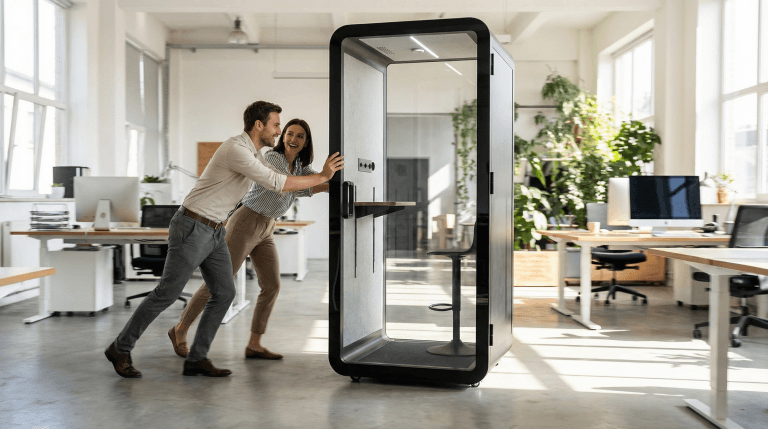
Small enclosed spaces heat up faster than open floors. Each occupant, laptop and display adds heat to a small air volume, and an enclosed room exchanges air with the main floor more slowly than an open desk area. A meeting room or phone booth can be comfortable at 10 am and stuffy by the end of a long call.
If complaints come from enclosed rooms, check three things:
- The room or pod has its own mechanical ventilation, and the fan is running whenever it is occupied.
- The surrounding office is within the recommended temperature range. A ventilated room draws in air from the office around it, so it cannot be cooler than that air.
- The occupancy matches the room size, and long meetings are not being held in spaces meant for short calls.
For freestanding cápsulas de escritório from B&H Ergonomics, the fan airflow is the same across the Elite Series, Flex Series and Oasis Series for each size: 102 CFM for S, 108 CFM for M, 216 CFM for L1, 324 CFM for L2 and 432 CFM for XL. B&H lists an air exchange of about once every 90 seconds, which works out to roughly 40 air changes per hour. Because the pod uses air from the surrounding office, keeping the main floor inside 68–76°F matters as much as the pod’s own airflow. For a model-by-model look at airflow paths and HVAC planning, see this guide to meeting pod ventilation and CFM.
When temperature complaints signal an air quality issue
Some “temperature” complaints are really air quality complaints. People describe a stuffy room as too warm, and dry winter air as uncomfortable even when the temperature is fine. Look beyond the thermostat when complaints include headaches, drowsiness, odors or dry eyes, when a room feels stuffy even at a normal temperature reading, or when humidity readings fall outside 20–60%.
Those signs point to ventilation rates, outdoor air supply or contaminant sources rather than the setpoint. The next step is a structured assessment; this guide to testes de qualidade do ar no escritório explains how to prepare, what to ask a consultant and how to read the results.
FAQ
Qual é a temperatura mínima legal para um escritório nos EUA?
There is no federal minimum office temperature. OSHA recommends 68–76°F as guidance and treats office temperature as a comfort issue rather than an enforceable standard. Check your state’s rules, since some states regulate workplace temperature more directly than federal OSHA does.
Qual é a melhor temperatura no escritório para a produtividade?
Utilize o ponto de ajuste que gerar menos reclamações dentro da faixa de 68–76 °F no seu próprio espaço. Comece em torno de 71–73 °F e, em seguida, ajuste-o com base no seu registo de reclamações. Vestuário, atividade, exposição solar e circulação de ar influenciam a definição adequada mais do que qualquer valor universal.
Por que alguns colaboradores sentem frio enquanto outros sentem calor com a mesma configuração?
A roupa, o nível de atividade, o metabolismo e o local onde as pessoas se sentam alteram a forma como uma determinada temperatura do ar é sentida. As correntes de ar dos difusores, as paredes frias e o sol através das janelas podem fazer com que duas secretárias reguladas pelo mesmo termóstato tenham sensações muito diferentes. Registe e meça em cada posto antes de alterar o ponto de regulação.