Snel antwoord
Geluidsabsorberende gordijnen voor kantoorgebruik kunnen echo en gereflecteerd geluid verminderen. Een zwaar, goed passend gordijn kan ook beperkte demping bieden wanneer een raam de voornaamste route voor geluid van buiten vormt. Het zal gesprekken, laagfrequent geluid van apparatuur of trillingen die via muren en vloeren worden overgedragen niet volledig isoleren. Gebruik gordijnen voor een vastgesteld raam- of nagalmprobleem, niet als primaire oplossing voor spraakprivacy of een rustige focusruimte.
Laatst bijgewerkt: 18 augustus 2026 | Auteur: Richard | Geschatte leestijd: 8 minuten
Wat geluidsabsorberende gordijnen daadwerkelijk doen
Geluidsabsorberende gordijnen voegen zacht, poreus oppervlak toe aan een ruimte. Hun belangrijkste functie is absorptie: het verminderen van een deel van de geluidsenergie die anders door glas, muren of andere harde oppervlakken zou worden gereflecteerd. Daardoor kunnen spraak en activiteiten minder scherp klinken en blijft geluid minder lang hangen.
Absorptie is niet hetzelfde als isolatie. Isolatie beperkt de geluidsoverdracht van de ene ruimte naar de andere en is afhankelijk van de volledige overdrachtsroute, waaronder muren, beglazing, deuren, plafonds, vloeren, afdichtingen en kieren. Een gordijn dat in een ruimte hangt, maakt van die ruimte geen afgesloten akoestische ruimte.
B&H Ergonomics verkoopt geen geluidsabsorberende gordijnen. De praktische waarde van deze gids is het afbakenen van waar deze categorie een redelijke akoestische laag vormt en waar een afgesloten werkruimte een geschiktere privacykeuze is.
ASTM C423 meet geluidsabsorptie en geluidsabsorptiecoëfficiënten in een nagalmkamer. Een C423-resultaat kan helpen vergelijken hoe geteste materialen geluid absorberen, maar het zegt niets over isolatie tussen ruimtes of spraakprivacy op kantoor.
Kan een gordijn geluid door een raam verminderen?
Dat kan alleen helpen wanneer het raam een belangrijke overdrachtsroute vormt en het gordijn zwaar en ruim bemeten is en een groot deel van het raam goed bedekt. Zelfs dan hangt het resultaat af van de beglazing, het kozijn, de afdichtingen, de wandconstructie, de gordijnconstructie en kieren langs de randen. Beschouw het gordijn als een aanvullende laag, niet als vervanging voor het herstellen van een lekkend kozijn of het verbeteren van de raamconstructie.
Breng het geluidsprobleem in kaart voordat u een gordijn kiest
Begin met de klacht en bepaal vervolgens waar het geluid vandaan komt en hoe het de luisteraar bereikt. De uitspraak “het kantoor is lawaaierig” is niet specifiek genoeg om een akoestisch product te selecteren.
Voer deze controles uit voordat u gordijnstalen of offertes aanvraagt:
- Leg vast wanneer en waar het probleem optreedt.
- Bepaal of de bron zich buiten het raam, in dezelfde ruimte, in een aangrenzende ruimte of bij gebouwinstallaties bevindt.
- Vergelijk het geluid bij het raam, de deur, de muur, het plafond en de vloer in plaats van ervan uit te gaan dat het raam de oorzaak is.
- Bepaal of het gewenste resultaat minder echo, minder afleiding, minder geluidsoverdracht of vertrouwelijke gesprekken is.
- Leg aanhoudend gebrom, trillingen of geluidsoverdracht via meerdere routes vóór de aanschaf van textiele akoestische behandeling voor aan de verhuurder, het facilitaire team, een HVAC-specialist of een akoestisch adviseur.
| Wat medewerkers opmerken | Waarschijnlijk probleem dat nader moet worden onderzocht | Pasvorm van het gordijn | Betere eerste aanpak |
|---|---|---|---|
| Spraak klinkt scherp of blijft nagalmen in een ruimte met veel glas | Reflecties en nagalm | Goed | Gordijnen, wand- of plafondabsorbers en aanpassingen van de indeling |
| Verkeer of activiteiten buiten zijn het sterkst bij één raam | Transmissie via het raam, het kozijn of de gebouwschil | Beperkt | Controleer eerst de afdichtingen en beglazing; voeg een getest gordijn toe als secundaire laag |
| Collega's in dezelfde open ruimte kunnen elk woord verstaan | Directe spraakroute en gebrek aan afscheiding | Slecht | Zonering, geluidsmaskering of een afgesloten werkruimte |
| Apparatuur veroorzaakt in de hele ruimte een laag dreunend geluid | Geluid van installaties of gebouwgebonden voorzieningen | Slecht | Onderzoek door facility management of HVAC-onderzoek en aanpak van de bron |
| Geluid of trillingen lijken zich door wanden, vloeren of plafonds te verplaatsen | Contactgeluid of flankerende transmissie | Slecht | Diagnose en behandeling op gebouwniveau van de daadwerkelijke overdrachtsroute |
| Een vertrouwelijk gesprek kan buiten de ruimte worden verstaan | Onvoldoende spraakisolatie | Slecht | Een correct ontworpen afgesloten ruimte of geteste akoestische omkasting |
De matrix is een screeningsinstrument, geen akoestische test. Als de bron of het overdrachtspad onduidelijk blijft, levert een diagnose meer op dan het toevoegen van nog een oppervlaktebehandeling.
Waar akoestische gordijnen kunnen helpen op kantoor
Akoestische gordijnen zijn een redelijke optie wanneer het vereiste resultaat overeenkomt met wat absorptie kan bieden.
Het verminderen van reflecties bij glas en harde afwerkingen
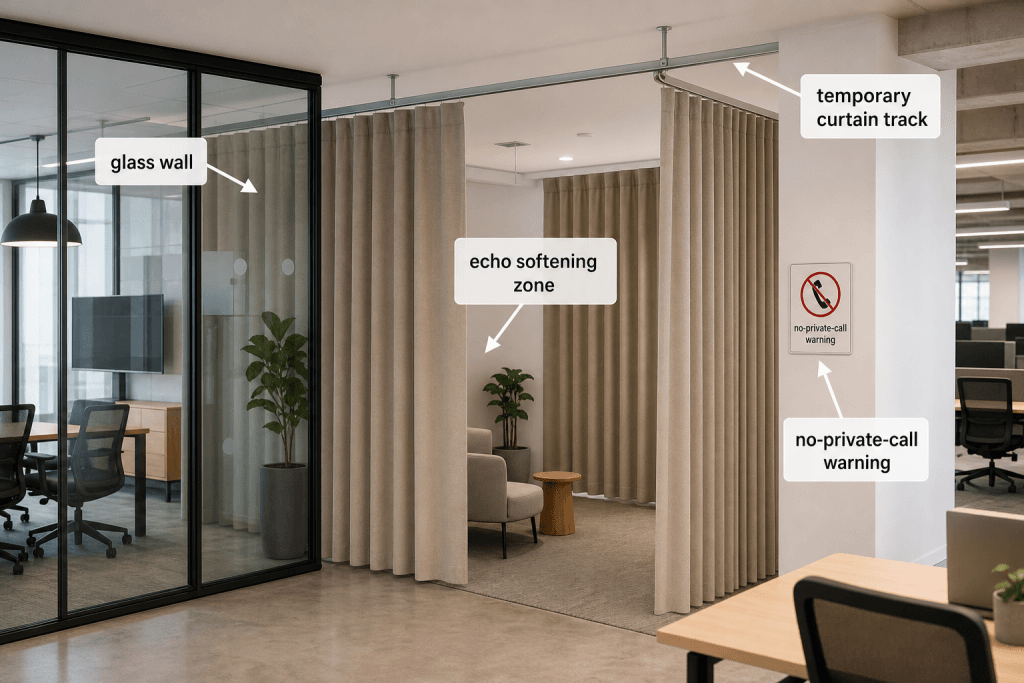
Een gordijn kan nuttige absorptie toevoegen aan vergaderruimten, lounges, receptieruimten of samenwerkingszones die grotendeels uit glas en andere reflecterende afwerkingen bestaan. Het kan een tijdelijke zone ook akoestisch minder blootgesteld laten aanvoelen zonder een nieuwe wand te bouwen.
Een behandeling van raamlawaai ondersteunen
Wanneer luistercontroles aantonen dat geluid van buiten voornamelijk door één raam binnenkomt, kan een zwaar gordijn met brede zijbedekking, overlap aan de bovenkant en zo min mogelijk open randen een beperkte extra vermindering bieden. Het raam en het kozijn bepalen nog steeds een groot deel van het resultaat. Repareer duidelijke kieren voordat u in het gordijn investeert.
Een omkeerbare indeling creëren
Gordijnen kunnen visuele afscheiding en een flexibele ruimte-indeling bieden in gehuurde of regelmatig heringerichte kantoren. Visuele afscheiding kan onderbrekingen verminderen, maar mag tegenover medewerkers niet worden omschreven als akoestische privacy.
Aanvullen in plaats van vervangen van andere behandelingen
Gordijnen kunnen samenwerken met plafondabsorbers, wandpanelen, indelingswijzigingen en geluidsmaskering. Elk element heeft een andere functie, dus de specificatie moet aangeven of het bedoeld is om reflecties te beheersen, achtergrondspraak te maskeren of geluidsoverdracht te verminderen.
Waar gordijnen niet de juiste primaire oplossing zijn
Specificeer gordijnen niet als belangrijkste oplossing wanneer het gewenste resultaat afhankelijk is van isolatie, vertrouwelijkheid of beheersing van een mechanische bron.
Gordijnen zijn als primaire oplossing ongeschikt voor:
- het voorkomen dat vertrouwelijke gesprekken naar aangrenzende werkgebieden lekken;
- het privé maken van vergaderingen van HR, juridische zaken, financiën of het management;
- het creëren van een onafhankelijke focusruimte binnen een open kantoor met veel lawaai;
- het beheersen van laagfrequent gerommel van HVAC-installaties, generatoren, liften, compressoren of andere apparatuur;
- het behandelen van trillingen die via een wand, vloer, plafond of draagconstructie van het gebouw worden overgedragen;
- het corrigeren van geluid dat via deuren, plafondholtes, doorvoeren voor installaties of meerdere flankerende overdrachtspaden reist.
Deze problemen vereisen een andere ingreep: bronaanpak, werkzaamheden aan het gebouw of de HVAC-installatie, verbeterde constructie en afdichting, professioneel ontworpen sound masking of een omkasting die is geselecteerd voor de daadwerkelijke privacytaak.
Wat huurders vóór de installatie moeten controleren
Een verwijderbaar product kan nog steeds afwerkingen beschadigen of in strijd zijn met vereisten uit de huurovereenkomst en van de facilitaire dienst. Vraag schriftelijke toestemming van de verhuurder of facilitaire dienst voordat u in een plafond, wand, stijl of kozijn rond een raam boort. Ga er niet van uit dat een spanstang, zelfklevende montage, hangrail of bestaand raster een zwaar akoestisch gordijn veilig kan dragen.
Documenteer vóór goedkeuring:
- de rail, beugels, bevestigingsmiddelen en het dragende oppervlak;
- het totale gewicht van de rail en het gordijn;
- de voorgestelde bevestigingspunten en verwijderingsmethode;
- de vrije ruimte ten opzichte van deuren, uitgangen, sprinklers, detectoren, luchtroosters, verlichting en bedieningselementen;
- de door het gebouw- of facilitair team vereiste informatie van de leverancier over brandprestaties;
- de verantwoordelijkheid voor reparaties en herstel in de oorspronkelijke staat aan het einde van de huurovereenkomst.
Als geen toestemming beschikbaar is, overweeg dan vrijstaande absorbers of een omkasting die volgens een goedgekeurd plan kan worden geïnstalleerd en verwijderd. “Geen grote bouwwerkzaamheden” mag niet worden geïnterpreteerd als “geen beoordeling van de installatie”.”
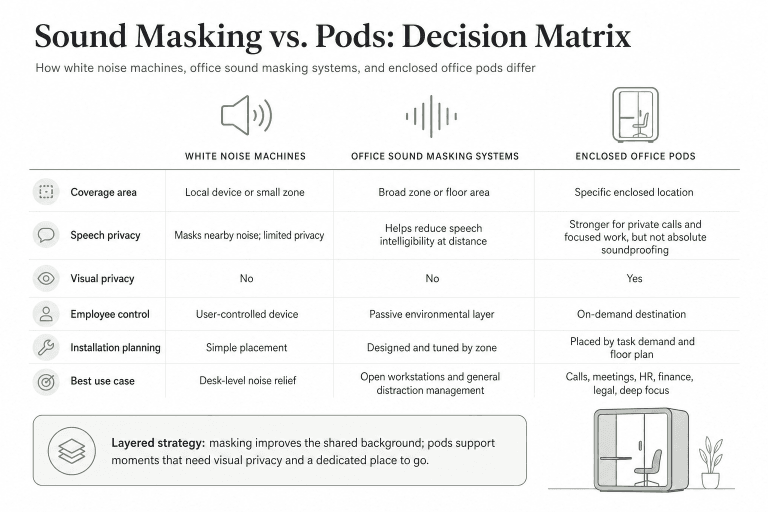
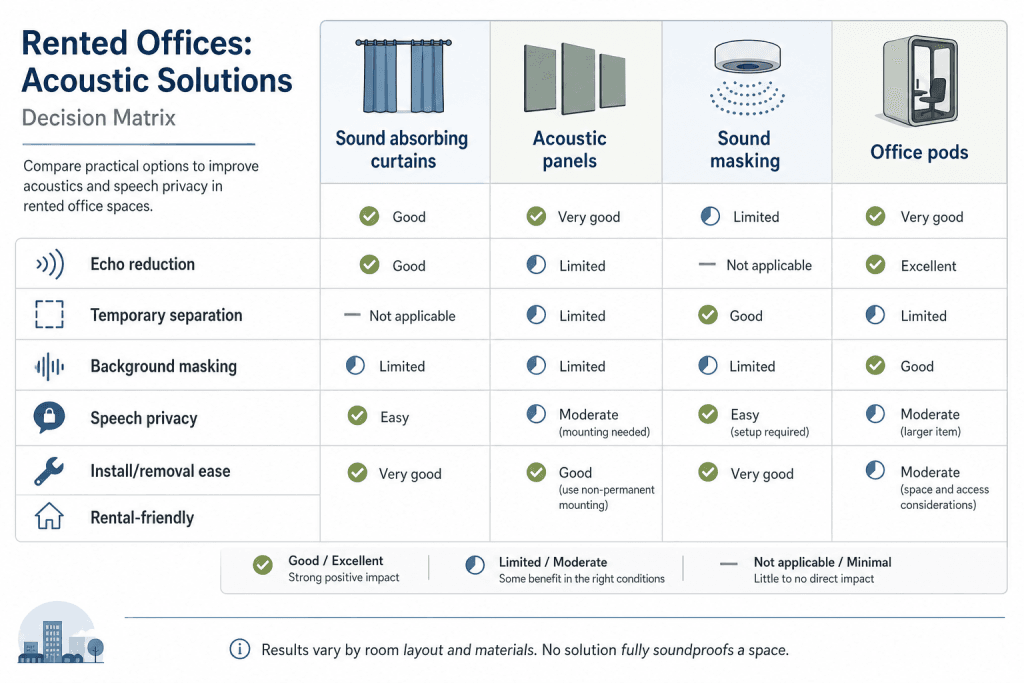
Gordijnen versus panelen, sound masking en kantoorpods
| Optie | Primaire functie | Beste gebruik | Belangrijkste beperking |
|---|---|---|---|
| Geluidsabsorberende gordijnen | Absorberen reflecties; voegen soms een beperkte laag toe bij een raam | Ruimten met veel glas, tijdelijke zonering, omkeerbare akoestische verzachting | Kieren en het ontbreken van een omkasting beperken de geluidsisolatie |
| Akoestische wand- of plafondpanelen | Voegen vaste absorptie toe op geselecteerde oppervlakken | Beheersing van nagalm waar permanente montage acceptabel is | Bieden op zichzelf geen spraakprivacy |
| Geluid maskeren | Voegt een gecontroleerd achtergrondgeluid toe om de verstaanbaarheid en afleiding door spraak te verminderen | Open kantoren met een professioneel ontworpen soundmaskingsysteem | Absorbeert of blokkeert het oorspronkelijke geluid niet |
| Behandeling van gebouw of HVAC-systeem | Pakt een bron of overdrachtsroute aan | Mechanisch gebrom, trillingen, lekkende ramen, deuren, wanden of plafonds | Vereist diagnose en kan de verhuurder of gespecialiseerde vakmensen erbij betrekken |
| Kantoorpod of afgesloten ruimte | Creëert een afgebakende ruimte voor gesprekken, vergaderingen of geconcentreerd werk | Spraakprivacy, vertrouwelijke activiteiten en afscheiding van een actief open kantoor | De prestaties zijn afhankelijk van de volledige omhulling, installatie, ventilatie en testmethode |
Vraag elke leverancier de geteste functie te benoemen. Absorptiegegevens, gegevens over geluidsoverdracht, prestaties van soundmasking en gegevens over spraakreductie van omhullingen beantwoorden verschillende vragen en mogen niet als onderling uitwisselbaar worden beschouwd.
Wanneer een kantoorpod de betere volgende stap is
Stap over van gordijnen naar een afgesloten oplossing wanneer de zakelijke vereiste is om te voorkomen dat spraak zich verspreidt, vertrouwelijke vergaderingen te houden of een speciale concentratieruimte te creëren binnen een lawaaiige open omgeving. Dit zijn taken voor een omhulling, geen taken voor stoffen behandeling.
Voor inkopers die beoordelen kantoorpods, vraag om bewijs dat aansluit bij het beoogde gebruik. ISO 23351-1 definieert een laboratoriummethode voor het meten van spraakniveauvermindering door meubelopstellingen en omhullingen. Deze methode is relevanter voor spraakreductie op het niveau van de omhulling dan een resultaat voor materiaalabsorptie, hoewel de werkelijke prestaties op de werkplek nog steeds afhangen van de productconfiguratie, installatie, omringende ruimte en meetomstandigheden.
B&H Ergonomics adviseert de taak te definiëren voordat modellen worden vergeleken: gesprekken met één persoon, geconcentreerd individueel werk, kleine vertrouwelijke besprekingen of grotere vergaderingen. De juiste volgende stap is om de grootte van de omhulling, toegankelijkheid, ventilatie, stroomvoorziening, plaatsing en akoestisch bewijs te beoordelen in relatie tot die taak.
FAQ
Houden geluidsabsorberende gordijnen verkeerslawaai van buiten tegen?
Ze kunnen de geluidsoverdracht in beperkte mate verder verminderen wanneer het raam de dominante overdrachtsweg vormt en het gordijn voldoende massa, dekking, overlap en een juiste installatie heeft. Ze verhelpen geen slecht afgedicht kozijn en houden geen geluid tegen dat via muren, ventilatieopeningen, deuren of andere wegen binnenkomt. Stel eerst een diagnose van de raamconstructie.
Kunnen akoestische gordijnen zonder boren worden geïnstalleerd in een gehuurd kantoor?
Soms, maar de bevestigingsmethode moet de volledige belasting veilig kunnen dragen en voldoen aan de vereisten van de huurovereenkomst en de locatie. Vraag vóór installatie goedkeuring aan, ook voor producten die als verwijderbaar of niet-beschadigend worden aangeprezen.
Welke testgegevens moet een inkoper van kantoorinrichting opvragen?
Voor echobeheersing vraagt u om frequentiespecifieke geluidsabsorptiegegevens en de exacte geteste montageconfiguratie; ASTM C423-gegevens kunnen relevant zijn. Voor vermindering van geluid van buitenaf via ramen of voor spraakprivacy zijn absorptiegegevens alleen onvoldoende. Vraag om bewijs voor de volledige samenstelling of omkasting en bevestig dat de testmethode het resultaat meet dat het kantoor daadwerkelijk nodig heeft.