Szybka odpowiedź
“Dźwiękoszczelny boks” zwykle oznacza akustyczne stanowisko pracy z wyższymi panelami, powierzchniami pochłaniającymi dźwięk i osłonami wizualnymi. Może ograniczać odbicia dźwięku i rozpraszające bodźce z otoczenia, ale otwarty lub częściowo otwarty boks nie zapewnia takiego samego poziomu prywatności rozmów jak zamknięte pomieszczenie. Wybierz rozwiązanie w formie boksu, gdy chcesz poprawić ogólne warunki na stanowisku pracy. Wybierz zamkniętą kabinę biurową, gdy pracownicy potrzebują wydzielonego miejsca do prowadzenia prywatnych rozmów telefonicznych, wideokonferencji, poufnych rozmów lub pracy wymagającej koncentracji.
Ostatnia aktualizacja: 24 sierpnia 2026 | Autor: Richard | Szacowany czas czytania: 10 minut

Co zwykle oznacza “dźwiękoszczelny boks”?
W rozmowach zakupowych dotyczących miejsca pracy określenie “dźwiękoszczelny boks” jest często używane jako wyszukiwane hasło dotyczące boksu akustycznego, a nie szczelnej, przypominającej pomieszczenie zabudowy. Produkt może mieć biurko, panele boczne, wysoki panel tylny, element sufitowy lub połączenie materiałów pochłaniających dźwięk. Jego zadaniem jest zapewnienie na stanowisku pracy większego poczucia osłonięcia oraz ograniczenie ilości dźwięku odbijającego się w bezpośrednim obszarze pracy.
To przydatne, ale spełnia inną funkcję niż izolowanie rozmowy. Jeśli boks ma otwartą górę, otwarte boki lub szczeliny wokół użytkownika, dźwięk nadal może rozchodzić się po biurze. Boks może sprawić, że rozmowa będzie mniej słyszalna przy biurku, nie zapewniając jednak prywatności rozmowy względem osoby znajdującej się kilka stóp dalej.
Praktyczne pytanie nie brzmi więc, czy produkt zawiera słowo “dźwiękoszczelny”. Pytanie brzmi, czy Twój projekt wymaga spokojniejszego stanowiska pracy, osłoniętego stanowiska pracy czy zamkniętego miejsca, w którym osoba może wykonać zadanie z większą prywatnością rozmów.
Pochłanianie dźwięku, osłonięcie, prywatność rozmów i izolacja to różne pojęcia
Te cztery terminy opisują różne mechanizmy akustyczne:
| Termin | Co zmienia | Czego nie gwarantuje |
|---|---|---|
| Pochłanianie dźwięku | Zmniejsza energię dźwięku odbitego w przestrzeni dzięki zastosowaniu powierzchni pochłaniających dźwięk | Nie zatrzymuje dźwięku rozchodzącego się wokół otwartego stanowiska pracy |
| Osłonięcie lub przegrody | Przerywa bezpośrednie linie widzenia i niektóre bezpośrednie drogi rozchodzenia się dźwięku między sąsiednimi biurkami | Nie tworzy szczelnego pomieszczenia ani nie eliminuje całej mowy z tła |
| Prywatność mowy | Utrudnia zrozumienie rozmowy w miejscu, w którym znajduje się słuchacz | Samo w sobie nie zapewnia poufności |
| Izolacja akustyczna | Ogranicza przenoszenie dźwięku między oddzielonymi przestrzeniami lub elementami konstrukcyjnymi | Wynik uzyskany jedną metodą badawczą nie pozwala automatycznie przewidzieć parametrów w każdych warunkach instalacji |
Biura typu open space zwykle wymagają połączenia pochłaniania dźwięku, odpowiedniego układu przestrzeni, blokowania i maskowania dźwięku. Badanie przeprowadzone w 21 biurach typu open space wykazało, że zakłócenia związane z mową oraz odległość między osobami miały istotne znaczenie dla postrzeganego komfortu akustycznego; wyniki podsumowano w rekordzie PubMed dotyczącym badania. That evidence supports a layered approach, not the assumption that one panel or one cubicle can solve every noise problem.
Soundproof Cubicle vs Office Pod: Decision Matrix
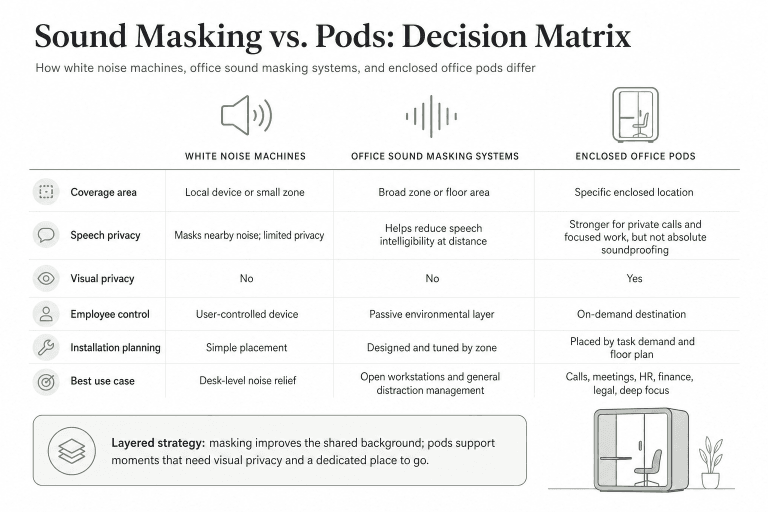
Use the matrix below to match the enclosure level to the work your team needs to complete.
| Czynnik decydujący | Acoustic cubicle or screened workstation | Enclosed office pod |
|---|---|---|
| Główny cel | Improve local comfort, visual separation, and workstation focus | Provide a separate place for focused or private work |
| Prywatność mowy | Limited to moderate; depends on height, layout, background noise, and distance | More predictable because the user is inside a defined enclosure |
| Prywatność wizualna | Partial or directional | High, subject to glazing and door configuration |
| Calls and video meetings | Suitable for routine calls when some sound leakage is acceptable | Better for frequent calls, hybrid meetings, and conversations that should not carry across the floor |
| Open-office coverage | Can improve many desks at once | Serves fewer users at a time but gives stronger task-specific privacy |
| Wpływ na montaż | Usually fits within workstation planning | Requires a footprint, access route, power planning, and an enclosure location |
| Best value signal | The problem is broad distraction or visual exposure | The problem is repeated privacy failure or lack of small rooms |
Choose the enclosure level according to the consequence of the problem. A cubicle-style intervention may be enough when employees can complete their work after nearby distraction is reduced. If people leave the floor to take calls or postpone sensitive conversations, an enclosed space addresses a different need. For a workstation replacement project, compare cubicle partitions with office pods against the privacy task, layout flexibility, and purchasing scope rather than assuming the two are interchangeable.
When a Cubicle-Style Acoustic Workstation Is Enough
A cubicle-style solution is a reasonable starting point when most of the following are true:
- Employees mainly need visual separation and fewer nearby reflections.
- Conversations do not need to be confidential.
- Routine calls can happen at the desk without disrupting the whole floor.
- The office has a reasonable ceiling, wall, and floor acoustic strategy.
- You want to improve many workstations without adding enclosed rooms.
- The team accepts that some speech and activity will remain audible.
In this situation, review panel height, material absorption, desk orientation, aisle traffic, and the position of noisy equipment together. A higher panel placed beside a printer or a busy walkway may help less than a lower-cost layout change that moves the traffic path away from focused workstations.
Do not use the word “soundproof” as the acceptance test for this type of project. Ask what level of distraction reduction is required, where conversations are allowed to remain audible, and whether the result will be evaluated at the workstation or across the wider office.
When an Enclosed Office Pod Is the Better Fit
An enclosed pod is usually the stronger option when the task itself requires separation. Typical examples include:
- confidential client, HR, finance, or manager conversations;
- recurring video meetings in an open-plan office;
- concentrated work that cannot be interrupted by nearby speech;
- one-to-one conversations that should not be intelligible across the floor;
- teams that need a bookable privacy resource rather than a quieter desk for everyone.
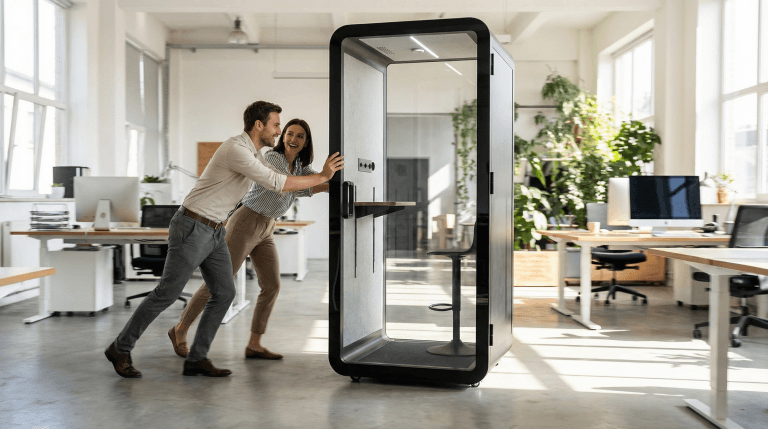
For these use cases, the next step is to compare enclosure type, capacity, ventilation, power, door clearance, user circulation, and the acoustic evidence for the complete product. B&H Ergonomics’ kapsuły biurowe collection is the appropriate place to review enclosed pod configurations after you have defined the task and site constraints.
An office pod still needs sensible placement. Put it away from the loudest circulation path when possible, confirm that the door can operate without blocking an aisle, and check that users can reach power and ventilation controls without improvised extensions or furniture changes. An enclosure improves separation; it does not correct a poor site plan.
How to Read ISO 23351-1 Evidence
When a vendor presents an acoustic number, first identify the test method and the object that was tested. ISO 23351-1 addresses the speech level reduction of furniture ensembles and enclosures. It is useful for comparing a complete enclosure tested under the stated method, but it should not be treated as an STC, NIC, or NRC rating.
Read an acoustic result in this order:
- Identify the metric. Confirm whether the number is speech level reduction, sound level difference, sound insulation, or sound absorption.
- Identify the tested configuration. Check the model, doors, glazing, ceiling, ventilation, power modules, and other components included in the test.
- Check the test conditions. Ask whether the result came from a laboratory or controlled factory setup, and whether the installed project will use the same configuration.
- Keep the use case in view. A measured reduction can support better speech privacy without promising that every word will be inaudible outside the enclosure.
Acoustic results vary with test method, installation, room geometry, background noise, door use, ventilation openings, and measurement setup. A responsible comparison keeps those conditions next to the number instead of presenting a single decibel figure as a universal guarantee.
B&H Elite-S: A Model-Specific Reference
For buyers comparing complete one-person enclosures, B&H Ergonomics can provide Elite-S as a model-specific reference. Elite-S achieved ISO 23351-1 Class A acoustic performance with a 33 dB speech level reduction for the tested configuration.
The 33 dB figure is an ISO speech level reduction result. It is not an STC rating, an NRC value, or a promise of complete sound isolation in every office. Before using the result in a specification, request the applicable report or technical documentation and confirm that the proposed doors, ventilation, glazing, and other options match the tested configuration.
Elite-S is therefore most useful as evidence to review during procurement, not as a shortcut around site planning. Buyers should still confirm the intended task, user count, available floor area, power location, delivery route, assembly scope, and the level of speech privacy the workplace actually needs.
Buyer Checklist Before Comparing Quotes
Use this checklist to make quotes comparable:
- Define the task: routine desk work, focused work, phone calls, video meetings, or sensitive conversations.
- Record the required capacity and whether the space is assigned, bookable, or shared.
- Measure the available footprint, ceiling height, door swing, aisle clearance, and delivery route.
- Confirm power, data, lighting, ventilation, and any building services required at the location.
- Ask for the acoustic metric, test method, tested configuration, and test conditions.
- Separate product performance from the acoustic performance of the surrounding room.
- Confirm what installation includes, including unloading, assembly, leveling, and commissioning.
- Decide what success means: fewer distractions, less intelligible speech, more usable call space, or a combination.
- Keep a written record of options that differ from the tested configuration.
The more privacy-sensitive the task, the less useful a quote is when it lists only a decibel number and a product photo. A useful proposal connects the evidence to the actual configuration and the workplace task.
Final Decision
A soundproof cubicle is often an acoustic workstation with useful screening and absorption, not a private room. It is a practical tool for improving the background environment across an open office. An enclosed office pod is the better fit when the business problem is task-specific privacy: a call that cannot spill into the floor, a meeting that needs separation, or focused work that repeatedly fails at the desk.
Define the task first, then compare the enclosure, evidence, site requirements, and installation scope. That approach produces a more defensible buying decision than choosing the largest soundproof claim on a product page.
FAQ
Czy dźwiękoszczelna kabina jest naprawdę dźwiękoszczelna?
Zazwyczaj nie. To określenie często opisuje kabinę akustyczną lub stanowisko pracy z przegrodami. Może ograniczać odbicia dźwięku i ekspozycję wizualną, ale otwarte lub częściowo otwarte stanowisko pracy nadal pozwala dźwiękowi rozchodzić się po biurze.
Czy przegrody akustyczne w boksach biurowych wystarczą do prowadzenia poufnych rozmów telefonicznych?
Niekoniecznie. Przegrody mogą ograniczać bezpośrednie drogi rozchodzenia się dźwięku i sprawiać, że stanowisko pracy wydaje się bardziej osłonięte, jednak poufne rozmowy wymagają poziomu prywatności mowy zależnego od zabudowy, otaczającego pomieszczenia, hałasu tła oraz odległości od słuchaczy. Gdy zrozumiałość rozmowy poza daną przestrzenią ma istotne znaczenie, należy zastosować zamkniętą kabinę.
Czy ISO 23351-1 jest tym samym co STC lub NRC?
Nie. Redukcja poziomu mowy wg ISO 23351-1, izolacyjność akustyczna STC oraz pochłanianie dźwięku NRC opisują różne pomiary i nie powinny być stosowane zamiennie. Przed porównaniem wyników poproś dostawcę o wskazanie miernika oraz testowanej konfiguracji.
Czy wyższy wynik w decybelach gwarantuje prywatność w moim biurze?
Nie. Wynik dotyczy określonej metody badawczej i konfiguracji. Sposób montażu, geometria pomieszczenia, wentylacja, działanie drzwi, hałas tła i aktywność w pobliżu mogą wpływać na to, co użytkownicy słyszą w miejscu instalacji.
Od czego powinienem zacząć: wytłumienia boksu biurowego czy kabiny biurowej?
Zacznij od konsekwencji, którą chcesz zmienić. Wybierz rozwiązania tłumiące dźwięk w boksach biurowych, gdy celem jest poprawa ogólnych warunków pracy przy stanowisku. Wybierz zamknięty moduł biurowy, gdy zespół potrzebuje wydzielonego miejsca do prowadzenia prywatnych rozmów telefonicznych, pracy wymagającej skupienia lub rozmów, które nie powinny być zrozumiałe dla osób znajdujących się w innych częściach biura.