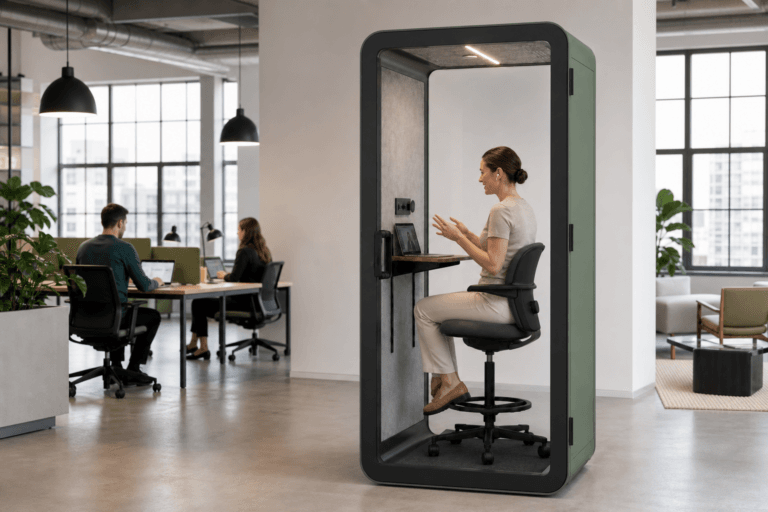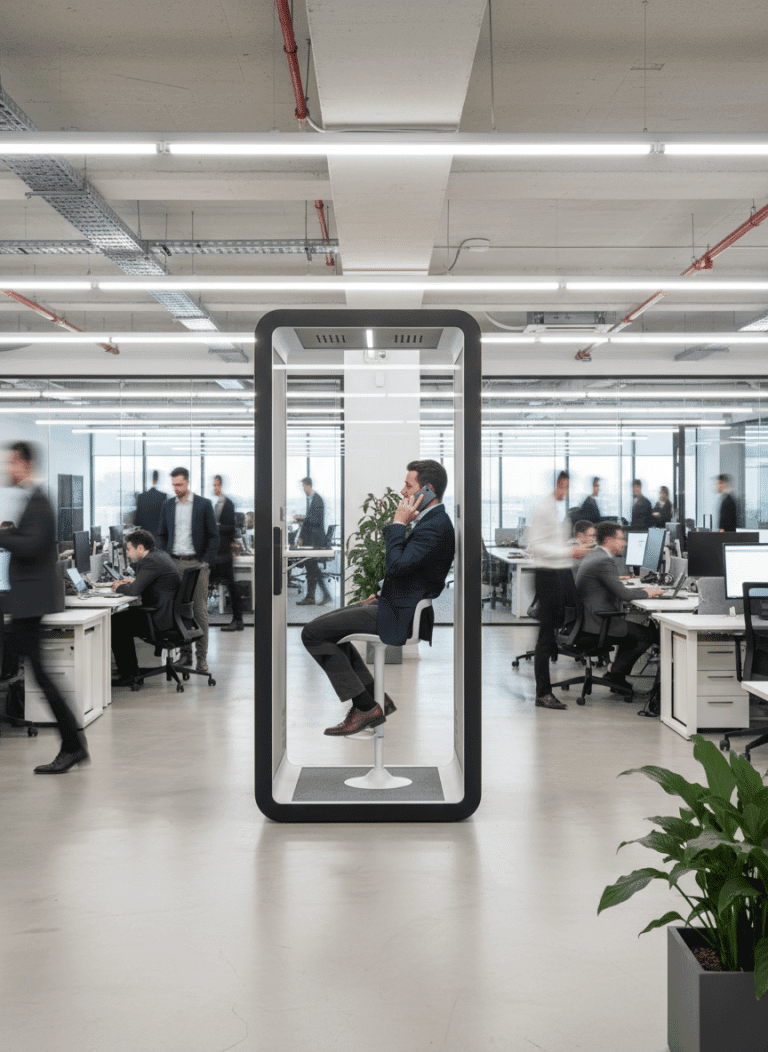
Szybka odpowiedź
Wskaźniki STC są przydatne do oceny, w jakim stopniu ściany, drzwi, przeszklenia lub panele ograniczają dźwięki powietrzne w kontrolowanych testach, jednak nie należy traktować ich jako ostatecznego potwierdzenia prywatności w biurowej budce telefonicznej. W przypadku kompletnych budek nabywcy powinni również uwzględnić kontekst NIC, redukcję poziomu mowy zgodnie z ISO 23351-1, kierunek testu oraz dokładną testowaną konfigurację.
Ostatnia aktualizacja: 7 lipca 2026 r. | Autor: Richard | Szacowany czas czytania: 12 minut

Wskaźniki STC vs NIC vs ISO 23351-1: szybkie porównanie
Jeśli porównujesz deklaracje akustyczne dotyczące biurowych budek telefonicznych, pierwszym błędem jest traktowanie każdej wartości w decybelach jako tego samego rodzaju potwierdzenia. Przed porównaniem produktów warto rozróżnić te pojęcia.
| Metryczny | Co głównie opisuje | Najlepsze zastosowanie | Główne ograniczenia dla kupujących stoisko |
|---|---|---|---|
| Wskaźniki STC | Laboratoryjna izolacyjność od dźwięków przenoszonych przez przegrody, drzwi, przeszklenia lub zespoły elementów | Porównywanie elementów budowlanych i izolacyjności akustycznej na poziomie komponentów | Nie potwierdza automatycznie prywatności rozmów w całej budce |
| NIC | Izolację hałasu między przestrzeniami lub warunki wewnątrz obudowy, zależnie od konfiguracji testu | Uzupełnienie kontekstu, gdy mierzona jest kompletna obudowa lub warunki terenowe | Wynik w dużej mierze zależy od konfiguracji, kierunku i warunków otoczenia |
| ISO 23351-1 | Redukcję poziomu mowy dla zestawów meblowych i obudów | Porównywanie kompletnych budek i zamkniętych produktów meblowych stosowanych dla zapewnienia prywatności rozmów | Musi odnosić się do dokładnie testowanego modelu i konfiguracji |
| Różnica poziomów dźwięku przetestowana fabrycznie | Kontrolowany pomiar wewnętrzny przeprowadzony przez dostawcę lub fabrykę | Pomocny kontekst uzupełniający, gdy jest wyraźnie oddzielony od norm niezależnych podmiotów | Nie jest tym samym co wynik niezależnego testu zgodnego z ISO, ASTM lub przeprowadzonego w warunkach terenowych |
Praktyczny wniosek jest prosty: wskaźniki STC mogą pomóc w zrozumieniu właściwości akustycznych komponentów, ale budka to nie tylko komponent. Budka jednoosobowa obejmuje panele, przeszklenia, drzwi, uszczelki, ścieżki wentylacyjne, przepusty zasilania, poziomowanie i szczegóły montażowe. To właśnie te słabe punkty często decydują o tym, czy rozmowy pozostają wystarczająco prywatne w rzeczywistym biurze.
Co właściwie mierzą wskaźniki STC?
STC stands for Sound Transmission Class. In buyer-friendly terms, it is a single-number rating used to describe how well a building element or assembly reduces airborne sound transmission across a tested frequency range.
That makes STC useful when you are comparing partitions, walls, doors, or glazing assemblies. For example, if an office project includes built rooms, conference-room walls, or permanent partitions, STC can be part of a serious specification discussion.
For an office phone booth, however, STC Ratings are only part of the story. A vendor might mention STC because a panel, glass assembly, or door component performed well in a lab. That does not automatically mean the finished booth creates the same privacy result after the door, floor contact, ventilation opening, cable routing, and installation details are added.
The standards landscape supports this distinction. ASTM E90 is associated with laboratory measurement of airborne sound transmission loss of building partitions and elements, while ASTM E413 covers how sound insulation ratings such as STC and related ratings are classified. Those references are valuable, but they do not turn a single panel number into a complete booth guarantee.
Why STC Ratings Alone Can Mislead Phone Booth Buyers
The phrase “STC 30 panels” sounds reassuring. The problem is that buyers usually care about a different question: can people outside the booth understand the conversation happening inside?
That real-world question depends on the complete enclosure. I usually look at five weak points before trusting any acoustic claim:
- Door perimeter sealing and latch pressure
- Glass-to-frame interfaces
- Phone booth ventilation paths and fan openings
- Cable, power, or service penetrations
- Final leveling, floor contact, and installation quality
If one of those details leaks sound, the finished booth may underperform even when one material or panel has a strong rating. This is why “soundproof phone booth” should be treated as a search phrase or marketing shorthand, not a technical promise. The more precise goal is speech privacy, sound reduction, and acoustic privacy for a specific office use case.
For buyers who are still comparing models, the commercial next step is to ask which acoustic evidence applies to the exact model being quoted.
Where NIC Fits in the Buying Process
NIC can be useful, but it is easy to misunderstand.
Noise Isolation Class is generally used to describe isolation between spaces or enclosure conditions. In a booth discussion, NIC may help when the test setup reflects the whole enclosure rather than just one material. But buyers still need to ask what was measured and how.
ASTM E596 is especially relevant when discussing laboratory measurement of noise reduction for sound-isolating enclosures. The important buyer lesson is that enclosure evidence must be interpreted according to the actual test method, sound source direction, and configuration.
Before accepting a NIC number, ask:
- Was the complete booth tested, or only part of the structure?
- Was the sound source inside the booth or outside it?
- Did the test include the door, glass, ventilation path, and electrical penetrations?
- Does the tested configuration match the product being sold?
- Was the measurement performed in a lab, a showroom, a factory setup, or a real office?
NIC is not a replacement for judgment. It is a supporting clue when the test context is clear.
Why ISO 23351-1 Is More Relevant for Complete Booths
For enclosed furniture products and office booths, ISO 23351-1 is often more relevant than a bare STC number because it focuses on speech level reduction for furniture ensembles and enclosures. That aligns more closely with how buyers actually use a booth: one person speaks inside, and the office outside should hear less clearly.
This does not mean every ISO 23351-1 claim is automatically good. You still need to confirm the exact tested model, the configuration, and whether the result applies to the product being quoted. But the method is more directly connected to booth-style products than a component-level partition claim.
For procurement teams, the cleanest acoustic evidence package usually separates four things:
| Evidence Type | What a Buyer Should Confirm |
|---|---|
| Wskaźniki STC | Which panel, door, glass, or assembly was tested |
| NIC | Whether the result reflects the complete enclosure and the right sound path |
| ISO 23351-1 | Whether the full booth model was tested for speech level reduction |
| Supplier or factory testing | Whether the result is internal, controlled, and clearly separated from third-party evidence |
That separation helps prevent a common purchasing mistake: comparing an STC panel number from one vendor against an ISO speech level reduction number from another vendor as if they were the same metric.

How B&H Ergonomics Handles Acoustic Claims
B&H Ergonomics treats acoustic language carefully because office booth buyers need practical privacy, not inflated promises.
For Elite-S, B&H Ergonomics can provide the relevant Intertek acoustic report during project evaluation where applicable. Elite-S achieved ISO 23351-1 Class A acoustic performance with 33 dB speech level reduction. In B&H factory testing under controlled conditions, Elite-S showed approximately 40 dB sound level difference.
Those two numbers should not be collapsed into one claim. The 33 dB result is the ISO 23351-1 speech level reduction result. The approximately 40 dB result is a B&H factory-tested sound level difference under controlled conditions. Acoustic results vary by test method, installation, site conditions, and measurement setup.
For Flex-S and Oasis-S, buyers should confirm the current product documentation, acoustic basis, and intended use case before relying on model-specific dB claims. That is a safer approach than repeating a generic “soundproof” claim across every product.
Vendor Checklist: Questions to Ask Before Trusting Any Acoustic Claim
Use this checklist before comparing quotes. It is short enough for procurement, facilities, or design teams to include in a vendor email.
| Pytanie | Dlaczego to ma znaczenie | Better Answer |
|---|---|---|
| Which standard supports the claim? | A decibel number without a method is hard to compare | The vendor names STC, NIC, ISO 23351-1, or another specific method |
| What was tested? | Component data and complete-booth data are not the same | The report identifies the exact product, assembly, or component |
| Where was the sound source? | Inside-to-outside speech privacy is not the same as outside-to-inside noise reduction | The test direction matches the real use case |
| Does the report match the quoted configuration? | Door, glass, seals, ventilation, and power details can change performance | The tested configuration matches the sold model |
| Is the result third-party, factory-tested, or field-tested? | Each evidence type has a different trust level | The vendor labels the source clearly |
| What can reduce performance after installation? | Real offices introduce leveling, placement, floor, and surrounding noise variables | The vendor explains installation and site-condition limits |
When to Use STC Ratings in Office Design
STC Ratings still belong in office design. They are especially useful when your project includes permanent partitions, enclosed rooms, glazing systems, or door assemblies. If you are building a conference room, a private office, or a room with architectural walls, STC can be a meaningful part of the design conversation.
For a booth purchase, I would use STC differently:
- Use STC to understand component-level sound transmission.
- Use NIC only when the test setup is clear.
- Use ISO 23351-1 to review complete booth speech level reduction.
- Use site and installation review to judge whether the quoted product will fit the real office.
This keeps the buyer from overvaluing the easiest number to market and undervaluing the parts of the booth that usually determine daily performance.
What Buyers Should Do Next
If your team is early in planning, start with the B&H Ergonomics Budka telefoniczna dla przewodnika biurowego to compare use cases, sizing, layout, and buying questions.
If your main concern is confidential conversation planning across HR, sales, finance, leadership, or support teams, the office privacy planning guide connects acoustic privacy with placement and workflow.
If you already know you need a one-person booth, compare B&H Ergonomics acoustic phone booth options and request the acoustic evidence that matches your preferred model, configuration, and project use case.
For quote preparation, send:
- Booth quantity and destination
- Preferred model or privacy priority
- Main use case, such as HR calls, sales calls, support calls, or general private calls
- Floor plan or placement area
- Ceiling height, delivery path, elevator, corridor, and doorway constraints
- Acoustic evidence requirements for procurement review
The goal is not to chase the biggest number. The goal is to choose a booth with evidence that matches the way your team will actually use it.
FAQ
Czy wskaźniki STC są wystarczające w przypadku biurowych budek telefonicznych?
Nie. Klasyfikacje STC są przydatne do oceny przegród, drzwi, szkła i innych elementów akustycznych, ale nie wystarczają do potwierdzenia pełnej prywatności w biurowej budce telefonicznej. Budkę należy również oceniać jako kompletną obudowę, uwzględniając uszczelki drzwiowe, szkło, wentylację, montaż oraz wskaźnik prywatności rozmów adekwatny do danego zastosowania.
Czy wskaźnik NIC jest lepszy niż STC w przypadku budek telefonicznych?
Wskaźnik NIC może być bardziej miarodajny niż wartość STC dotycząca wyłącznie komponentu, gdy odzwierciedla kompletną obudowę lub istotny warunek izolacyjności. NIC nadal zależy jednak od konfiguracji testowej. Nabywcy powinni zapytać, co było testowane, gdzie umieszczono źródło dźwięku oraz czy testowana konfiguracja odpowiada oferowanej kabinie.
Dlaczego norma ISO 23351-1 jest ważna dla kabin biurowych?
ISO 23351-1 is important because it is focused on speech level reduction for furniture ensembles and enclosures. That makes it more directly relevant to office phone booths than a bare panel or partition rating, especially when the buyer’s goal is speech privacy for calls and confidential conversations.
Czy dźwiękoszczelna budka telefoniczna jest naprawdę dźwiękoszczelna?
Żadnej biurowej budki telefonicznej nie należy uznawać za zdolną do blokowania wszystkich dźwięków w każdym środowisku. Lepszym pytaniem jest, czy budka zapewnia wystarczającą, zmierzoną prywatność rozmów oraz redukcję hałasu dla zamierzonego zastosowania biurowego. Parametry akustyczne różnią się w zależności od metody badania, instalacji, warunków w miejscu użytkowania i konfiguracji pomiarowej.
O jaki raport akustyczny należy poprosić dostawcę kabiny?
Zapytaj o metodę badania, kompletną badaną konfigurację, kierunek źródła dźwięku oraz o to, czy wynik pochodzi z niezależnego badania, badania fabrycznego czy badania terenowego. W przypadku kompletnych kabin szczególnie przydatny jest wskaźnik redukcji poziomu mowy zgodny z ISO 23351-1, natomiast STC i NIC mogą stanowić dodatkowy kontekst, jeśli są jasno wyjaśnione.