Most conference room complaints come from one of two problems: speech bouncing around inside the room (echo), or speech escaping through the door, walls or ceiling (sound leaks). Sound dampening with absorptive panels fixes the first. It does almost nothing for the second, which needs sealing and blocking. Spend ten minutes working out which problem you have before buying anything, because the wrong fix costs money and leaves the complaint in place.
Last Updated: October 16, 2026 | Author: Richard

Echo, leak or call echo? Diagnose before you buy
There is also a third problem that people often blame on the room: remote participants hearing their own voice on a video call. That is usually an equipment issue, and no amount of wall treatment will cure it.
Run these three checks in the room you are trying to fix:
| What people say | 10-minute check | Likely problem | Fix first | Sign the first fix is not enough |
|---|---|---|---|---|
| “It sounds hollow in here.” “I can’t follow people at the far end of the table.” | Stand in the middle of the empty room and clap once, sharply. A ringing or fluttering tail after the clap means hard surfaces are reflecting speech. | Room echo (reverberation) | Absorption on the ceiling and the wall behind the screen | The room still rings with the main surfaces treated: check glass walls, the table top and the parallel wall pair |
| “Everyone outside heard our HR meeting.” | Close the door. One person talks at normal volume inside while another listens at the door, along the corridor wall and in the next room. Note where the words are clearest. | Sound leaks (poor isolation) | Door seals and gaps at the wall edges | Speech is still clear through the wall itself, or from the room next door with the door sealed: the wall or ceiling path needs construction work |
| “Remote people say they hear themselves.” | Join a test call from a second location. Mute every laptop in the room except the main conference device, then compare. | Call echo (equipment) | One active microphone and speaker per room; check echo cancellation | The echo continues with a single device: have your AV provider check the device settings and speaker placement |
Many rooms have both of the first two problems. Fix them in separate passes, because the materials do different jobs: soft, porous material absorbs reflections inside the room, while dense, airtight construction stops sound passing through to the next space.
How to fix echo inside a conference room
Echo is the easier problem. You are adding absorption to a room that is mostly hard surfaces: plasterboard, glass, a large table and often a hard floor.
Treat the surfaces in this order:
- Ceiling. A hard ceiling is usually the largest reflective surface in the room. Acoustic ceiling tiles, or panels suspended above the table, cover a lot of area with one change.
- The wall behind the screen or camera. On a video call, the microphone picks up speech reflecting off this wall. Treating it also helps the people in the room hear the far-end audio more clearly.
- One wall of each parallel pair. Two bare walls facing each other create flutter echo, the buzzing tail you hear after a clap. Panels on one side break the pattern.
- Floor and furniture. A carpet or large rug, upholstered chairs and a fabric-covered credenza add absorption without wall fixings.
When comparing panels, look at the NRC (noise reduction coefficient). It runs from 0 to about 1, and a higher number means the material absorbs more speech-range sound. GSA’s Sound Matters guide recommends wall panels rated NRC 0.8 or higher, covering 25% of the wall area, in conference and meeting rooms. Thickness and the air gap behind the panel matter as well: a thin decorative felt tile does far less than its area suggests.
Glass walls cannot take panels. Use the opposite solid wall and the ceiling instead, or add kurtyny dźwiękochłonne that can be drawn across the glass for sensitive or hybrid meetings.
Do not cover every surface. A room with too much absorption feels muffled and makes people raise their voices, which works against privacy. Stop when the clap test leaves a short, clean decay rather than a ring.
How much echo control is enough?
Rooms are measured by reverberation time (RT60): how many seconds it takes a sound to fade by 60 dB after it stops. The Standard budowlany WELL sets a maximum of 0.6 seconds for conference rooms, in line with GSA’s Sound Matters recommendation for meeting rooms. If you need a documented result, for example after a fit-out dispute, ask an acoustic consultant to measure RT60 before and after treatment. For an ordinary room, the clap test and fewer complaints from remote participants are a reasonable working check.
If your open-plan areas have the same problem, the office acoustic panels guide covers where panels help outside enclosed rooms.
How to stop sound leaking out of a conference room
This is where most budgets go wrong. Acoustic panels on the inside of the walls barely change how much speech passes through them. To soundproof a conference room in practice, find the weakest path and close it. A wall that performs well with a gap under the door performs like the gap.
Work through the leak points in this order. It roughly follows cost, from cheapest to most expensive:
- The door. Fit perimeter seals on the head and both jambs, plus an automatic drop seal that lowers when the door closes. A hollow-core door is a weak point even when sealed; a solid-core door is the usual upgrade.
- Gaps at the wall edges. Look for gaps where the wall meets the floor, the ceiling and the window mullions, and around back-to-back electrical boxes. Close them with acoustic sealant.
- The space above the ceiling. In many offices the meeting room walls stop at the suspended ceiling, and sound travels over the top into the next room. Check by lifting a ceiling tile. The fix is a plenum barrier above the wall line, or taking the wall up to the structural slab. GSA’s guide specifies slab-to-slab partitions for rooms that need high isolation.
- Ductwork and transfer grilles. A shared duct or an open return-air grille can carry speech between rooms. Ask your mechanical contractor about lined ducts or acoustic transfer boots, and keep the ventilation working while you do it.
- The wall itself. If speech is still clear through a sealed wall, it needs more mass or a decoupled layer, usually extra plasterboard on resilient fixings. This is construction work, and in a leased office it needs landlord approval.
Two ratings show up in quotes. STC (Sound Transmission Class, ASTM E413) is a laboratory rating for a wall or door assembly. NIC (Noise Isolation Class, ASTM E336) is measured between finished rooms, so it includes every leak path. Gaps, ceiling voids and ducts can make the finished result much worse than the laboratory rating, which is why GSA’s Sound Matters recommends specifying NIC and field-testing installed partitions. If privacy matters, ask your contractor for the expected result between the finished rooms, not just the product rating of the wall.
Sound masking can help the people outside the room. A low, steady background sound in the corridor makes leaked speech harder to understand. It works best alongside sealing, not instead of it. The office sound masking vs acoustic pods guide explains where masking fits.
When the echo is the call, not the room
If the clap test is clean but remote participants still complain, check the meeting setup before the walls:
- More than one active microphone. When attendees join from their laptops as well as the room system, every open microphone picks up the room speaker. Use one device for audio and mute the rest.
- Speaker too close to the microphone. Move them apart or lower the speaker volume, then retest.
- Echo cancellation turned off or overloaded. Most room systems and conferencing apps have it; your AV provider can confirm it is enabled and tuned for the room.
Acoustic treatment still helps here, because a less reverberant room is easier for echo cancellation to handle, but it will not fix a laptop left unmuted.
When fixing the room stops making sense

Some conference rooms reach a point where each improvement costs more than the problem is worth. These are the common signs:
- The leak is the building. The walls stop at the ceiling grid, and the lease or the building’s mechanical layout rules out taking them to the slab.
- The room is mostly glass. You can control echo with curtains and ceiling treatment, but a glass wall with a standard door leaves limited room for better isolation without replacing the glazing.
- The room serves too many meeting types. A large room booked all day for two-person calls, interviews and HR conversations wastes space while the sensitive meetings still leak.
- You need it to be movable. Construction work stays behind when the lease ends.
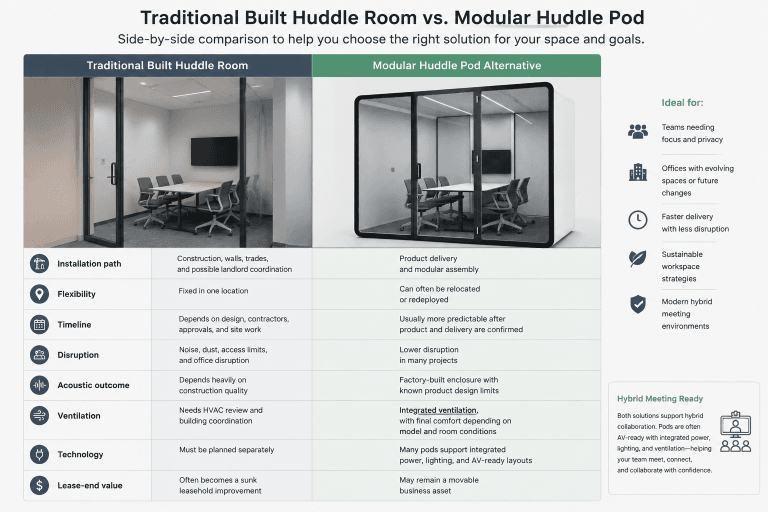
At that point, moving the small, private meetings into enclosed kapsuły konferencyjne is an option to compare against rebuilding the room. A meeting pod arrives as a self-contained enclosure with its own walls, ceiling, door, lighting and ventilation, so it does not depend on the existing ceiling void or wall line. The Elite Series meeting sizes, for example, are Elite L1 (2200 x 1250 x 2250 mm) and Elite L2 (2200 x 1600 x 2250 mm) for four people, and Elite XL (2500 x 2200 x 2250 mm) for four to six, with 216, 324 and 432 CFM of ventilation respectively.
Apply the same checks to a pod as to a room. Its door seals, glazing and ventilation openings are sound paths too, so ask the supplier how each one is sealed.
Pods do not replace every conference room. A board room for twelve or a training room still needs proper construction. They are most useful when the same few sensitive or video-heavy meetings keep exposing the weak points of a room that cannot be rebuilt.
FAQ
Czy panele akustyczne zapewniają dźwiękoszczelność sali konferencyjnej?
Nie. Panele akustyczne zmniejszają pogłos wewnątrz pomieszczenia, dzięki czemu mowa jest wyraźniejsza dla osób znajdujących się w nim i uczestniczących w rozmowie. Mają niewielki wpływ na to, ile dźwięku mowy przenika przez ściany lub drzwi. Aby ograniczyć nieszczelności, potrzebne są uszczelki, zamknięcie szczelin, a czasem także prace przy ścianach lub suficie.
Czy szklaną salę konferencyjną można uczynić prywatną?
Można to poprawić, ale szkło ogranicza zakres możliwych działań. Uszczelnij drzwi, zamknij szczeliny przy słupkach i suficie oraz zastosuj zasłony lub adaptację akustyczną sufitu, aby ograniczyć pogłos. Jeśli po wprowadzeniu tych zmian mowa nadal jest zrozumiała na zewnątrz, ograniczeniem jest przeszklenie, a jedynymi pozostałymi opcjami są jego wymiana lub przeniesienie poufnych spotkań w inne miejsce.
Jaka jest najtańsza zmiana, która przynosi realną różnicę?
W przypadku nieszczelności – uszczelki drzwiowe i automatycznie opadająca uszczelka progowa. W przypadku echa – adaptacja akustyczna sufitu lub dodanie dużego dywanu i miękkiego wyposażenia. Najpierw skorzystaj z tabeli diagnostycznej, aby inwestować w rozwiązanie problemu, który faktycznie występuje.