Resposta rápida
Os pods de trabalho para a neurodiversidade podem contribuir para um escritório mais inclusivo, dando às pessoas maior controlo sobre distrações causadas pela fala, exposição visual, iluminação, fluxo de ar e privacidade. Funcionam melhor como um recurso partilhado de concentração, disponível para qualquer pessoa que necessite de um espaço com menos estímulos. Um pod deve complementar o apoio individual no local de trabalho, não substituir um processo de adaptação nem prometer um resultado médico ou de produtividade.
Última atualização: 22 de julho de 2026 | Autor: Richard | Tempo estimado de leitura: 10 minutos
Comece pelo problema sensorial, não pelo produto
Um projeto de espaço silencioso deve começar pelas condições que os colaboradores estão a tentar gerir. Num escritório aberto ou numa área pública partilhada, o problema pode ser um zumbido mecânico persistente, conversas nas proximidades, movimento na visão periférica, iluminação intensa, fragrâncias fortes ou um material interior desagradável ao toque.
Estes fatores não afetam todas as pessoas da mesma forma. Uma pessoa pode precisar de menos distrações causadas pela fala, enquanto outra pode necessitar de uma luz mais suave ou de menos exposição visual. Alguns colaboradores revelarão um diagnóstico; outros poderão não ter um, não querer revelá-lo ou mascarar o esforço necessário para trabalhar num ambiente com muitos estímulos. Por isso, a questão prática de design não é: “Para que diagnóstico serve este pod?” É: “Que controlos ambientais este local de trabalho precisa de disponibilizar?”
A Employer Assistance and Resource Network on Disability Inclusion disponibiliza orientações mais abrangentes sobre neurodiversidade no local de trabalho. A seleção de produtos é apenas uma parte dessa abordagem ao local de trabalho. As políticas, a escolha dos colaboradores, o comportamento dos gestores e o acesso a outras formas de apoio continuam a ser importantes.
Porque uma “zona silenciosa” ainda pode falhar
Muitos escritórios criam uma zona silenciosa mudando uma placa ou deslocando algumas secretárias. Isto pode reduzir as interrupções sociais, mas não controla necessariamente o ambiente físico.
| Fonte de incómodo | Porque uma zona silenciosa aberta pode não resolvê-lo | O que investigar |
|---|---|---|
| Ruído de conversas e chamadas telefónicas | As conversas podem propagar-se por um piso aberto, mesmo quando as pessoas tentam falar baixo | Se um espaço fechado proporciona uma redução útil da fala para a localização em causa |
| Zumbido mecânico | Os sistemas AVAC, equipamentos de iluminação, impressoras e outros sistemas podem continuar audíveis | A localização do pod, o ruído da ventilação e o perfil de ruído circundante |
| Movimento visual | As pessoas continuam a passar pelo campo de visão periférica do utilizador | Enclausuramento, linhas de visão, envidraçados e vidro fosco opcional |
| Luz intensa ou desconfortável | A zona pode utilizar a mesma iluminação suspensa do restante escritório | Controlo do utilizador sobre o brilho e a temperatura de cor |
| Sensibilidade a odores | Os odores de fragrâncias e produtos de limpeza podem circular pelo ar partilhado | Localização, política de limpeza, análise dos materiais e localização da entrada de ventilação |
| Desconforto tátil | Uma cadeira, a borda da secretária, o acabamento da parede ou o tecido podem distrair um utilizador específico | Amostras de acabamento e um teste físico do produto antes de uma encomenda de grande volume |
É por isso que uma cabine mal especificada pode reproduzir o mesmo problema num espaço mais pequeno. Um espaço de trabalho fechado com um ventilador intrusivo, luz intensa fixa, superfícies desconfortáveis ou exposição visual excessiva não é automaticamente adequado para pessoas com sensibilidades sensoriais.
O Que uma Cabine de Trabalho Pode e Não Pode Controlar
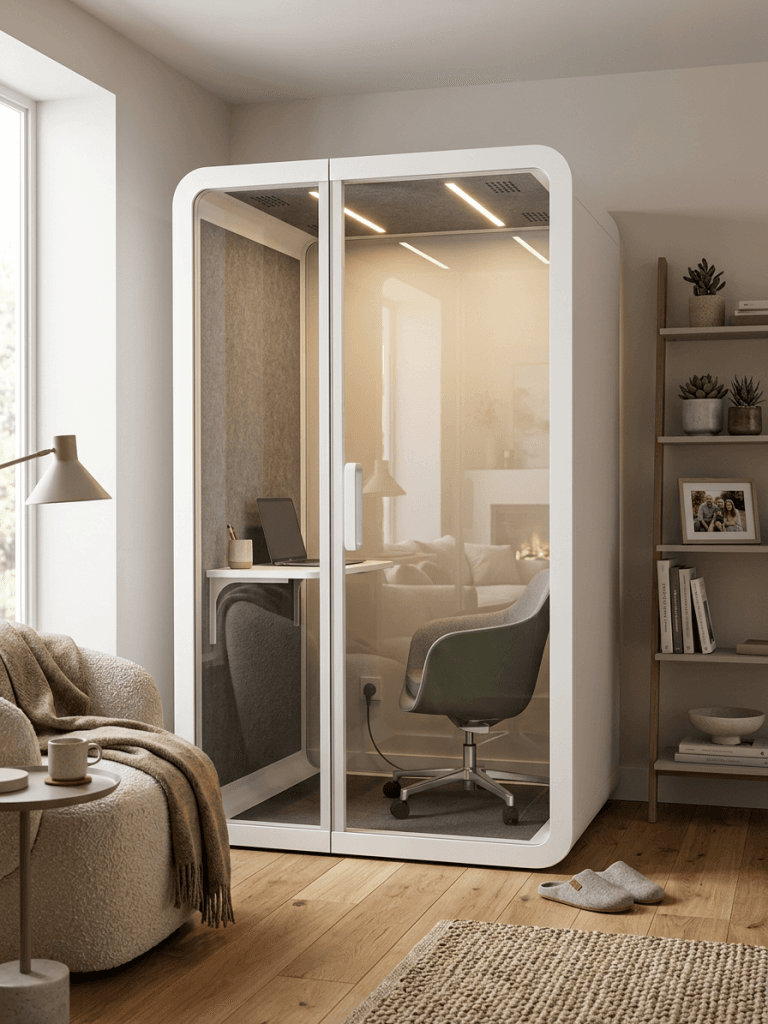
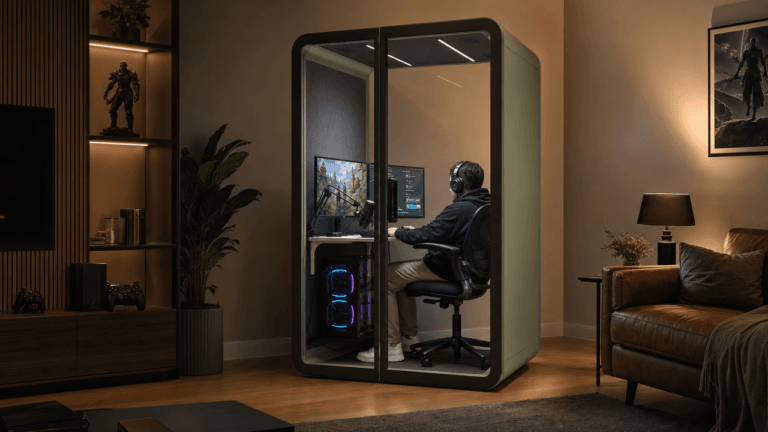
Uma cabine de trabalho pode criar uma separação mais clara entre o trabalho concentrado e o escritório envolvente. Consoante a configuração, pode reduzir as distrações causadas pela fala, limitar o movimento periférico, proporcionar privacidade visual e dar ao utilizador controlo direto sobre a iluminação e a ventilação.
Não pode eliminar todos os sons, impedir todos os odores nem garantir que todos os colaboradores se sintam confortáveis num espaço fechado. Também não pode determinar se uma pessoa necessita de uma adaptação formal do local de trabalho. Estes limites devem ser definidos antes da aquisição, para que o produto seja avaliado como um espaço de trabalho controlável e não como uma solução universal.
Quando o projeto estiver pronto para comparar os modelos atuais, acabamentos, prioridades acústicas e requisitos de instalação, consulte B&H Ergonomics’ cápsulas de trabalho coleção.
Matriz de Seleção de Cabines de Trabalho Adequadas para Pessoas com Sensibilidades Sensoriais
A especificação mais eficaz associa cada problema do local de trabalho a uma funcionalidade que o comprador pode verificar.
| Fator Desencadeante ou Necessidade no Local de Trabalho | Controlo da Cabine a Analisar | Pergunta de Verificação para o Comprador | Limite importante |
|---|---|---|---|
| Fala nas proximidades | Compartimento completo, vedações da porta, envidraçamento, percurso de ventilação, evidências acústicas | O modelo completo foi testado, segundo que método e em que configuração? | Não compare valores de decibéis não relacionados como se medissem a mesma coisa |
| Movimento visual | Profundidade do compartimento, disposição dos vidros, opção de vidro fosco | O utilizador pode reduzir a exposição visual sem tornar o espaço inseguro ou demasiado fechado? | As preferências variam; alguns utilizadores querem mais visibilidade, não menos |
| Desconforto com a iluminação | Regulação da intensidade e temperatura de cor ajustável | O utilizador pode alterar a luminosidade e a temperatura de cor a partir do interior da cabine? | Não alegue desempenho sem cintilação sem documentação de produto verificada |
| Desconforto causado pelo ventilador ou fluxo de ar | Definições de ventilação, ruído do ventilador, localização da entrada e saída de ar | O utilizador pode alterar a definição de ventilação e esta é confortável durante a duração prevista da utilização? | Confirme os dados do modelo atual em vez de utilizar uma alegação genérica sobre o fluxo de ar |
| Sensibilidade a odores ou materiais | Acabamento interior, produtos de limpeza, amostras de materiais | O comprador pode analisar os acabamentos e os requisitos de limpeza antes de encomendar? | Um compartimento não pode garantir um ambiente sem odores |
| Longer focus sessions | Desk depth, chair fit, power, lighting, airflow, entry and exit | Is the setup usable for the tasks and session lengths employees actually need? | A compact call booth may not suit sustained laptop work |
| Shared access | Location, booking, occupied indicator, cleaning ownership | Can employees use the space without disclosing a medical condition? | Universal access does not cancel individual accommodation responsibilities |
Review Acoustic Evidence Precisely
“Soundproof” is too broad to guide a purchase. Buyers should ask what was tested, whether the result applies to the complete enclosure, and whether the tested configuration matches the product being quoted.
ISO 23351-1 addresses measurement of speech level reduction for furniture ensembles and enclosures. That makes it more relevant to a complete work pod than a material-only rating, but the model, configuration, result, and test documentation still need to match.
B&H Ergonomics identifies Elite-M as achieving ISO 23351-1 Class A acoustic performance. Buyers should request the current report and confirm that the tested configuration matches the product being quoted, including any glass or finish options. Acoustic results vary by test method, installation, site conditions, surrounding noise, and measurement setup.
Give Users Meaningful Lighting and Privacy Choices
An adjustable light is useful only when the control is easy to reach and the available settings are comfortable for the person using the pod. Brightness and color temperature should be reviewed separately. Frosted glass can reduce visual exposure, but it should be offered as a choice rather than treated as the default preference for every user.
The same principle applies to ventilation. A user-adjustable setting can provide more control, but facilities teams should still evaluate fan sound, airflow direction, heat, session length, and maintenance requirements.
B&H Project Insight: An Elite-M Focus Oasis
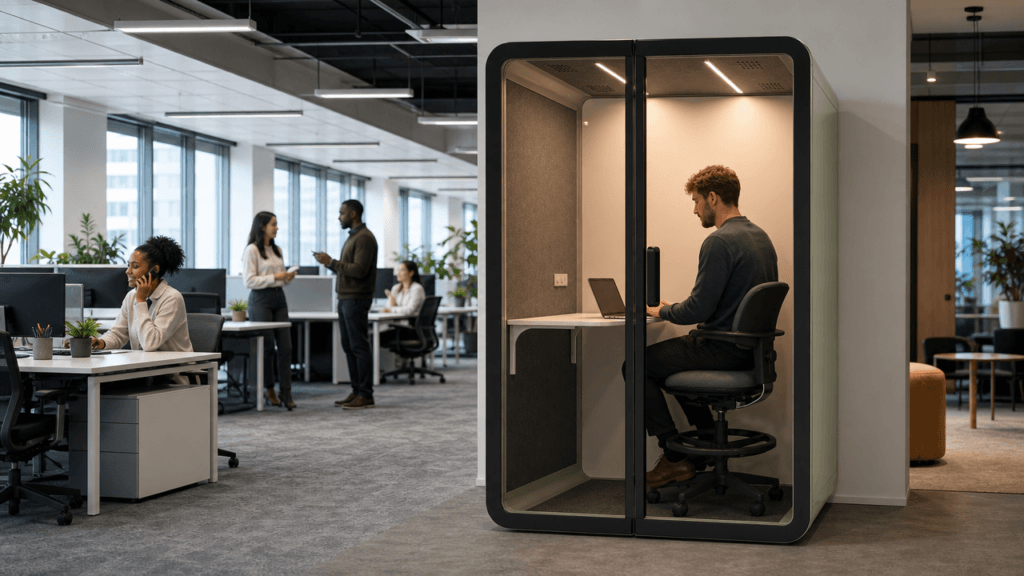
In one B&H Ergonomics project, the buyer selected an Elite-M work pod with frosted glass and adjustable color temperature. The project goal was to create a calmer focus area within an open office, giving employees a place to step away from surrounding speech and visual activity without leaving the workplace.
The value of this example is not that one configuration will suit every neurodivergent employee. It shows how a buyer can translate a workplace problem into specific choices: stronger acoustic evidence, reduced visual exposure, and direct control over the lighting environment.
For another project, clear glass or a different interior finish may be more comfortable. A short product trial and employee feedback are more useful than assuming that a feature labeled “sensory-friendly” will work for everyone.
Make the Pod a Universal Focus Resource
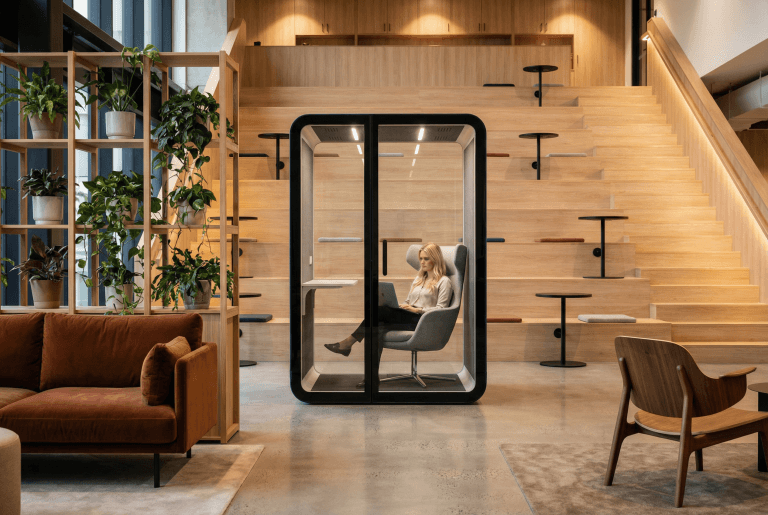
A pod is less likely to create stigma when it is introduced as a normal workplace resource rather than a space that employees can use only after proving a medical need. Writers, analysts, developers, managers, and other employees may all need lower-interruption space for concentrated work.
| Policy Decision | More Inclusive Approach | Por que é que isso ajuda? |
|---|---|---|
| Who may use the pod? | Anyone with a legitimate focus, privacy, or lower-stimulation task | Reduces disclosure pressure and normalizes use |
| How is it described? | Focus resource or focus room | Avoids labeling the space around a diagnosis |
| How is access managed? | Simple booking or clear occupied/vacant status | Prevents informal ownership by one team or seniority level |
| What is appropriate use? | Focused work, reading, writing, analysis, or a private video call | Keeps the pod available for tasks that benefit from enclosure |
| How is feedback collected? | Anonymous or low-friction comments about light, airflow, privacy, and comfort | Improves the space without asking employees to disclose medical details |
| What happens when a person needs more support? | Route the individual request through the appropriate HR process | Keeps universal design and individual accommodation working together |
A universal policy does not mean every request must be handled identically. If an employee needs a specific adjustment, HR and the employee should review it separately. The Job Accommodation Network is one starting resource for employers and individuals considering workplace accommodation options.
Pilot the Space Before Scaling
There is no credible universal rule that every office needs one pod for a fixed number of employees. Demand depends on job roles, attendance patterns, meeting behavior, floor layout, existing rooms, and how long people use the space.
Use a pilot to establish a project-specific ratio:
- Record the main problems the pilot is intended to address, such as speech distraction, visual movement, or lack of adjustable lighting.
- Choose a location near the intended users without blocking circulation, accessible routes, exits, or building systems.
- Test one unit or a small mixed configuration before committing to a large rollout.
- Collect usage, wait-time, session-length, comfort, cleaning, and maintenance feedback without asking employees to disclose diagnoses.
- Review whether users change the lighting, ventilation, or privacy settings and whether those controls are easy to understand.
- Adjust placement, policy, configuration, or quantity before expanding to other departments or sites.
Do not reduce the pilot to a speculative productivity or employee-retention calculation. Usage patterns and specific employee feedback provide a more defensible basis for the next purchasing decision.
Know When a Work Pod Is Not the Complete Answer
A work pod may be a useful part of a neuroinclusive office plan, but it is not always the right or only intervention.
- If the main need is recurring group collaboration, a meeting pod or room may be more appropriate.
- If the task is mainly a short phone call, a smaller phone booth may use space more efficiently.
- If a user finds enclosed spaces uncomfortable, consider another quieter workstation, scheduling option, remote-work arrangement, or environmental change.
- If the concern involves an individual accommodation, follow the appropriate HR and legal process rather than treating the pod as automatic compliance.
- If placement affects accessibility, egress, fire protection, electrical work, or building operations, involve the relevant site professionals before ordering.
The best outcome is not the largest number of pods. It is a workplace where employees can choose an environment that fits the task, and where the organization can explain what each space does and does not provide.
FAQ
As cabines de trabalho são exclusivas para funcionários neurodivergentes?
Não. Uma cabine de trabalho deve, em geral, estar disponível para qualquer pessoa que necessite de concentração, privacidade visual, menos distrações causadas por conversas ou de um ambiente controlado para uma chamada privada. O acesso universal pode reduzir o estigma e a pressão para revelar informações pessoais, permitindo ao mesmo tempo que os pedidos individuais de adaptação sejam tratados separadamente.
Uma cabine de trabalho consegue eliminar todo o ruído do escritório?
Não. Um pod de trabalho pode reduzir distrações causadas por conversas e pelo ambiente, mas não deve ser descrito como proporcionando silêncio total. Verifique o método exato de teste acústico, a configuração do modelo, as condições de instalação e o ruído no escritório circundante.
Que características são mais importantes para o controlo sensorial?
Start with the user’s actual friction points. Common review areas include acoustic evidence, visual privacy, adjustable brightness, adjustable color temperature, ventilation settings, interior finishes, desk comfort, and easy-to-use controls.
Uma cabine de trabalho substitui um processo de adaptação do local de trabalho?
Não. Um recurso partilhado para concentração pode melhorar a variedade de ambientes disponíveis aos colaboradores, mas não substitui uma discussão sobre adaptações individualizadas nem a análise jurídica e de RH aplicável.
Quantas cabines de trabalho deve um escritório disponibilizar?
Comece com um projeto-piloto em vez de uma proporção fixa de colaboradores por cabine. Meça a procura, o tempo de espera, a duração das sessões, o feedback dos utilizadores e a disponibilidade de outros espaços silenciosos e, em seguida, dimensione com base em dados concretos do ambiente de trabalho.