Resposta rápida
A criação de segurança psicológica no local de trabalho começa pela forma como líderes e colegas respondem quando alguém faz uma pergunta, admite um erro, manifesta uma preocupação ou discorda. O design do escritório não pode criar essa confiança. No entanto, pode eliminar barreiras práticas ao oferecer às pessoas opções adequadas para conversas delicadas, trabalho concentrado e discussões em pequenos grupos. A abordagem mais eficaz alinha o comportamento da gestão, os processos da equipa e o design do local de trabalho, em vez de esperar que uma cabine privativa ou uma sala silenciosa resolva um problema cultural.
Última atualização: 14 de julho de 2026 | Autor: Richard | Tempo estimado de leitura: 9 minutos
O que a segurança psicológica realmente significa no trabalho
A segurança psicológica é a crença partilhada de que uma equipa é segura para assumir riscos interpessoais. As orientações da American Psychological Association sobre segurança psicológica no trabalho relacionam-na com a capacidade de se manifestar, pedir ajuda, apresentar ideias e reconhecer erros sem receio de humilhação ou punição.
A palavra importante é interpessoais. A segurança psicológica diz respeito ao que as pessoas esperam que aconteça quando se tornam vulneráveis perante colegas ou gestores.
Não é o mesmo que:
- sentir-se confortável em todos os momentos;
- evitar discordâncias ou feedback difícil;
- eliminar padrões de desempenho;
- ter um escritório silencioso;
- manter informações confidenciais; ou
- disponibilizar uma sala privada.
Uma sala silenciosa pode ainda assim parecer insegura se um gestor reagir de forma defensiva. Um gestor que presta apoio pode, ainda assim, colocar um colaborador numa situação difícil se uma conversa pessoal tiver de ocorrer ao alcance dos ouvidos da equipa. Por isso, criar segurança psicológica exige decisões humanas e ambientais, mas essas decisões não têm o mesmo peso. O comportamento da liderança e as normas da equipa continuam a ser essenciais.
Comece pelo risco interpessoal, não pelo mobiliário
Antes de escolher uma intervenção, identifique o momento em que um colaborador pode hesitar. A questão relevante não é simplesmente: “As pessoas sentem-se seguras?” É: “O que é que as pessoas hesitam em dizer ou fazer aqui e o que esperam que aconteça se avançarem?”
Os exemplos podem incluir:
- um colaborador júnior questionando a suposição de um colega sénior;
- um responsável pelo projeto admitindo que um prazo já não é realista;
- um colaborador comunicando um risco relacionado com a qualidade, a segurança ou o cliente;
- um membro da equipa pedindo esclarecimentos antes de cometer um erro;
- um gestor dando um feedback difícil; ou
- alguém solicitando um ambiente mais adequado para uma conversa sensível.
Cada situação tem uma resposta humana e pode também envolver uma barreira processual ou espacial. Tratar cada hesitação como um problema de design do escritório ignora a causa. Tratar o ambiente físico como irrelevante pode ignorar uma barreira fácil de eliminar.
O Modelo de Responsabilidade em Três Camadas
Este modelo separa as responsabilidades das lideranças, dos processos operacionais e do design do espaço de trabalho.
| Camada | Pergunta central | Ações adequadas | O que esta camada não consegue fazer sozinha |
|---|---|---|---|
| Liderança e cultura de equipa | O que acontece depois de alguém se manifestar? | Incentivar a participação, responder de forma construtiva, reconhecer a incerteza, proteger o desacordo respeitoso e dar seguimento | Uma mensagem positiva não consegue superar comportamentos defensivos ou punitivos repetidos |
| Processos e acesso | Como é possível comunicar e acompanhar uma preocupação? | Disponibilizar canais claros, vias de escalonamento, práticas de reunião, rotinas de feedback e acompanhamento visível | Um canal de denúncia não ajuda se as pessoas esperarem uma resposta injusta |
| Conceção do espaço de trabalho | O ambiente torna a interação desnecessariamente difícil? | Disponibilize uma escolha adequada de ambientes abertos, silenciosos, individuais e para pequenos grupos | A privacidade e o controlo acústico não podem criar confiança nem impedir retaliações |
O modelo também clarifica a responsabilidade. Os gestores e líderes de equipa são responsáveis pela resposta social. Os RH e as operações ajudam a estabelecer processos justos. As equipas de instalações e de espaço de trabalho podem melhorar o acesso a ambientes adequados. Nenhum destes grupos deve usar o trabalho dos outros como substituto da sua própria responsabilidade.
Porque é que o escritório aberto continua a ser importante
Um escritório aberto não é automaticamente psicologicamente inseguro. Os ambientes partilhados podem apoiar uma comunicação rápida e a colaboração informal. O problema é a falta de escolha quando todas as atividades têm de decorrer no mesmo ambiente visível e audível.
Duas preocupações surgem repetidamente nas conversas B&H Ergonomics sobre divisórias para o espaço de trabalho: os colaboradores precisam de um local para tratar chamadas sensíveis sem serem facilmente ouvidos, e a atividade num escritório aberto pode dificultar o trabalho concentrado. Estas preocupações não provam que uma equipa não tenha segurança psicológica. Identificam obstáculos ambientais que podem tornar determinadas tarefas ou conversas mais difíceis do que o necessário.
A investigação sobre o local de trabalho apoia o tratamento da privacidade e do ruído como considerações legítimas de conceção. A análise de Kim e de Dear aos inquéritos a ocupantes de escritórios concluiu que as vantagens de comunicação das configurações em plano aberto não compensavam necessariamente a insatisfação com o ruído e a privacidade. O estudo deles, “Satisfação com o espaço de trabalho: a relação de compromisso entre privacidade e comunicação em escritórios em plano aberto”, não demonstra que os escritórios abertos causem danos psicológicos. Apoia uma conclusão mais limitada: a comunicação, o ruído e a privacidade precisam de ser equilibrados, em vez de otimizados através de uma única configuração para todas as tarefas.
Para a segurança psicológica, a questão prática de conceção é se os colaboradores podem escolher um ambiente adequado à interação. A resposta pode envolver uma sala, uma divisória, uma prática de reunião diferente ou nenhuma alteração física.
Seis ações para criar segurança psicológica no local de trabalho
1. Defina os comportamentos que a equipa pretende proteger
Traduza o objetivo em ações observáveis. Uma equipa pode querer que as pessoas comuniquem riscos mais cedo, questionem pressupostos, peçam esclarecimentos, admitam erros ou solicitem ajuda antes de falhar um prazo.
Isto estabelece uma razão clara para o trabalho. Também dá aos gestores algo mais útil para reforçar do que uma instrução geral para “falar”.”
2. Defina um padrão de resposta para os líderes
As pessoas aprendem com a resposta que se segue ao risco interpessoal. Um líder que pede contributos francos e depois desvaloriza uma resposta inconveniente ensina a equipa a permanecer em silêncio.
Um padrão de resposta simples pode incluir quatro medidas:
| Quando alguém manifesta uma preocupação | Resposta construtiva | Resposta a evitar |
|---|---|---|
| Os factos estão incompletos | Agradeça-lhes, pergunte o que observaram e identifique o que precisa de ser verificado | Exigir certezas antes de ouvir |
| A preocupação põe em causa uma decisão | Explique o raciocínio, teste a premissa e indique quem irá decidir | Tratar a discordância como deslealdade |
| Ocorreu um erro | Estabilize o problema, analise as condições que contribuíram para o mesmo e atribua a próxima ação | Humilhar a pessoa perante a equipa |
| Não está disponível uma solução imediata | Registe a questão, designe um responsável e indique uma hora para acompanhamento | Permitir que a preocupação desapareça sem qualquer atualização |
As orientações da Harvard Business School Online sobre criar segurança psicológica no local de trabalho também considera a segurança psicológica como algo que os líderes devem discutir, avaliar e revisitar, em vez de simplesmente anunciar uma vez.
3. Disponibilize Mais do Que Uma Forma de Falar
Nem todas as questões devem ser abordadas numa reunião de grupo. As equipas podem disponibilizar uma combinação de discussão ao vivo, conversa individual, acompanhamento por escrito e uma via de escalonamento definida.
A escolha é importante porque o conteúdo, a urgência, o público e a relação de poder variam. Uma pergunta sobre uma tarefa de rotina pode ser adequada num canal da equipa. Uma preocupação que envolva um gestor pode exigir uma via diferente. Um contexto privado pode facilitar uma conversa sensível, mas a organização continua a necessitar de um processo fiável para a receber.
4. Reveja os Momentos que Exigem um Ambiente Diferente
Os responsáveis de RH, Instalações e as lideranças de equipa devem analisar atividades específicas, em vez de solicitar um “espaço silencioso” genérico. Algumas questões úteis incluem:
- Trata-se de uma chamada individual, de uma tarefa que exige concentração ou de uma discussão em pequenos grupos?
- O principal problema é poder ser ouvido por terceiros, ser interrompido ou gerir quem está presente?
- Quanto tempo dura normalmente a atividade?
- Envolve requisitos de RH, jurídicos, médicos, de segurança ou de tratamento de informação que exijam uma análise especializada?
- Basta alterar as práticas de reunião ou justifica-se um ambiente fechado?
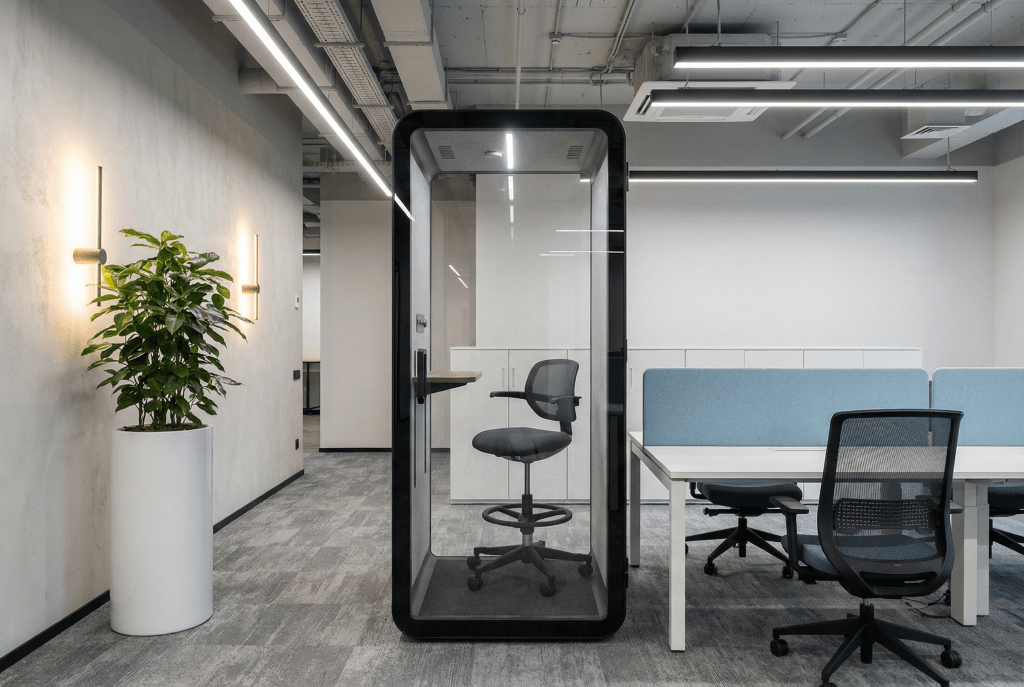
É neste ponto que a B&H Ergonomics aplica uma abordagem centrada primeiro nos casos de utilização. Uma cabine telefónica, um pod de trabalho e um pod de reunião servem atividades diferentes; não devem ser adquiridos como versões intercambiáveis de uma vaga sala silenciosa.
5. Elimine Obstáculos à Utilização da Opção Disponível
Disponibilizar um espaço não significa que as pessoas o consigam utilizar de forma eficaz. A quantidade, a localização, as regras de reserva e a conveniência influenciam a adoção, juntamente com o desempenho do produto.
Procure pontos práticos de falha. Os espaços adequados estão sistematicamente ocupados quando ocorrem chamadas sensíveis? Estão tão longe que os colaboradores permanecem nas suas secretárias? Todas as conversas breves exigem reserva? As normas da equipa sugerem que utilizar um espaço fechado significa que alguém está indisponível ou desligado?
Estas questões dizem respeito à implementação, e não à avaliação psicológica. Corrigi-las pode tornar um recurso do local de trabalho mais fácil de utilizar, mas não deve ser apresentado como prova de que a confiança melhorou.
6. Meça a Cultura e o Ambiente Separadamente
Não utilize as reservas de cabines como um indicador indireto de segurança psicológica. Uma elevada utilização pode indicar chamadas frequentes; uma baixa utilização pode indicar má localização, regras inadequadas ou baixa procura.
Analise indicadores distintos:
Indicadores de cultura e processo
- As perguntas e preocupações são levantadas antes de os problemas se agravarem?
- Os colaboradores acreditam que os gestores respondem de forma construtiva?
- As lideranças dão seguimento após uma questão ser levantada?
- As pessoas podem utilizar mais do que um canal quando a linha de comunicação habitual não é adequada?
Sinais de acesso no local de trabalho
- Os colaboradores conseguem encontrar um ambiente adequado quando a atividade o exige?
- A espera, os conflitos de reserva ou regras pouco claras estão impedindo o acesso?
- Determinados locais ou configurações ficam sem utilização?
- O feedback dos colaboradores identifica um ambiente específico em falta?
Os dois grupos podem informar-se mutuamente, mas não devem ser reunidos numa única pontuação nem utilizados para alegar que um produto causou um resultado cultural.
O que o design do local de trabalho pode e não pode apoiar
O design do local de trabalho pode apoiar a criação de segurança psicológica no trabalho, reduzindo a exposição desnecessária e oferecendo aos colaboradores uma escolha de ambientes. Pode facilitar a realização adequada de chamadas comuns, trabalho concentrado ou pequenas discussões.
Não pode garantir:
- confiança num gestor ou colega;
- proteção contra retaliação;
- procedimentos justos de RH ou de denúncia;
- confidencialidade em todos os cenários sensíveis;
- menor ansiedade, cortisol, burnout ou rotatividade; ou
- uma melhoria mensurável da produtividade.
As alegações sobre uma estrutura fechada específica devem basear-se em especificações verificadas do produto e no método de ensaio relevante. Os resultados acústicos variam consoante o produto, a instalação, as condições do local, o ruído envolvente, o comportamento do utilizador e a configuração da medição.
Questões que RH, Gestão de Instalações e Lideranças Devem Resolver em Conjunto
Antes de alterar políticas ou espaços, os três grupos devem conseguir responder:
- Que riscos interpessoais os colaboradores relutam atualmente em assumir?
- Como se espera que os gestores respondam quando esses riscos são assumidos?
- Que canais de comunicação ou discussão estão disponíveis quando o gestor direto não é adequado?
- Que interações são dificultadas pela configuração física atual?
- Que evidências permitiriam distinguir um problema cultural de um problema de acesso ou de layout?
- Quem irá analisar a resposta, o acompanhamento e a usabilidade de qualquer novo ambiente?
Se a análise identificar uma verdadeira falta de ambientes fechados, compare cápsulas de escritório por caso de utilização, ocupação, especificações verificadas e requisitos do projeto. Essa decisão deve seguir o diagnóstico, não substituí-lo.
FAQ
O design do escritório pode criar segurança psicológica?
Não. A segurança psicológica depende principalmente do comportamento da liderança, das normas da equipa e de respostas consistentes quando as pessoas assumem riscos interpessoais. O design do escritório pode eliminar barreiras ambientais ao proporcionar privacidade, controlo acústico e uma variedade de ambientes, mas não pode criar confiança nem impedir retaliações.
Qual é a diferença entre segurança psicológica e privacidade no local de trabalho?
A segurança psicológica diz respeito ao que as pessoas esperam que aconteça quando questionam, discordam, pedem ajuda ou admitem um erro. A privacidade no local de trabalho diz respeito ao controlo sobre quem pode ver ou ouvir uma atividade. A privacidade pode favorecer uma interação sensível, mas não determina se a resposta será respeitosa ou justa.
Os escritórios de planta aberta são psicologicamente inseguros?
Não necessariamente. A questão mais útil é saber se o escritório oferece às pessoas um ambiente adequado para as atividades que precisam de realizar. A falta de opções pode criar atritos, mas a cultura da equipa e o comportamento da gestão continuam a ser os principais fatores determinantes da segurança psicológica.
Como devem as equipas de RH e de Gestão de Instalações trabalhar em conjunto na segurança psicológica?
Os RH devem ajudar a definir processos justos, canais de denúncia e expectativas de gestão. As equipas de instalações devem identificar se o local de trabalho disponibiliza ambientes adequados para conversas sensíveis e trabalho concentrado. Os líderes devem dar o exemplo da resposta esperada. Os grupos devem analisar separadamente os sinais culturais e os sinais de acesso ao local de trabalho, para que uma alteração espacial não seja confundida com um programa completo de segurança psicológica.