
I’m going to share a harsh industry secret: your team’s most valuable asset—their uninterrupted time to create, innovate, and solve complex problems—is being systematically destroyed by your open office layout. You invest heavily in top-tier talent, only to place them in an environment engineered for constant distraction. It’s like buying a Formula 1 car and forcing it to navigate rush-hour traffic.
This isn’t another abstract article about productivity hacks. We’re diving into the physics, biology, and hard economics of focus. I’ll show you how to stop managing distractions and start physically manufacturing the conditions for deep work.
Last Updated: Sep 23th, 2025 | Estimated Read Time: 12 minutes
Table of Contents
The Hidden Tax on Focus: Understanding Attention Residue
Most managers believe the cost of an interruption is just the few minutes of the conversation itself. This is a critical misunderstanding. The real cost, a concept proven by business school professor Sophie Leroy, is Attention Residue. This is the cognitive bandwidth that remains stuck on the previous task (Task A) long after you’ve attempted to switch your focus to the new task (Task B).
Let’s look at a scenario you witness daily:
A software developer is deep in thought, debugging a complex piece of code. They have constructed a fragile “palace of logic” in their mind, holding multiple variables, functions, and dependencies at once. A colleague walks up and asks, “Hey, how was your weekend?”
The developer answers for 30 seconds. But the damage is done.
When they turn back to their screen, the mental palace has crumbled. Research from the University of California, Irvine, suggests it can take an average of 23 minutes and 15 seconds to regain the same level of concentration after an interruption. Those 23 minutes are the “cognitive tax” you pay for that 30-second chat. If this happens just four times a day, your company loses nearly 1.5 hours of that employee’s peak productivity.
| Interruption Type | Time of Interruption | Recovery Time (“Attention Residue” Tax) | Cumulative Daily Loss (4 Interruptions) |
|---|---|---|---|
| Colleague question | 30 seconds | ~23 minutes | ~92 minutes |
| Unexpected phone call | 2 minutes | ~20 minutes | ~80 minutes |
| Loud conversation nearby | N/A (passive) | ~15 minutes (per event) | ~60 minutes |
Pro Tip: Encourage a “do not disturb” signaling system (like a small desk flag or a specific Slack status) for employees working outside a booth. It’s a low-tech way to reduce interruptions, though it doesn’t solve ambient or visual distractions.
The Quest for Flow State (And Why Headphones Aren't the Answer)
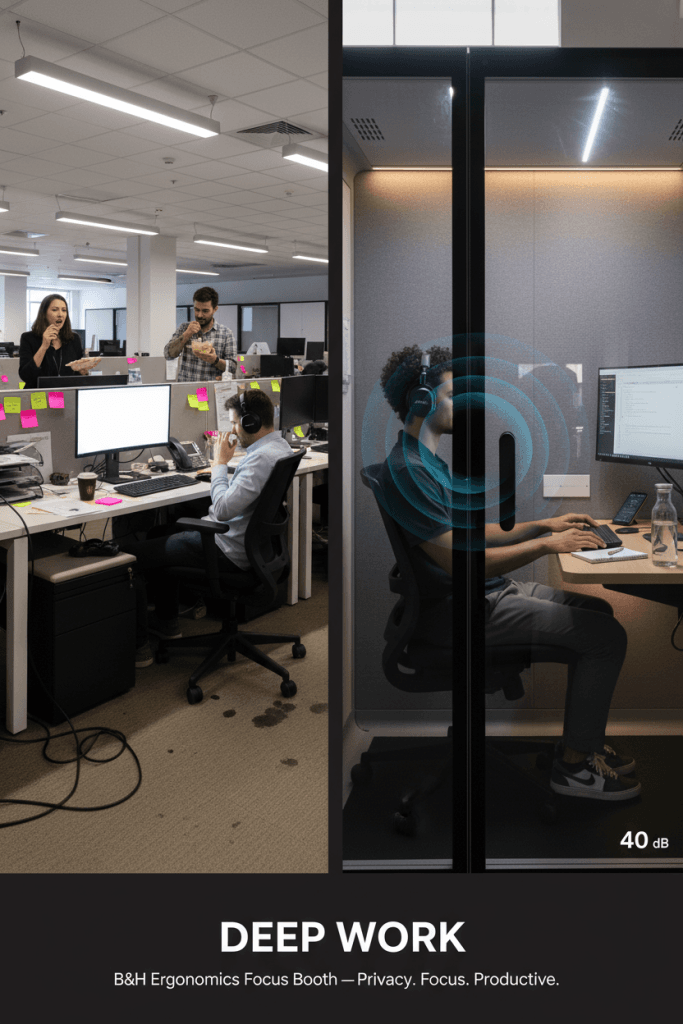
Many companies see noise-canceling headphones as the go-to solution for how to reduce office distractions. This is a common but dangerously flawed assumption. Headphones are, at best, a social signal that says “please don’t talk to me.” They are an imperfect acoustic patch, but they are completely powerless against the silent killer of focus: visual distraction.
Your brain’s limbic system still operates on an ancient “savannah sentinel” protocol. Any movement detected in your peripheral vision is subconsciously flagged as a potential opportunity or threat, forcing a micro-scale “context switch.” A person walking by, a hand waving in the distance, an animated ad on a colleague’s screen—each of these events silently withdraws cognitive resources from your focus account.
Headphones cannot stop this. They create an acoustic island, but you remain adrift in an ocean of visual noise, preventing you from achieving a true flow state at work.
Engineering the Perfect Deep Work Space: Anatomy of a Focus Booth
To achieve genuine deep work, you need an environment that physically severs all sources of external stimuli. A true office focus booth is not just a box; it’s a precisely engineered concentration chamber. Let’s dissect its core components.

Acoustic Isolation: Severing the Triggers for Context Switching
There are two types of auditory distractions. The first is constant, low-level ambient noise (like HVAC hum), which the brain can often adapt to and filter out. The second, and far more destructive, is intermittent, unpredictable impulse noise—a cough, a phone ringing, a sudden laugh. These are the assassins of flow state because they are unpredictable and demand your attention.
A basic pod might use a single layer of material to “block” sound. A professional-grade soundproof work pod, like those in the B&H Ergonomics Work Pods collection, uses a multi-layered, heterogeneous material structure. This “sandwich” approach combines:
- High-Density Steel Panels: To reflect and block airborne sound waves.
- High-density acoustic panel: A dense, flexible polymer layer that dampens vibrations and absorbs mid-frequency sounds (the range of human speech).
- Aluminum Frame with Shock Absorbing
- Acoustic cavity with insulation cotton: To absorb sound energy and prevent it from passing through the wall assembly.
- Another High-density acoustic panel
- PET Acoustic Felt: To absorb interior sound reflections, creating a clear, echo-free internal environment.
This structure is engineered to neutralize the very impulse noises that are most damaging to concentration.
Visual Privacy: Preventing Unconscious Attention Shifts
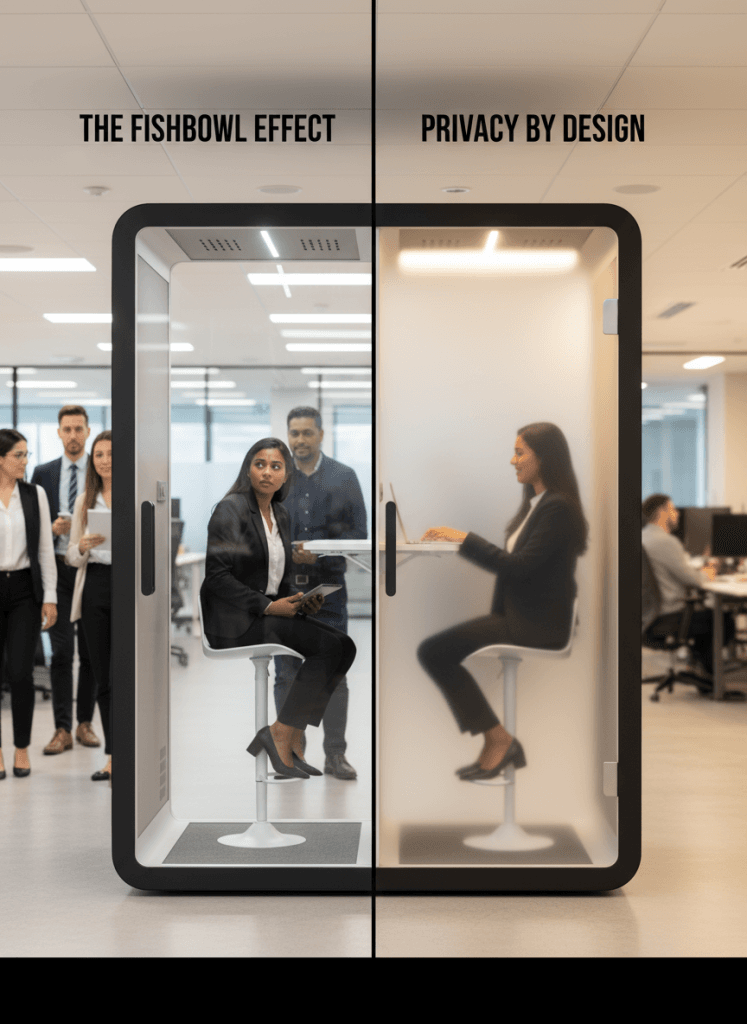
As discussed, your brain’s “savannah sentinel” is always on guard. The primary function of a focus booth is to create a “zone of visual safety.” By providing three solid walls and a controlled entryway, it completely eliminates all dynamic motion from your peripheral vision.
This does more than just prevent you from being “distracted.” When your brain confirms that the visual field is static and safe, it down-regulates its vigilance level. This frees up significant cognitive resources that were previously reserved for environmental monitoring. You stop trying to focus and instead enter a state where focus becomes the effortless default.
Pro Tip: When placing focus booths in an office, position the glass door to face a low-traffic area, like a wall or a window. This minimizes the chance of people walking directly past the user’s line of sight, further enhancing visual privacy. or use B&H smart privacy glass.
Controlled Environment: Reducing Decision Fatigue
Focus is a finite resource, much like muscle strength. It’s depleted by every tiny decision you make throughout the day—a phenomenon known as decision fatigue. “Is this light too bright?” “Is it getting stuffy in here?” “Where is the nearest power outlet?”
A premium focus booth is designed to be a zero-decision environment:
| Environmental Factor | The Problem (Decision Fatigue) | The Focus Booth Solution |
|---|---|---|
| Lighting | Is it too dim? Too harsh? Causing glare? | 4000K Natural Color Temperature Light: Scientifically recognized as optimal for prolonged concentration without causing eye strain. It’s on by default, requiring no adjustment. |
| Air Quality | Is it getting stuffy? Is CO2 building up? | Silent, High-Volume Ventilation: Systems like ours fully exchange the air inside the pod every 1-2 minutes, ensuring a constant supply of fresh, oxygenated air to maintain peak cognitive function, all without creating any audible noise. |
| Ergonomics | Is the desk height right? Are my devices charged? | Integrated, Optimized Workspace: Features a built-in desk at an ergonomic height, with readily accessible power outlets, USB ports, and data connections. You simply sit down and begin working. |
By creating a perfectly optimized default setting, the booth preserves 100% of your willpower for the actual task at hand.
From Anecdote to Asset: Measuring the ROI of a Focus Booth
Stop thinking of a productivity pod as office furniture. Start seeing it as a capital investment in your team’s output. Let’s run a conservative calculation.
Step 1: Calculate the Employee’s Hourly Cost
- Employee Annual Salary: $120,000
- Fully Loaded Cost (Salary + ~30% for benefits, taxes, overhead): $156,000
- Working Hours Per Year (40 hrs/wk * 50 wks): 2,000 hours
- Fully Loaded Hourly Cost: $156,000 / 2,000 = $78/hour
Step 2: Estimate Productivity Loss
- Let’s assume a conservative loss of just 45 minutes of deep work per day due to distractions.
- Daily Productivity Cost: 0.75 hours $78/hour = *$58.50 per day
Step 3: Calculate the Payback Period
- Monthly Productivity Cost: $58.50 20 workdays = *$1,170 per month
- Cost of a single-person focus booth (e.g., B&H Space Oasis Pod S): ~$4,500 (example cost)
- Payback Period: $4,500 / $1,170 per month = ~3.8 months
In this conservative scenario, the focus booth pays for itself in less than four months by recapturing the lost productivity of a single key employee. For a team, the ROI is exponential. This isn’t an expense; it’s one of the most clearly justifiable strategic investments you can make.
Pro Tip: After deploying focus booths, run a simple anonymous survey with your team after 30 and 90 days. Ask them to rate their ability to focus on complex tasks on a scale of 1-10, both before and after the booths were installed. This qualitative data provides powerful support for the quantitative ROI calculation.
Conclusion: Don't Just Manage Distractions, Eliminate Them
You can continue to implement office etiquette policies, buy more noise-canceling headphones, and hope for the best. But these are temporary fixes. You are trying to bail out a sinking boat instead of plugging the hole.
An office focus booth provides a structural, permanent solution. It fundamentally changes the physical environment to eliminate the root causes of distraction. It is not a luxury item; it is an essential professional tool for any modern knowledge-based company that is serious about unlocking its team’s full potential. For a deeper look at the various options available, explore our comprehensive Office Pod Buyer’s Guide.
Ready to Unlock Your Team's True Potential?
Stop letting your most valuable employees struggle in a sea of cognitive noise. It’s time to provide them with the environment they need to do their best work.
At B&H Ergonomics (Space Oasis), we provide scientifically engineered solutions to create pockets of deep work within any office. Our factory-direct model ensures you get world-class engineering at an unparalleled value. We support global DDP shipping with no minimum order, making it possible for businesses of any size to invest in their most important asset: their team’s focus.
A focus booth is specifically engineered for sustained deep work. The office phone booth is mainly for short-term working or phone calls.
Meeting pod for teamwork, it's a big waste to use the meeting pod for 1 person's deep work.
No. Headphones only reduce auditory distractions, and even then imperfectly. They do nothing against visual distractions—movement in your peripheral vision that subconsciously hijacks attention. A focus booth solves both problems by creating a physically controlled microenvironment, enabling true flow state that headphones cannot replicate.
A typical rule of thumb is 1 booth for every 3-5 employees in knowledge-based roles. This ratio ensures availability without overspending. For teams like engineering, R&D, or strategy (where deep work is the core output), a higher ratio—1 booth for every employee—is recommended. Usage data can be tracked post-installation to optimize deployment.
No. Modern focus booths are plug-and-play units. They require only a standard power outlet for integrated lighting and ventilation. Maintenance is minimal—mostly occasional filter clean for ventilation and simple surface cleaning.
On the contrary, focus booths make collaboration more effective. When employees have access to distraction-free time, their contributions in meetings and team discussions are sharper and more creative. Instead of draining energy fighting distractions all day, they bring their best thinking to collaborative settings.

 EN
EN  DE
DE  NL
NL  FR
FR  ES
ES  PL
PL  PT
PT  IT
IT  EN_GB
EN_GB