Quick Answer
An office pod delivery checklist helps facility managers confirm the delivery term, named delivery point, dock or entrance access, unloading plan, freight elevator route, receiving inspection, damage notes, internal module movement, and installation handoff before the pod arrives. The highest-risk moment is signing for freight before checking the packaging, package count, and visible condition.
Last Updated: June 4, 2026 | Author: Richard | Estimated Reading Time: 12 minutes
Start With the Delivery Term, Not the Install Date
The first delivery mistake I see in office pod projects is treating “delivery” as one simple event. For a facility manager, it is a chain of custody. The project moves from supplier to freight carrier, then to the building receiving team, then to the people who move and assemble the pod.
That chain usually has four separate questions:
- Where will the freight carrier stop?
- Who unloads the goods from the vehicle?
- Who moves the package or modules from the delivery point to the final room?
- Who assembles, checks, and signs off the finished pod?
At B&H Ergonomics, standard delivery is typically to the loading dock or downstairs delivery point unless inside movement, upstairs movement, unpacking, or installation has been agreed in the quote or project scope. That distinction matters because a project can be “delivered” to the building while still needing local handling before the pod reaches the final room.
B&H Ergonomics can support DDP delivery for Europe, the United States, the United Kingdom, and Australia. For other countries, the delivery term should be confirmed before order approval. For projects outside those DDP regions, B&H can arrange shipment at least to a nearby seaport and then review the most practical onward delivery option for the destination.
Incoterms are useful because they clarify responsibilities, costs, and risks between buyer and seller, but they do not replace a written site plan. The ICC Incoterms 2020 rules should be treated as a contract language framework, not as a promise that every building service is included. Your purchase order should name the delivery point clearly: seaport, loading dock, downstairs entrance, warehouse, jobsite receiving area, or final-room installation.
Create a Delivery Scope Sheet Before the Truck Is Booked
Before you measure doors or reserve a dock, create a one-page delivery scope sheet. This prevents the supplier, carrier, property manager, and facility team from using the word “delivery” to mean different things.
| Scope Question | Facility Manager Answer | Why It Belongs in Writing |
|---|---|---|
| Named delivery point | South loading dock, ground-floor receiving, warehouse, seaport, or final room | The carrier needs a stop point, not a general office address |
| Unloading included? | Yes, no, or confirm with quote | Delivery terms and unloading service are not always the same thing |
| Inside or upstairs movement included? | Yes, no, local mover, installer, or internal team | Standard freight delivery may stop before the final room |
| Installation included? | Yes, no, internal team, or local installer | Delivery handoff and installation handoff are separate responsibilities |
| Packaging inspection owner | Named person plus backup | Damage notes must be made before signature when visible damage exists |
| Moving equipment owner | Building, mover, installer, or facility team | Avoids a stalled truck and rushed manual handling |
| Damage reporting method | Photos, freight note, delivery receipt, supplier contact, claim window | Protects the support record if freight damage is suspected |
Use this sheet in the purchase file, the building request, and the delivery-day runbook. It is not glamorous, but it is the document that keeps a delivery from turning into a hallway negotiation.
The 10-Business-Day Pre-Delivery Checklist
Use this checklist before the pod ships or as soon as you receive the estimated arrival window.
| Item | What to Confirm | Why It Matters |
|---|---|---|
| Delivery point | Loading dock, downstairs entrance, warehouse, seaport, or final room | Prevents the carrier from stopping somewhere your team cannot receive the goods |
| Delivery contact | Name, phone, email, and backup contact | Freight drivers and building teams need a reachable person |
| Building approval | Property manager, security desk, loading dock booking, certificate or delivery forms if required | Many buildings will not accept freight without notice |
| Delivery window | Business hours, after-hours access, dock appointment, local holiday limits | Office pods often arrive as large packed modules |
| Unloading support | Forklift, pallet jack, dock plate, liftgate truck, or receiving crew | Avoids a stalled delivery when the truck arrives |
| Freight elevator | Door size, cab size, weight rating, booking rules | Confirms whether the package can move upstairs intact |
| Internal route | Doors, turns, corridor width, stairs, ramps, ceiling obstructions | Determines whether the package should stay intact or be opened at the dock |
| Staging area | Clean, dry, secure space near the delivery point | Prevents damage and lost hardware during unpacking |
| Installation team | Internal team, local installer, or professional crew | Delivery and installation are not always the same service |
| Receiving paperwork | Packing list, order reference, photos, freight notes | Essential if visible damage or missing parts must be reported |
If the project is still in model-selection stage, review B&H Ergonomics office pods before locking the delivery plan. A one-person phone booth, a two-person work pod, and a meeting pod can have very different packaging, route, and handling requirements.
Delivery Responsibility Matrix
A smooth office pod delivery is usually the result of clear responsibility, not luck. Assign each task before the truck arrives.
| Task | B&H Ergonomics / Supplier | Freight Carrier | Facility Manager | Building Property Team | Installer |
|---|---|---|---|---|---|
| Confirm packed dimensions and package count | Yes | No | Review | No | Review |
| Confirm delivery term and named destination | Yes | Follow booking | Approve | Approve if building rules apply | Review |
| Book loading dock or receiving area | No | Sometimes | Yes | Approve | No |
| Confirm pallet jack, forklift, liftgate, or dock plate need | Advise | May supply if booked | Confirm | May supply | No |
| Inspect packaging before signature | No | Present delivery | Yes | Optional witness | Optional |
| Note visible packaging damage on paperwork | No | Accept notation | Yes | Optional witness | Optional |
| Move modules upstairs or to final room | Only if agreed | Usually no | Arrange | Permit access | If included |
| Assemble and level the pod | Only if included | No | Coordinate | Permit work | Yes |
| Complete final punch list | Support | No | Lead | Optional | Lead with facility manager |
If one row is unclear, write it into the delivery plan before the shipment is booked. Delivery-day assumptions are expensive.
Measure the Route After You Know the Package Strategy
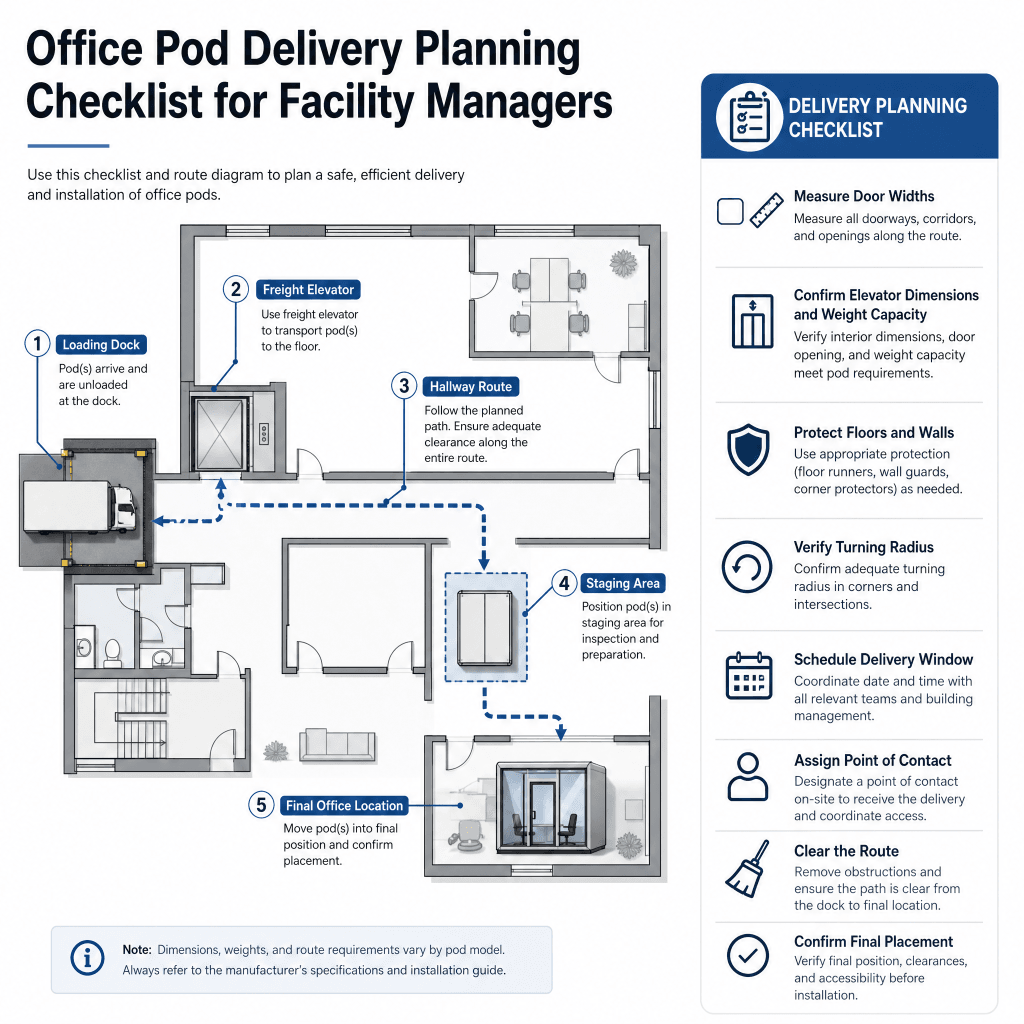
Do not measure the building route in the abstract. First decide which package strategy is likely:
- Move the packed crate or pallet from dock to final room.
- Open the package at the dock and move protected modules.
- Hold the shipment in a secure staging area and install later.
- Hire a local mover for the building portion.
Each strategy needs different measurements. A crate strategy depends on pallet size, elevator limits, and turning clearance. A module strategy depends on the longest panel, glass protection, stair turns, and staging discipline.
Ask the supplier for:
- packed package dimensions;
- largest single flat-pack module size;
- approximate packed weight;
- recommended number of handlers;
- whether glass doors or wall panels require special handling;
- whether the package can be opened at the loading dock and moved in smaller modules.
Then record the measurements that affect the handling decision.
| Route Detail | Why It Matters |
|---|---|
| Dock height and truck access | Determines whether a liftgate or dock plate is needed |
| Freight elevator door and interior | Decides whether packed modules can move upstairs |
| Elevator weight rating | Confirms whether package, equipment, and handlers are within limit |
| Lowest overhead obstruction | Flags pipes, sprinkler lines, signs, or low fixtures during movement |
| Tightest turn | Often decides whether a long glass or wall panel must be carried separately |
| Staging area size | Keeps modules organized before assembly |
| Final-room access | Confirms that the last doorway is workable, not just the dock |
For larger workplace layouts, B&H Ergonomics’ guide to commercial office space planning with office pods can help facility teams connect delivery planning with pod placement, circulation, and future use.
What If the Building Has No Moving Equipment?
Many commercial buildings have a pallet jack, freight elevator, dock plate, or loading dock tools. Some do not. The worst time to discover that gap is when a driver is waiting outside with a packed office pod.
If the building does not have dedicated moving tools, a flat-pack pod may give you more flexibility than a fully assembled enclosure. In some projects, the package can be opened carefully and carried upstairs module by module instead of moving one large crate through the building.
That does not mean the work should be casual. Treat each module as a protected component:
- Keep glass panels upright and protected.
- Keep hardware bags labeled.
- Avoid dragging panels across floors.
- Do not stack heavy parts on ventilation, lighting, or electrical components.
- Keep the packing list with the modules until final assembly is complete.
- Photograph visible package damage before unpacking.
For heavy or awkward materials, follow safe material-handling practices and confirm the rating of any mechanical aid. OSHA’s materials handling and storage guidance is a useful reference for general storage, stacking, and handling precautions, even though your building team or local safety reviewer should make the final site decision.
Use this rule: if the building route is uncertain, do not open the package until you have photographed the outside condition, checked the packing list, and assigned one person to track every module from dock to staging area.
Receiving Inspection Before You Sign
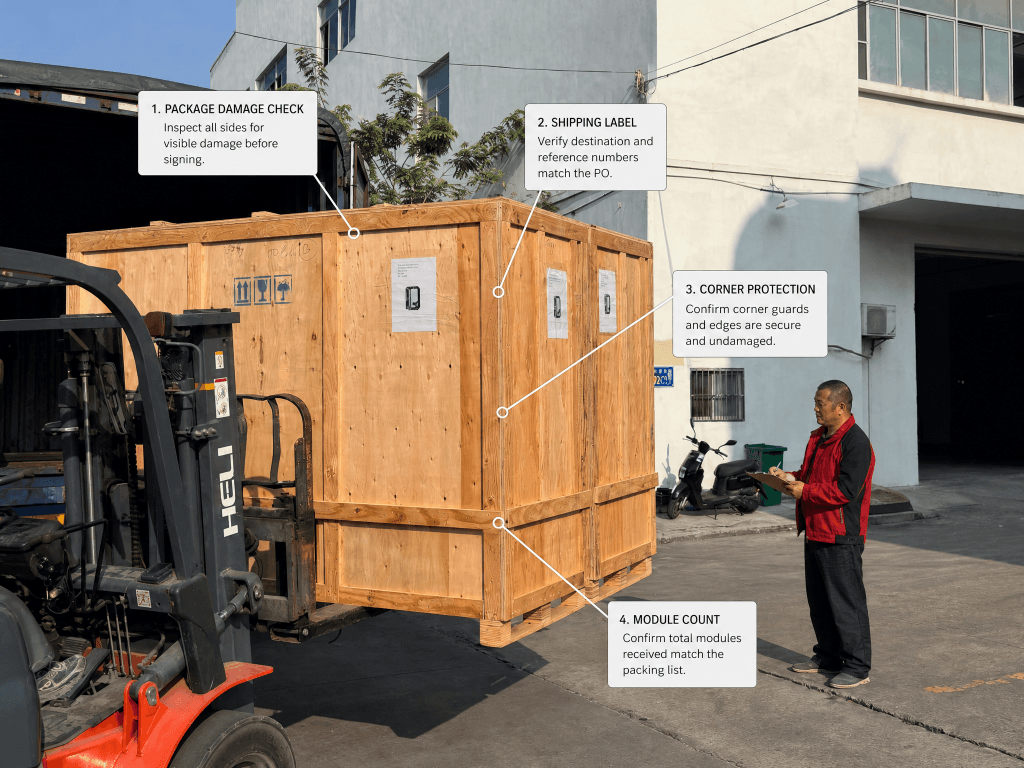
The most important delivery-day rule is simple: inspect the packaging before signing.
If the packaging is clean and intact, record normal delivery photos anyway. If the packaging is dented, torn, wet, crushed, punctured, re-taped, or shifted on the pallet, do not sign as if everything arrived in perfect condition.
| Inspection Point | What to Look For | What to Record |
|---|---|---|
| Outer packaging | Tears, crushed corners, punctures, water stains | Wide photos and close-up photos |
| Pallet condition | Broken pallet, shifted crate, loose straps | Photo of full pallet and affected side |
| Shipping label | Order number, consignee, destination | Clear photo of label |
| Package count | Number of packages against packing list | Count and note mismatch |
| Fragile areas | Impact signs near glass, door, or panel sections | Photo before opening |
| Carrier paperwork | Delivery receipt, bill of lading, damage notation | Write visible package damage before signing |
This is especially important when shipping insurance or carrier review is involved. A visible packaging damage note made before signature is usually more useful than a later message saying the freight looked damaged after the carrier left.
If the driver or receiving desk is rushed, slow the process down. A two-minute inspection can protect a project that took weeks to coordinate.
What to Write When Packaging Is Damaged
Avoid vague notes such as “subject to inspection.” Write what you can see before signature, using plain factual language.
| Visible Condition | Better Freight Note |
|---|---|
| Corner crushed | “Outer carton crushed on lower left corner before signing; photos taken.” |
| Torn wrap | “Stretch wrap torn on long side; panel package visible; photos taken.” |
| Wet packaging | “Outer carton wet on bottom edge before unloading; photos taken.” |
| Loose pallet | “Pallet broken and straps loose at delivery; photos taken before acceptance.” |
| Missing package | “Packing list shows 4 packages; 3 received at delivery.” |
Then send the photos, freight note, delivery receipt, and order reference to the supplier contact. This creates a cleaner evidence chain for carrier review, freight insurance, or replacement-part support.
From Loading Dock to Final Room: Keep a Module Log
Once the shipment is accepted, the next risk is internal movement. This is where the facility manager should decide whether to move the packed package, unpack at the loading dock, or stage the modules closer to the final room.
Moving the packed package can be faster when:
- the loading dock has the right equipment;
- the freight elevator is large enough;
- the path is wide and straight;
- the final room is close to the elevator.
Opening the package and moving modules individually may be better when:
- the elevator is small;
- there are tight turns;
- the route includes stairs;
- the package is too bulky for the corridor;
- the building has no pallet jack or forklift.
If you unpack early, keep the process controlled. Do not scatter parts across the office. Create one staging area, keep labels visible, and separate fragile panels from hardware, frame parts, ventilation pieces, lighting parts, and accessories.
| Module / Package | Moved By | Destination | Condition After Move | Notes |
|---|---|---|---|---|
| Package 1 | ||||
| Package 2 | ||||
| Glass / door module | ||||
| Hardware box | ||||
| Electrical or fan parts |
The point is not paperwork for its own sake. The point is knowing whether a scratch, missing part, or broken component happened in freight, during internal movement, or during assembly.
Installation Handoff and Punch List
Delivery is not finished when the package is inside the building. The facility manager still needs a handoff process after assembly.
Use this punch list before the installer leaves or before your internal team closes the project.
| Area | Check |
|---|---|
| Placement | Pod is in the approved location and does not block circulation, egress, cleaning access, or service access |
| Leveling | Pod is stable, level, and not rocking |
| Door | Door opens and closes cleanly; seals make contact as intended |
| Panels | Glass, acoustic panels, frame, ceiling, and floor pieces show no visible damage |
| Ventilation | Fans operate as expected and vents are not blocked |
| Lighting | Lights turn on and controls work |
| Power | Outlet, USB, and power connection work as specified |
| Cable path | No trip hazard from the power cord |
| Hardware | No loose screws, missing caps, or leftover unidentified parts |
| User readiness | Booking rules, cleaning rules, and use guidance are ready |
| Support record | Photos, order number, warranty contact, and remaining issues are stored |
If the project touches fire safety, accessibility, sprinkler clearance, electrical routing, or local authority review, do not treat this checklist as a code decision. Use the B&H Ergonomics office pod compliance guide and confirm the final installation with your building team, landlord, electrician, or local reviewer.
Office Pod Delivery Checklist Template
Copy this checklist into your project file.
Before Shipment
- Confirm the final delivery term and named destination.
- Confirm whether delivery is to seaport, loading dock, downstairs entrance, warehouse, final room, or another named point.
- Confirm whether unloading, upstairs movement, inside delivery, unpacking, and installation are included.
- Ask for packed dimensions, package count, largest module size, and approximate packed weight.
- Ask whether the pod can be moved as flat-pack modules if the full package cannot reach the room.
- Confirm whether the project is DDP, port delivery, dock delivery, or another delivery arrangement.
10 Business Days Before Arrival
- Book the loading dock or building receiving area.
- Reserve the freight elevator.
- Confirm building access hours, security rules, and required delivery paperwork.
- Confirm pallet jack, forklift, liftgate, dock plate, or moving crew needs.
- Walk the full route from truck to final room.
- Choose a clean, dry, secure staging area.
- Share delivery contact and backup contact with the supplier.
Delivery Day
- Inspect packaging before signing.
- Photograph every side of the package.
- Photograph shipping labels and order references.
- Compare package count with the packing list.
- Write visible package damage on the carrier paperwork before signing.
- Keep copies of delivery paperwork.
- Move the package or modules only after the route and equipment are ready.
After Assembly
- Check placement, leveling, door operation, panels, ventilation, lighting, and power.
- Record photos of the completed pod.
- Store warranty and support information.
- Create a short user notice for booking, cleaning, and daily use.
- List any unresolved issue as a punch-list item with owner and due date.
When to Ask B&H Ergonomics for Help
Ask B&H Ergonomics to review the destination, delivery point, access route, and project timing before final order approval when:
- the project includes multiple pods;
- the building is a high-rise office;
- the site has no loading dock or freight elevator;
- the final room requires tight turns, stairs, or after-hours access;
- the shipment is outside standard DDP regions;
- the buyer needs inside delivery, installation, or project-specific delivery coordination.
For a simple project, the right question is not only “when will it arrive?” Ask:
- Where exactly will the carrier deliver?
- What is excluded from the delivery service?
- Can the package be moved as modules?
- What should we inspect before signing?
- What photos should we keep for support or freight review?
That is how a facility manager turns office pod delivery from a risky handoff into a controlled project step.
FAQ
Does office pod delivery include upstairs movement?
Not automatically. B&H Ergonomics typically delivers to the loading dock or downstairs delivery point unless upstairs movement, inside delivery, or installation is specifically included in the project scope. Always confirm the named delivery point before order approval.
What should I inspect before signing for an office pod shipment?
Check the outer packaging, pallet condition, shipping label, package count, visible impact marks, water damage, and re-taped areas. If packaging is damaged, photograph it and write the visible damage clearly on the carrier paperwork before signing.
Can an office pod be moved without a forklift?
Sometimes, if the pod can be unpacked and moved as separate protected modules. The facility manager still needs enough people, safe handling practices, a clear route, and a controlled staging area. Heavy or fragile modules should not be dragged, rushed, or handled without planning.
Does DDP delivery include installation?
No, not unless installation is included in the quote or written project scope. DDP can clarify responsibilities for delivery to a named destination, but it should not be treated as automatic unloading, upstairs movement, final-room placement, or assembly.
Who should prepare the loading dock and receiving area?
The facility manager should coordinate the building access plan unless another party has accepted that responsibility in writing. The quote or delivery plan should state whether unloading support, liftgate service, dock delivery, inside delivery, or installation is included.