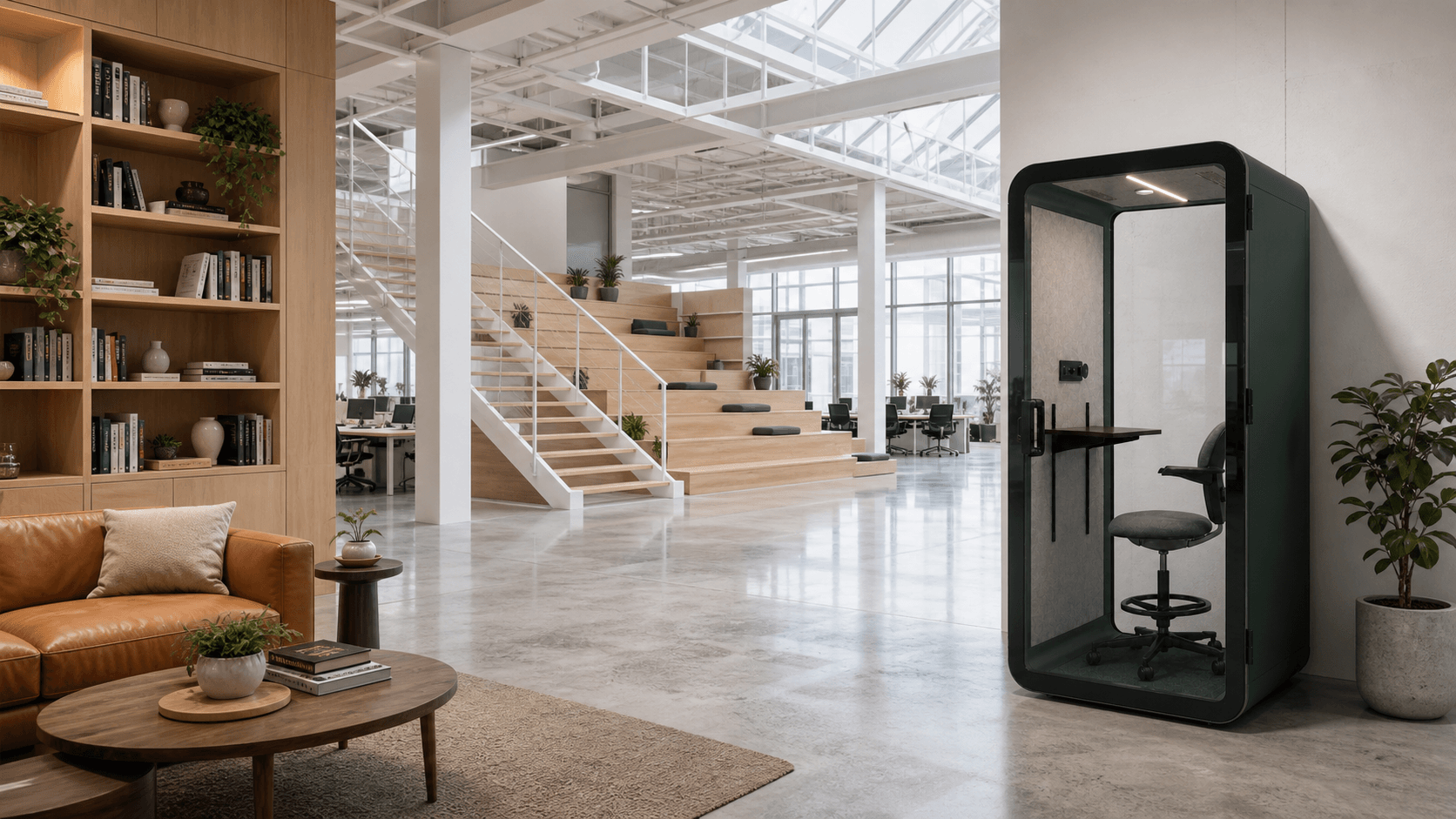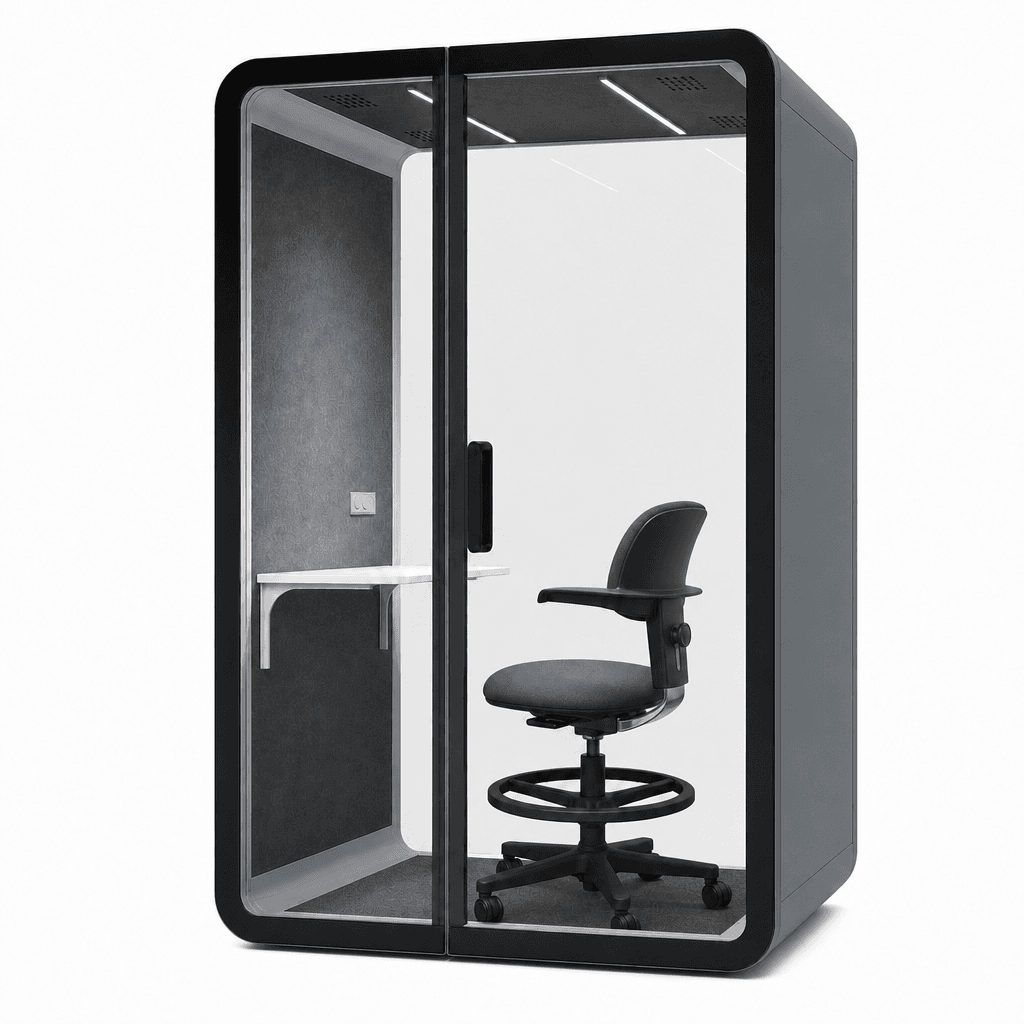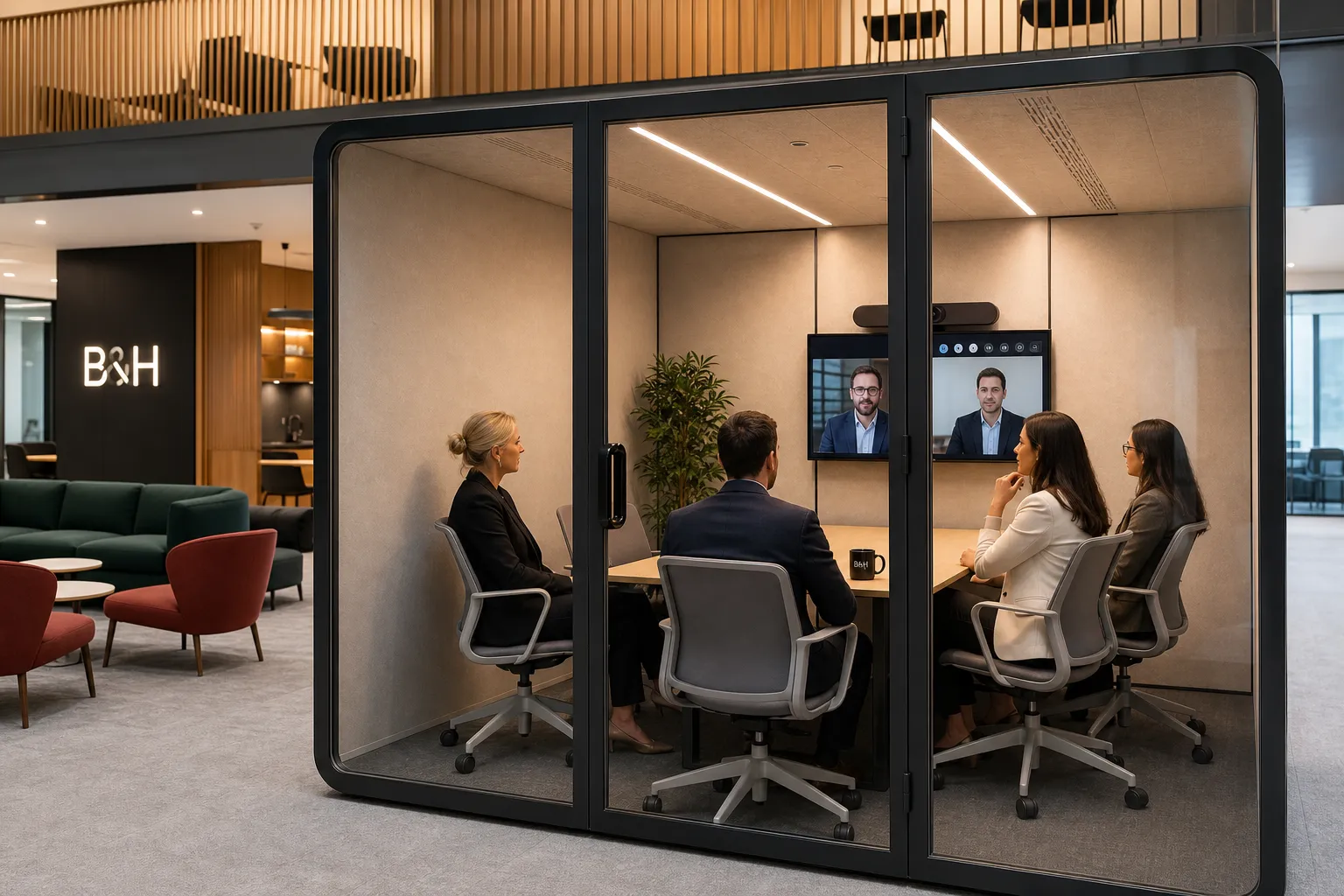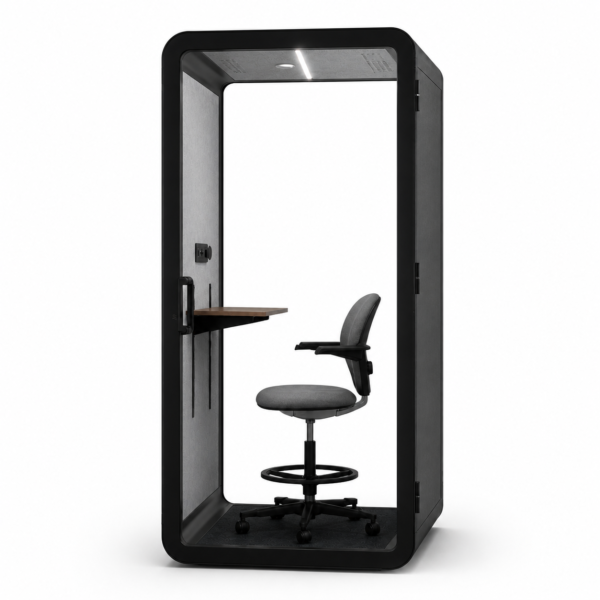
Quick Answer
An office pod is a modular enclosed workspace used inside an office for private calls, focused work, small meetings, and confidential conversations without permanent construction. This office pod guide helps workplace teams choose the right pod type, estimate demand, plan placement, compare acoustic claims, and prepare a cleaner buying checklist before requesting a quote. If you are already ready to compare pod models, sizes, and quote options, go directly to the B&H Ergonomics office pods collection.
Fast Buyer Path
| If Your Main Need Is… | Best Next Step |
|---|---|
| Compare all office pod types and models | View the office pods collection |
| Private calls or short video meetings | Start with office phone booths |
| Focus work or longer solo sessions | Compare work pods |
| Small team meetings or hybrid collaboration | Compare meeting pods |
Last Updated: June 29 th, 2026 | Author: Richard | Estimated Reading Time: 15 minutes
What Is an Office Pod?
An office pod is a self-contained workspace enclosure placed inside an existing workplace. Most office pods combine acoustic materials, glass or solid panels, ventilation, lighting, power access, and a door system. The goal is not perfect silence. The practical goal is to create a more controlled space for work that needs privacy, fewer interruptions, or better speech privacy.
Office pods are commonly used when a workplace has:
- Too many calls happening at open desks
- Too few private rooms for HR, sales, or one-on-one conversations
- Employees who need focused work time in open-plan offices
- Meeting rooms that are overbooked for short discussions
- A need for flexible enclosed space without drywall construction
If your team is already ready to compare models, start with the B&H Ergonomics office pods collection. If you are still planning, use this guide to define the right type, quantity, location, and buying requirements first.

How This Guide Works With the Office Pods Collection
Use this guide when you are still learning how office pods work, which pod type fits each use case, how many pods your office may need, and what to check before requesting a quote.
Use the office pods collection when you are ready to compare product options, review available pod categories, and request pricing for a real project.
| Buyer Stage | Best Page to Use | Why |
|---|---|---|
| Learning what office pods are | This office pod guide | Explains pod types, use cases, placement, comfort, acoustics, and buying checks. |
| Choosing between phone booths, work pods, and meeting pods | This office pod guide first, then the collection page | Helps define the right category before comparing models. |
| Comparing product options or requesting a quote | Office pods collection | Shows commercial product paths and the next step for buyers. |
| Planning a larger office project | This guide plus the collection page |
Office Pod Types: Phone Booths, Work Pods, and Meeting Pods
The first buying mistake is treating every pod as the same product. A phone booth, a work pod, and a meeting pod support different behaviors.
| Pod Type | Typical Capacity | Best For | Not Best For |
|---|---|---|---|
| Office phone booth | 1 person | Short calls, video calls, sales calls, HR conversations | All-day seated work or multi-person meetings |
| Work pod | 1-2 people | Deep work, analysis, writing, coding, interviews, manager check-ins | High-turnover call traffic or frequent group meetings |
| Meeting pod | 4-6 people | Small team discussions, hybrid meetings, client conversations, project reviews | Short single-user calls when a smaller booth would be more efficient |
At B&H Ergonomics, office phone booths, work pods, and meeting pods are all part of the modular office pod family. Modular is not a separate fourth product type here; it is the construction approach that supports easier shipping, self-assembly, relocation, customization, and project flexibility.
For deeper category guidance, see the office phone booth guide, work pod guide, and acoustic meeting pods guide.
How to Choose an Office Pod by Use Case
Start with the work behavior, not the product photo. The best office pod selection usually starts with one question: what will people actually do inside the pod?
If the Main Need Is Private Calls
Choose a 1-person phone booth when the main problem is call privacy. This is usually the right fit for sales teams, customer support, HR conversations, telehealth calls, short Zoom meetings, and offices where employees leave the room to take calls in hallways.
If the Main Need Is Uninterrupted Focus
Choose a work pod when users need more than a short call space. For developers, analysts, writers, designers, managers, and finance teams, a work pod should feel like a small private workstation rather than a narrow standing booth.
If the Main Need Is Small-Group Collaboration
Choose a meeting pod when the office has overbooked meeting rooms or needs a flexible alternative to a fixed conference room. A 4-person or 6-person pod can support project discussions, leadership check-ins, interviews, and hybrid meetings without weeks of construction.
If the Main Need Is Layout Flexibility
Choose the right pod type first, then confirm that the model uses a modular structure. This matters for growing teams, coworking spaces, hybrid offices, and leased buildings where permanent construction creates cost, disruption, or landlord approval issues.

How Many Office Pods Do We Need?
Pod quantity should be planned by peak demand, not just headcount. A 100-person office does not automatically need a fixed number of pods. It needs enough enclosed space for the moments when calls, focus work, and small meetings happen at the same time.
A practical planning method:
- Observe peak use for one to two weeks.
- Record how many private calls, focus sessions, and small meetings happen at busy times.
- Separate demand by department, such as sales, HR, finance, engineering, and management.
- Decide which pods should be bookable and which should be first-come-first-served.
- Start with a pilot layout when demand is uncertain, then expand after real usage data.
| Planning Signal | What It Usually Means | Better First Step |
|---|---|---|
| Sales calls spill into hallways | Not enough private call space | Add phone booths near sales or support teams. |
| HR or finance conversations happen in public areas | Confidentiality risk | Add phone booths or 2-person work pods near those teams. |
| Developers or analysts cannot find quiet time | Focus space shortage | Add work pods near the relevant team zone. |
| Meeting rooms are booked for two-person conversations | Room mismatch | Add small pods so large rooms stay available. |
| One pod is always occupied | Demand is higher than capacity | Add another pod or split use cases by pod type. |
The right answer may be fewer pods than expected if placement is good and booking behavior is clear. It may also be more pods than expected if several departments need privacy at the same peak hours.
Where Should an Office Pod Go?
Placement has a direct effect on whether a pod gets used. A pod should be close enough to the team that needs it, but not so exposed or noisy that people avoid it.
Use this placement checklist:
- Place pods near the teams that will use them most often.
- Avoid reception, pantry, printers, and loud collaboration zones when possible.
- Confirm door swing and glass door clearance before final placement.
- Keep circulation paths, emergency egress routes, and accessible routes clear.
- Leave enough space for cleaning, maintenance, and panel access.
- Confirm nearby power access and avoid cable trip hazards.
- Consider HVAC supply/return locations and sprinkler coverage questions.
- Check ceiling height, floor conditions, and the route from delivery point to final location.
- Leave sensible pod-to-pod spacing so one busy pod does not make the next pod feel exposed.
For complex projects, especially healthcare, education, public buildings, or enterprise offices, placement should be reviewed with the building manager or the relevant project professional.
B&H Office Pod Path by Use Case
This guide should help you decide what category you need. The commercial product comparison belongs on the office pods collection, but the basic path is simple:
| Buyer Need | Recommended B&H Path |
|---|---|
| Private calls and short video meetings | Start with office phone booths. |
| Focus work or longer solo sessions | Start with work pods. |
| Small group meetings or hybrid collaboration | Start with meeting pods. |
| Mixed workplace privacy across departments | Start with the full office pods collection. |
All of these B&H pod categories use modular office pod construction. The difference is the use case and capacity, not whether the product is modular.
Office Pods vs Fixed Rooms and Drywall Construction
Office pods are not the only way to create privacy, but they are often the faster and more flexible option inside an active office.
| Option | Best For | Tradeoff |
|---|---|---|
| Modular office pod | Fast privacy, flexible placement, relocatable workspace | Requires floor space and delivery access |
| Fixed room or drywall | Permanent room layouts and architectural integration | Slower, messier, harder to relocate, usually more disruptive |
| Cubicles | Visual separation and desk zoning | Limited acoustic privacy and no true enclosure |
| Acoustic panels | Reducing echo and reflected noise | Do not create an enclosed private room |
If the office needs a movable solution with less construction disruption, a pod often makes more sense than drywall. If the office wants a permanent architectural change and can accept construction time, fixed rooms may still be appropriate.
Acoustic Privacy: Terms Buyers Should Not Confuse
Acoustic privacy is one of the most misunderstood parts of office pod buying. A useful pod does not need to promise total silence. It needs to reduce speech distraction and make conversations less intelligible outside the pod.
| Term | Plain-English Meaning | Buyer Note |
|---|---|---|
| Sound absorption | Reduces echo and reflections inside a space | Useful for voice comfort, but does not automatically block sound leaving the pod. |
| Sound isolation | Reduces sound transmission between inside and outside | Depends on walls, glass, seals, door, floor, and ventilation paths. |
| Speech privacy | Makes speech harder to understand outside the pod | Usually more useful than chasing a vague “soundproof” claim. |
| STC | A lab rating often used for partitions or components | Helpful context, but not always the same as full pod performance. |
| NIC | A field measurement of noise isolation in a real environment | Often lower than ideal lab results because installation and site conditions matter. |
| ISO 23351-1 speech level reduction | A test method used for furniture ensembles and enclosures | Useful for comparing pod-like products when the full product is tested. |
| Factory-tested sound level difference | A controlled internal measurement | Useful only when the test setup and method are clearly explained. |
For B&H Ergonomics, Intertek tested Elite-S under ISO 23351-1:2020, and Elite-S achieved Class A acoustic performance with 33 dB speech level reduction. In B&H office testing under controlled conditions, Elite-S also showed approximately 40 dB sound level difference.
These are not the same metric. The 33 dB result refers to ISO 23351-1 speech level reduction. The approximately 40 dB result refers to an office-tested sound level difference under controlled conditions. Neither should be read as a universal promise that every real office will experience the same reduction. Acoustic results vary by test method, installation, site conditions, and measurement setup.
Ventilation, Lighting, Power, and Daily Comfort
A pod that looks good but feels stuffy will not be used. Comfort is especially important for work pods and meeting pods because people stay inside longer than they do in a quick call booth.
Check four comfort areas:
| Feature | What to Check | Why It Matters |
|---|---|---|
| Ventilation | Airflow path, fan noise, inlet/outlet position, service access | Weak airflow makes the pod uncomfortable; noisy airflow weakens the privacy experience. |
| Lighting | Brightness, color temperature, face lighting for video calls | Poor lighting makes video meetings look unprofessional and can cause eye strain. |
| Power | AC outlets, USB-A/USB-C, cable routing, device placement | Users need to charge laptops, phones, screens, and conferencing equipment. |
| Ergonomics | Interior width, desk depth, seat movement, screen distance | A pod used for focus work must support real working posture, not only short occupancy. |
For long-session work pods, ventilation and ergonomics should be weighted at least as strongly as exterior appearance.
Customization: Size, Color, and Office Style Fit
Office pods should not feel like random boxes dropped into a finished workplace. For corporate offices, coworking spaces, law firms, healthcare offices, and design-led interiors, appearance still matters.
B&H Ergonomics can support size and color customization so a pod can fit different office styles. This can include exterior color direction, interior finish direction, and project-specific size discussions when standard models do not match the layout.
Customization is useful when:
- The office has a specific brand color palette
- The interior design needs a calmer or more premium finish
- The pod must fit a narrow or unusual floor plan
- Multiple departments need different pod types but a consistent look
- A dealer or project buyer needs a repeatable style for several sites
Custom size, color, and finish decisions should be confirmed before the quote is finalized because they can affect lead time, production planning, freight packaging, and final cost.
Office Pod Cost Basics: What the Quote Should Separate
This guide should not replace a formal quote. Still, buyers should know which cost buckets to separate before comparing suppliers.
| Cost Bucket | What It Covers |
|---|---|
| Product price | Base pod model and standard specification |
| Customization | Size, color, finish, and project-specific changes |
| Freight and delivery | International shipping, destination delivery, and unloading terms |
| Duties and import handling | Customs-related charges where applicable |
| Self-assembly support | Documentation, packaging logic, and customer-side setup |
| Optional local installation | Third-party assembly help when the buyer requests it |
| After-sales support | Replacement parts, service help, and warranty handling |
If your team is comparing products or preparing a purchase request, use the office pods collection as the next step.
The safest way to compare quotes is to separate product price, customization, shipping, unloading, installation support, and after-sales service. A lower product price is not always the lower project cost if freight, duties, site handling, or installation support are unclear.

DDP Shipping, Self-Assembly, and Support
B&H Ergonomics supports DDP shipping for many office pod projects. DDP can make the landed cost clearer because import clearance, duties, and delivery to the agreed destination are handled in the quoted delivery arrangement.
DDP does not automatically mean final-room placement, unpacking, assembly, or installation unless those services are clearly included in the quote. For office pod buyers, the quote should clarify the delivery point, tail lift or unloading support, who moves components from the delivery point to the final room, and whether the buyer will self-assemble.
B&H can help contact a local installation company when a customer needs outside installation support. That service is usually not cheap. For standard projects with a capable facilities team, simple self-assembly can reduce dependence on expensive site labor. For large enterprise, healthcare, education, or public-building projects, installation choices should be reviewed against site rules, insurance requirements, safety expectations, and electrical requirements.
Warranty, Lead Time, and Compliance: Keep These as Checks
Warranty, lead time, electrical certification, and destination-market compliance are important, but they should not take over this guide. Treat them as final checks before purchase, then use the dedicated office pod compliance guide for deeper compliance planning.
Before ordering, ask:
- What is the warranty period for structure, electrical components, and finishes?
- Are replacement parts available for fans, lights, seals, and power components?
- What is the real production lead time, not just the best-case estimate?
- Are electrical components suitable for the destination market?
- Does the buyer need UL-related evidence, CE documentation, or another destination-market document?
- Are there local fire, sprinkler, accessible route, or building-manager requirements?
For compliance-heavy projects, confirm requirements with the building owner, local authority, or qualified professional before purchase.
Office Pod Buying Checklist
Before sending a quote request, prepare these details:
- Primary use case: calls, focus, meetings, confidential work, or mixed use
- Desired capacity: 1, 2, 4, or 6 people
- Estimated peak demand by department
- Whether pods should be bookable or first-come-first-served
- Destination country, city, and delivery address type
- Preferred size, color, and finish direction
- Acoustic privacy expectation and whether third-party test evidence is required
- Power and device charging needs
- Placement constraints, including door swing, egress, cleaning space, and cable routing
- Whether the buyer will self-assemble or request optional local installation support
- Timeline, budget range, and procurement process
The more complete this information is, the easier it is to avoid quote revisions, freight surprises, and mismatched pod recommendations.
FAQ
An office pod is used to create enclosed privacy inside an existing workplace. Common uses include phone calls, video meetings, focused individual work, HR conversations, interviews, small meetings, and confidential discussions in open offices.
There is no universal ratio. Estimate demand by observing peak call, focus, and meeting needs for one to two weeks, then separate demand by department. Many teams start with a pilot layout, measure occupancy, and add more pods only when usage data justifies it.
Place it close to the team that will use it most, but away from pantry noise, reception traffic, and loud collaboration zones. Confirm power access, door swing, emergency routes, cleaning clearance, HVAC or sprinkler considerations, and the delivery route before final placement.
No office pod should be treated as completely soundproof in every environment. A better goal is acoustic privacy and speech privacy. Ask for the test method, full-pod results, seal design, ventilation design, and third-party evidence when acoustic performance matters.
Sometimes. Requirements depend on the building, region, electrical configuration, fire safety expectations, placement, and use case. For enterprise, healthcare, education, or public-building projects, confirm with the building owner or qualified local professional before purchase.