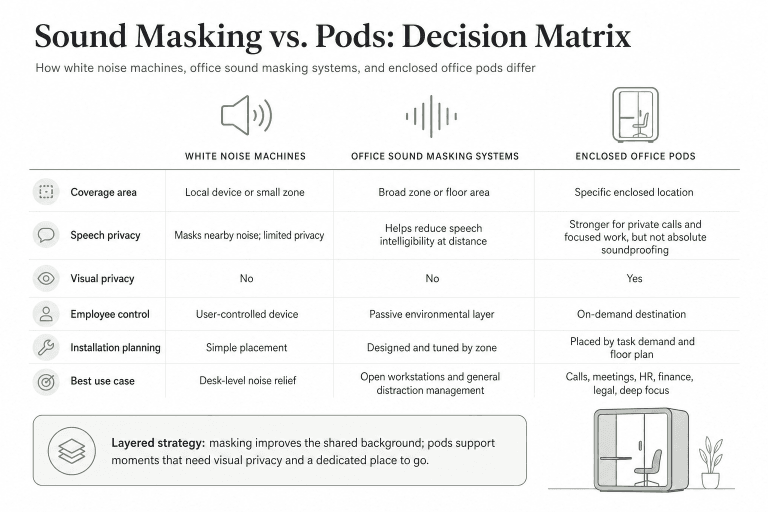
A sustainable office upgrade starts with the equipment you already own. Keep assets that remain safe and useful, repair replaceable parts, and relocate items that fit the next space at a sensible cost. Buy new when those options cannot meet the requirement, then check the supplier’s material, repair and environmental evidence before choosing a product.
My starting question is simple: what actually needs to change? A dated desktop, a worn door seal and a shortage of private meeting space call for different decisions. Identify the problem before asking for replacement quotes.
Last Updated: September 23, 2026 | Author: Richard

Start with what your office already has
Walk through the office with the asset list and record each item’s model, location, condition, current use and known faults. Include the next layout: equipment that works well today still needs to fit the people and activities planned for the space.
At B&H Ergonomics, my recommendation for a one-to-three-year-old office pod is to keep it if the hardware, electrical systems and acoustic seals are in good condition and it still meets your team’s needs. Inspect those components before deciding to replace it.
Ask finance to check the remaining book value and disposal implications before retiring an asset. I would still keep a fully depreciated pod if it works well and meets the brief. Its accounting value does not tell you whether it needs replacing.
Write down the reason for each proposed change. If the desktop finish no longer matches the office, get a price for a new top. If the lifting mechanism has failed, get a repair assessment. Those are different jobs with different costs.
Keep, repair, relocate or buy: a decision table
| Choice | Use it when | Check before approving | Office example |
|---|---|---|---|
| Keep | The asset is safe, functional and still suited to its users | Condition, capacity, comfort and maintenance needs | A one-to-three-year-old pod with sound hardware, electrical systems and seals |
| Repair or refresh | The problem is limited to replaceable components or finishes | Part compatibility, service availability, repair cost and expected continued use | Replace a worn desktop or a damaged pod door seal |
| Relocate | The asset remains useful and fits the destination | Access route, dimensions, dismantling method, total moving cost and remaining service life | Move a serviceable modular pod into a new office layout |
| Buy new | Existing assets cannot meet the requirement, or repair and relocation are impractical | Required function, suitable alternatives, whole installed cost and supplier evidence | Add an appropriately sized pod where existing rooms cannot meet private-call demand |
I would check custom reception counters and fitted cabinets against the new floor plan before including them in a move. An item built around an awkward corner can require more cutting and rebuilding than it is worth. If it cannot be reused in the new space, consider leaving it with the premises by agreement, selling it or transferring it to another user.
Repair the part before replacing the whole product
Refresh a desk around its working frame
When a desktop looks dated but the frame is stable and the lifting system operates correctly, price a replacement top first. Check its dimensions, weight, fixing positions and compatibility with monitor arms and other accessories. Include the desktop and equipment in the frame’s load review.
For our BH-D23RS standing desk frame, we provide a five-year frame warranty and three years for motors, control boxes and hand controls. We confirm the final terms in the quotation. If the base is working properly and you want a different desktop finish, I recommend checking a compatible replacement top before replacing the whole desk.
Request a quote for a compatible top, fitting and any required adjustments. Compare that total with replacing the desk, taking the frame’s condition and applicable warranty terms into account.
Inspect pod door seals and hardware
If a pod has cracked door seals or gaps caused by loose hinges, I would assess a repair first. Send the supplier the model and photographs, and request a quote for compatible seals, hinge or latch work, labor and downtime. Have an appropriate service technician handle glass-door hardware.
Repair is worth pursuing when the rest of the pod remains serviceable and the quoted work will address the fault at a reasonable cost. Before approval, agree the acceptance checks: reliable door closure and latching, consistent seal contact and no unintended gaps. If measured acoustic performance is required, include that check in the scope; a visual inspection cannot establish a sound-isolation result.
Check whether relocation is worth it
Before deciding to move an asset, I would compare two complete quotes: returning it to service at the destination, and buying and installing a replacement that meets the same need.
Relocation cost = dismantling + protective packing + transport + reassembly + required repairs or adaptations + temporary arrangements during downtime.
Replacement cost = purchase + delivery + installation + removal or transfer of the old item, less any confirmed resale proceeds.
Avoid counting the same disposal or resale item twice. Compare the likely remaining service of the existing asset with the replacement, especially when the upfront costs are close.
For low-value furniture, moving costs can exceed the delivered and installed cost of a suitable new item. In that case, moving it solely to avoid a purchase can be a poor financial choice. For an office pod, the value of the working enclosure can justify a more involved relocation, provided it fits the route and destination.
Keep the cost comparison separate from any emissions calculation. To compare carbon footprints, you also need evidence covering transport, replacement parts, continued use and the alternative purchase.
Ask the installer to confirm access dimensions, the dismantling method, replacement parts and the checks needed before the pod goes back into use. Include those items in the moving quote, even when the product is described as modular.
Ask suppliers for evidence before buying new
If your existing assets cannot provide the enclosed space you need for calls or small meetings, compare our office pods against your required occupancy, footprint and service needs. Review the documents for the configuration you are considering, including when you buy from us.
The US Federal Trade Commission’s Green Guides summary advises against broad, unqualified claims such as “green” or “eco-friendly.” It also distinguishes recycled-content claims from recyclability claims, including the availability of suitable recycling facilities. Use that guidance to ask for specific claims and supporting documents.
Use a procurement evidence table
Record evidence source separately from review outcome. A supplier declaration can meet a requirement that accepts declared material content. It cannot satisfy a requirement for third-party certification on its own. For each claim, check the quoted product, document scope and required form of evidence before marking it meets requirement, needs clarification, does not meet requirement or not applicable, with a reason.
| Claim or requirement | Evidence to request | What to check | If evidence is missing or does not match |
|---|---|---|---|
| Recycled material content | Declaration with material code, recycled percentage, input source and calculation method | Post-consumer and pre-consumer content separately; what total the percentage uses, such as PET fiber mass or finished-panel mass; match to the quoted material | Request the missing scope or calculation details before accepting the percentage |
| Material sourcing | Material specification and any claimed sourcing certificate | Supplier, covered material, certificate scope, validity and connection to the quoted item | Leave the sourcing claim unverified |
| Low emissions | Relevant emissions test report or certification | Tested product or finish, method, date and applicability to the ordered configuration | Do not treat “low VOC” wording as evidence that the specified product passed a test |
| Repairability | Parts list, replacement instructions and service terms | Seals, hinges, locks, fans and controls that can be replaced; prices, availability and lead times | Price the service uncertainty or require a parts commitment |
| Repeated disassembly | Dismantling and reassembly instructions | Required skills, tools, access, packaging and components that must be renewed | Do not assume repeated moves are straightforward |
| Recyclability | Material separation guidance and a receiving route | Adhesives, coatings, mixed materials, dismantling requirements and local acceptance | Record that end-of-use recycling is not yet arranged |
| Environmental footprint | Product-specific environmental product declaration (EPD) or life-cycle assessment (LCA), if claimed or required | Product match, issue date, verification status, included life-cycle stages, service-life assumptions and units used for comparison | Avoid a quantified footprint comparison without compatible evidence |
| Warranty and after-sales support | Written terms for the quoted model | Coverage by component, exclusions, service process and responsibility for labor or shipping | Clarify the terms before order approval |
When comparing EPD or LCA figures, first check that the documents cover comparable functions, life-cycle stages and assumptions. I would only use them to support a preference once those comparison boundaries are clear.
If a tender requires a particular certificate or test, treat missing evidence as an unmet requirement until resolved. For an optional claim, leave it out of the comparison rather than assigning it an assumed benefit.
For each request, record the supplier and quoted model, exact claim, material code, document reference and date, evidence source, supplier response, review outcome and next action. Keep the reviewer and review date with the decision so another buyer can understand why the evidence was accepted.
Read a PET declaration at material level
The PET acoustic material we specify contains at least 50% post-consumer recycled PET, according to our supplier’s material declaration. This percentage applies to the PET material covered by that declaration, not to the complete pod. When reviewing a quotation, match the declared material to the material specified for your pod.
Check the material code, declaration date and calculation basis. Ask whether the percentage is measured against the PET fiber, the finished panel or another stated total. For a mass-based claim, the calculation should identify the eligible recycled mass and the total material mass used as the denominator. Ask suppliers to distinguish post-consumer material from pre-consumer inputs and explain how production scrap is classified under the stated method; the word “scrap” alone does not establish eligible recycled content.
Recycled content describes the input used to make a material. Recyclability concerns what can happen after use. For PET panels and aluminum frame components, ask how they can be separated and which recycler will accept them in their actual condition. A recyclable base material does not establish an available recycling route for the assembled pod.
Record the decision and review it after use
Keep a short decision record for each asset or group of identical items:
- Asset identification, condition and the function it must provide.
- Decision: retain, repair, relocate or replace, with the reason and compared costs.
- Supporting quotations, material declarations, warranty terms and service instructions.
- Work completed, parts replaced, destination or recipient, and acceptance checks.
- Responsible person and the next inspection or review date.
For an ESG program, I recommend starting with records you can substantiate: assets retained, repairs completed, products transferred and documented material content. Use measured weights when reporting weight. If your target requires avoided-emissions figures, agree the baseline and calculation method with the person responsible for that reporting.
At the next review, check whether the repair held, the relocated item is being used and the promised spare parts or service were available. Use those results to decide what to keep and what to require from the next supplier.