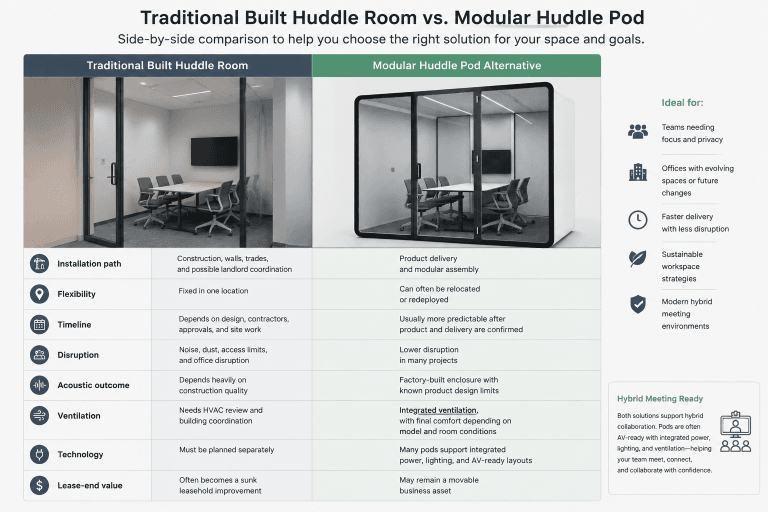
Quick Answer
Temporary meeting pods make sense when short-notice meetings are a recurring capacity problem, not a one-time emergency. If a team needs a room immediately and is unlikely to need it again, renting an office or creating a simple temporary meeting area is more realistic than buying a pod. Buying becomes a stronger option when meetings regularly compete for too few rooms and the pods will remain useful after the immediate shortage ends.
Last Updated: July 31, 2026 | Author: Richard | Estimated Reading Time: 7 minutes
What Does “Temporary” Mean for Your Office?
The word “temporary” can describe very different workplace problems. Those differences determine whether buying a pod is practical.
A One-Time Emergency
A team may need a private room today, this week, or for one isolated event. A purchased meeting pod is usually the wrong response because product selection, delivery, placement, and setup cannot solve an immediate need as quickly as a nearby rented office or a basic temporary meeting area.
A Defined Project or Renovation Phase
A project team may lose access to meeting rooms for a planned period while an office is renovated or reconfigured. A pod can work in this situation when the project schedule allows time for procurement and there is a clear use for the pod after the temporary phase. Without that second use, a short-term space rental may still be more practical.
A Recurring Room Shortage
Some offices call meetings “temporary” because they are arranged at short notice, but the shortage itself is permanent. Teams repeatedly search for rooms, small groups occupy rooms that are larger than they need, and private discussions spill into unsuitable open areas. This is the strongest case for buying meeting pods because the office is solving repeated demand rather than a single event.
When Is a Meeting Pod the Wrong Choice?
Do not buy a meeting pod simply because the current request feels urgent. Use a faster temporary alternative when:
- the room is needed before a pod could realistically be delivered and set up;
- the requirement is limited to one meeting, event, or brief visit;
- the business has no likely use for the pod after the immediate need ends;
- a rented office, existing room, or simply arranged private area can handle the requirement;
- the meeting does not require an enclosed space.
B&H Ergonomics sells meeting pods; it does not offer temporary pod rentals. A buyer whose only goal is to rent a room or pod for a single urgent occasion should use a local workspace or event-space provider instead.
When Does Buying Temporary Meeting Pods Make Sense?
Buying is more defensible when the office can show that the problem repeats. The strongest signals are:
- private or hybrid meetings regularly exceed available room capacity;
- several short-notice meetings occur at the same time;
- the shortage continues beyond one isolated project;
- the pod will have a defined location and purpose after a renovation or temporary phase;
- the organization values an enclosed asset that can be moved or reassembled as layouts change.
For an office with frequent meeting conflicts, the purchase can deliver better long-term value than repeatedly improvising spaces. The decision should be based on expected reuse, not on the word “temporary” alone.
Decision Matrix: Rent Space, Improvise, or Buy Pods?
| Workplace situation | Most practical first response | Why |
|---|---|---|
| A room is needed immediately for one meeting or event | Rent a nearby office or arrange a simple temporary space | Speed matters more than owning a reusable asset |
| A short project has a predictable end date and no later use | Rent space | The need ends before ownership creates enough value |
| A renovation temporarily removes meeting rooms, but pods will be reused afterward | Consider buying pods | The same units can support the temporary phase and remain in service later |
| Short-notice private meetings repeatedly exceed room capacity | Buy appropriately sized pods | The office is correcting an ongoing capacity gap |
| Meetings are infrequent and do not need enclosure | Use an existing or lightly arranged area | A pod would be underused |
| The layout changes frequently and enclosed meeting capacity is still required | Consider movable pods | The meeting space can follow the changing layout instead of being abandoned |
How Many Pods Does the Office Need?
Do not calculate pod quantity from total headcount alone. Record the meetings that fail to find a suitable room and measure the peak shortfall.
- Count simultaneous meeting conflicts. Record how many meetings compete for unavailable rooms at the busiest time.
- Record group size. Separate two-person conversations from four-person team meetings and six-person sessions.
- Exclude demand that does not require enclosure. An open collaboration area may be enough for informal work that does not need privacy or acoustic separation.
- Size for the repeatable peak. A rare exceptional event may be handled with rented overflow space instead of permanently increasing the pod count.
- Confirm the pod’s next use. For a renovation project, assign each unit a post-renovation location before purchasing it.
For example, if the recurring peak is two simultaneous two-person meetings and one four-person meeting, the starting capacity is two M units and one L unit. The purpose of this calculation is to replace observed room conflicts, not to create spare pods without a defined use.
Choosing M, L, or XL
B&H Ergonomics offers three meeting pod capacities for this planning decision:
| Configuration | Capacity | Best matched to |
|---|---|---|
| M | 2 people | One-to-one meetings, interviews, private conversations, and compact hybrid calls |
| L | 4 people | Small team meetings, project discussions, and recurring group collaboration |
| XL | 6 people | Larger team sessions, presentations, and meetings that consistently exceed four people |
Choose the smallest capacity that serves the recurring group size without forcing larger meetings into undersized pods. Do not choose XL for occasional six-person events if most room conflicts involve only two people. Conversely, several M units cannot replace an L or XL when the same group must meet together.
Once recurring demand and group size are clear, compare B&H modular meeting pods by capacity rather than treating every temporary meeting as the same space problem.
Plan for Movement and Reuse
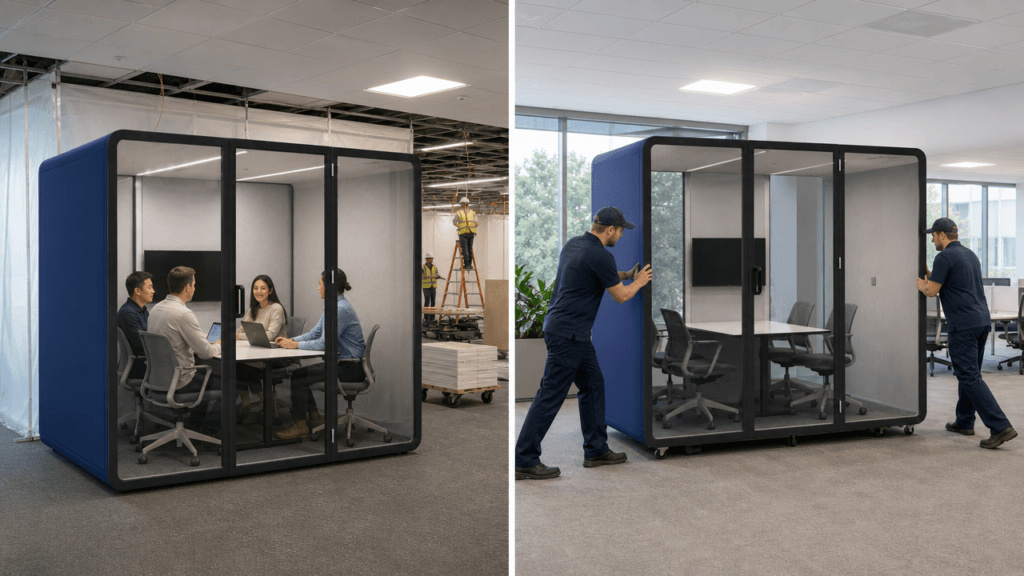
A temporary placement should have a planned second life. B&H meeting pods can be disassembled and reassembled when they need to move to a substantially different location. For a short move inside the same workplace, they can also be moved intact when the route and site conditions allow it.
Before purchase, document:
- the initial placement during the temporary phase;
- the intended location after that phase ends;
- whether the move is a short indoor repositioning or requires disassembly;
- the clear route between locations, including turns and obstructions;
- the capacity and meeting type the pod will serve in both locations;
- who will coordinate the move and setup.
Do not assume that “movable” means a pod can be pushed anywhere at any time. The relocation method depends on distance, access, and the conditions at both positions.
Temporary Meeting Pod Planning Checklist
Use this checklist before requesting configurations or pricing:
- [ ] Is the need immediate and one-time, or does it recur?
- [ ] How many meetings fail to find a suitable room during the busiest period?
- [ ] How many people attend each of those meetings?
- [ ] Which meetings genuinely require an enclosed space?
- [ ] Would rented space solve the need more realistically?
- [ ] If buying, should the mix include M, L, XL, or more than one size?
- [ ] Where will each pod be placed first?
- [ ] Where will each pod be used after the temporary phase?
- [ ] Can a short indoor move be completed intact, or will disassembly be required?
- [ ] Is there a clear, practical route between the planned locations?
If the checklist reveals only one urgent event and no later use, do not buy. If it reveals repeated room conflicts and a clear reuse plan, temporary meeting pods can become permanent capacity that remains useful as the office changes.
FAQ
Does B&H Ergonomics rent temporary meeting pods?
No. B&H Ergonomics sells meeting pods and does not provide temporary rentals. For a one-time urgent requirement, renting a nearby office or arranging a simple private meeting area is usually more realistic.
Can a meeting pod be moved without disassembly?
Yes, for a short move inside the workplace when the route and site conditions allow the complete pod to move safely. For a more substantial relocation, B&H meeting pods can be disassembled and reassembled. Confirm the route and relocation method before the pod is moved.