Quick Answer
Office soundproofing will not solve phone-call disruption if employees must choose between calling at an open desk and occupying the only large meeting pod. Separate three needs: less distraction from understandable speech, an easy place for one person to call, and a genuinely private setting for sensitive business. Absorption and sound masking can help with the first need, but they do not make a conversation confidential. For recurring private calls, evaluate an enclosed space such as Elite-S. Elite-S achieved ISO 23351-1 Class A acoustic performance with 33 dB speech level reduction.
Last Updated: August 18, 2026 | Author: Richard | Estimated Reading Time: 6 minutes
The Hidden Failure in a “Quieter” Office
A nearby call is disruptive because the listener can understand words and meaning. That speech competes with writing, analysis, and another conversation even when the room does not seem unusually loud.
This is why a softer-sounding room can still expose a call. The useful question is not “How do we make the office silent?” It is “Where should this call take place, and what boundary does it require?”
When the Meeting Pod Becomes a Phone Room
A large meeting pod is designed for group work. It becomes the wrong office soundproofing purchase when it is also expected to absorb every short individual call.
| Observed behavior | Consequence |
|---|---|
| A colleague takes a quick call in the group pod | A meeting user cannot access the room |
| The pod is booked when a sensitive call arrives | The caller returns to the open desk |
| The pod is inconvenient to reach | The caller delays or speaks in a corridor |
| Employees avoid the oversized room | The original speech distraction remains on the floor |
The workplace has bought group capacity while leaving individual communication without a dependable destination. Enlarging the meeting room does not correct that mismatch.
Decide Which Problem You Are Solving
| Complaint | Correct question | Direction |
|---|---|---|
| Nearby speech breaks concentration | Can routine calls move away from focus work? | Provide an easy one-person destination; use open-plan treatments only as support |
| Solo callers occupy group rooms | Is meeting capacity being consumed by another task? | Separate individual-call access from group capacity |
| The caller cannot discuss the subject at a desk | Does the call contain company, client, personnel, financial, or legal information? | Use an enclosure with evidence relevant to speech privacy |
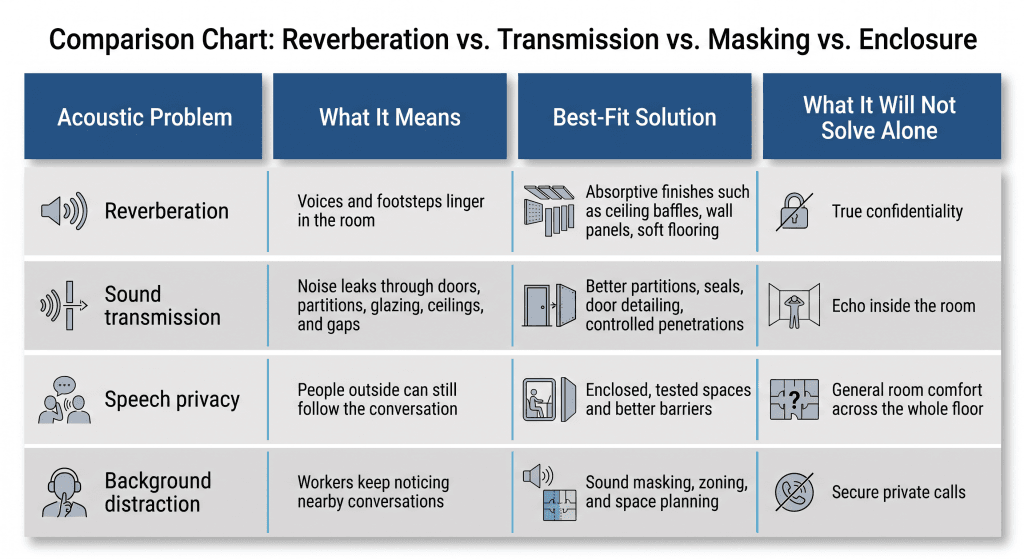
| The area is harsh and reverberant | Are reflections making ordinary calls more intrusive? | Treat the reflective surfaces, without calling that a privacy solution |
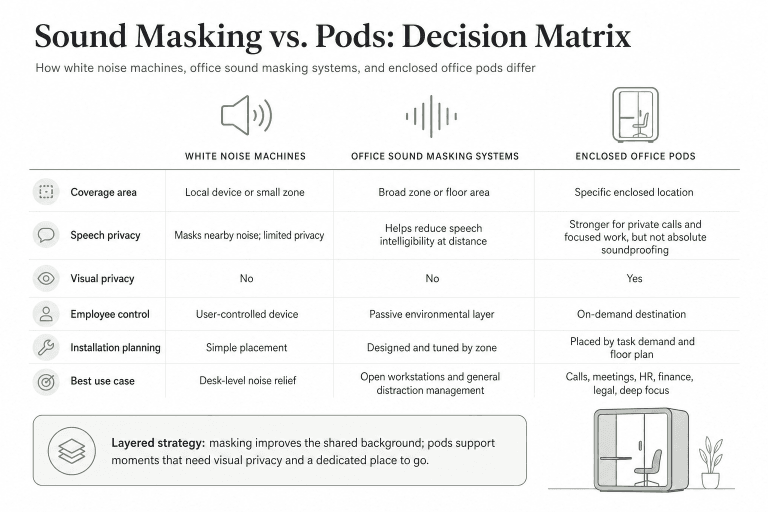
For routine calls, zoning, absorption, and a sound masking system for an office can reduce open-area distraction. Office acoustic panels address reflected sound. Neither option encloses the speaker or protects sensitive content.
When Elite-S Is the Better Boundary
If the call itself must not remain exposed, the requirement changes from comfort to speech privacy. The workplace needs an enclosed destination that is usable when the call arrives.
Elite-S achieved ISO 23351-1 Class A acoustic performance with 33 dB speech level reduction. ISO 23351-1 measures speech level reduction from furniture ensembles and enclosures. That is different from panel absorption, NRC, STC, or an informal sound-level reading in an occupied room.
Acoustic results vary by test method, installation, site conditions, and measurement setup. Confirm that the evidence applies to the complete enclosure and its proposed configuration. Also check door operation, ventilation, power, access, and location.
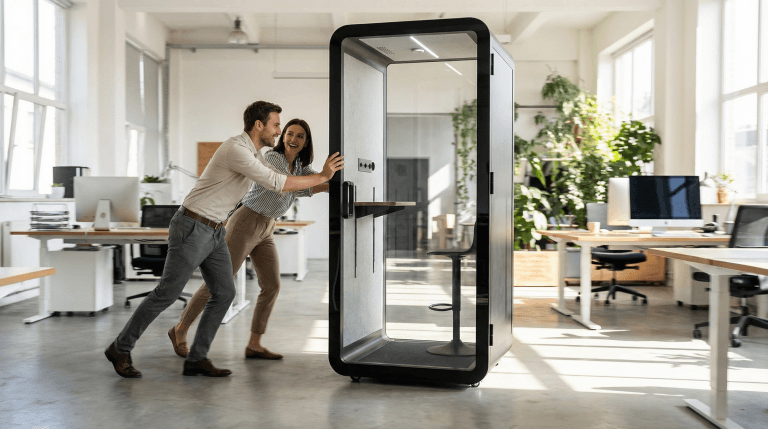
For a workplace that must protect both team meetings and one-person business calls, acoustic office pods should be assessed as task-specific destinations. A large pod can serve a meeting while an individual enclosure handles recurring sensitive calls. The goal is predictable privacy for the required task, not total silence throughout the building.
Write the Brief Around the Failure
Before requesting a layout or quote, document:
- group meeting capacity that must not be consumed by short calls;
- where employees currently call: desks, corridors, or borrowed rooms;
- which call types require an enclosed destination;
- whether the proposed location is convenient for a five-minute call;
- the acoustic metric, test method, and complete configuration covered by the evidence.
If the proposed change does not alter where individual calls happen, it has not addressed the interference. If sensitive calls still happen at open desks, the privacy requirement remains unmet.
FAQ
Can a large meeting pod solve phone-call distraction?
Not on its own. It can handle meetings, but it becomes unavailable or inconvenient for quick individual calls. Continued open-desk calling shows that the workplace needs a separate one-person option or a different operating rule.
Can acoustic panels make a business call private?
No. Panels can reduce reflected sound and improve comfort. They do not create an enclosed boundary around a conversation containing sensitive company or client information.
When should a company consider Elite-S?
Consider Elite-S when employees need a recurring enclosed location for private calls or focused work, especially where business, client, personnel, financial, or legal information is involved. Check the configuration, access, services, and applicable acoustic evidence first.