Quick Answer
A back to work pumping schedule works best when the employer turns it into a simple operations template: likely time windows, calendar rules, manager coverage, backup contacts, and a first-week adjustment log. The employee owns personal lactation details; the workplace owns access, coordination, and schedule protection.
Last Updated: July 7, 2026 | Author: William | Review: Richard | Estimated Reading Time:11 minutes
Why This Is an Employer Schedule Template, Not Medical Advice
Most advice about a pumping schedule back to work is written for the employee. It often covers when to start pumping, how often to pump, and what to pack.
That advice matters, but it is not the part an employer should try to manage.
For HR, facilities, and office managers, the better question is operational: can the workday support broad recurring time windows without making the employee re-explain the need, lose coverage, or negotiate access every day?
I would not ask HR to create a medical schedule. I would ask HR, facilities, and the manager to create a workplace support template.
This article is not medical advice, lactation consulting, or legal advice. It is a workplace planning guide for employers. For legal baseline questions, employers should review the U.S. Department of Labor’s Pump at Work resources and consult their own counsel.
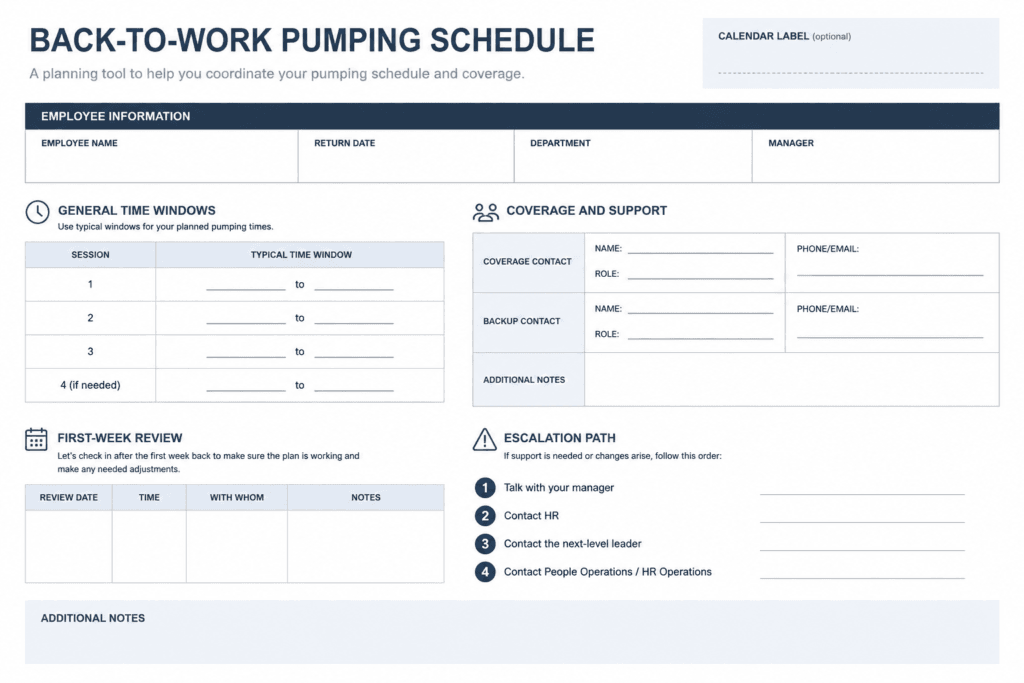
The Employer-Side Back-to-Work Pumping Schedule Template
Before an employee returns, do not start by asking for exact personal details. Start with a neutral template that protects the workday and the employee’s privacy.
The U.S. Department of Labor’s Fact Sheet #73A explains the federal break-time and private-space framework for expressing breast milk at work. This template does not replace that guidance. It turns the employer side of the process into something managers can run consistently.
Use this structure:
| Template Field | What to Record | Why It Matters |
|---|---|---|
| Return date | Expected first day back | Starts the planning clock |
| Schedule owner | HR, manager, or office manager contact | Prevents the employee from chasing multiple people |
| General time windows | Broad blocks, not medical detail | Helps plan coverage without overstepping |
| Calendar label | Reserved, private, unavailable, or HR protected block | Protects access without broadcasting personal information |
| Coverage contact | Who handles urgent work during the block | Keeps work moving without interruption |
| Backup contact | Who fixes access or calendar conflicts the same day | Prevents one small issue from recurring |
| First-week review | Date for the first adjustment check | Makes schedule changes normal |
| Escalation path | HR or facilities contact for repeated problems | Keeps managers from inventing policy under pressure |
The point is not to make the employee disclose more. The point is to remove daily improvisation.
[Insert approved image: employer back-to-work pumping schedule template; alt text: back-to-work pumping schedule template for employers]
Build the Schedule Around Work Coverage
The most useful employer question is not “Can she take a break?” It is “What work needs to be covered so the break is not treated as a disruption?”
For each likely window, identify the work coverage pattern:
| Role Type | Coverage Question | Employer Action |
|---|---|---|
| Office or administrative role | Can meetings, calls, or deadlines be blocked around the window? | Add private calendar blocks and avoid recurring meeting conflicts |
| Customer-facing role | Who handles walk-ins, calls, or front-desk coverage? | Name a coverage contact for each window |
| Clinical or care setting | Who handles time-sensitive patient or room duties? | Coordinate with the shift lead before return |
| Warehouse or production role | Who covers station, line, dispatch, or floor duties? | Build windows into shift coverage planning |
| Managerial role | Who handles urgent approvals during the block? | Set delegation rules for short recurring windows |
This keeps the schedule from becoming personal drama. It becomes ordinary work planning.
Use Calendar Blocks Without Exposing Personal Details
The calendar system should protect access without forcing the employee to disclose more than needed.
Depending on the company, a calendar block might say:
- “Reserved”
- “Private”
- “Unavailable”
- “Wellness room hold”
- “HR protected block”
Avoid labels that broadcast medical or personal information to the wider team. The manager and HR can know what they need to know; the entire workplace does not.
The Manager Coverage Script
Managers often want to help but do not know what to say. A short script prevents awkwardness and protects the employee from repeated explanations.
Use language like:
“We have blocked the time windows you shared and arranged coverage for urgent items during those periods. If the first week shows that the timing needs to change, let me know and we will adjust the work plan.”
For the team, if coverage needs to be mentioned, keep it neutral:
“There will be a recurring coverage block on the schedule. Please route urgent requests to me during that time.”
The manager does not need to announce why the coverage exists. They only need to make sure the work is covered and the employee is not interrupted.
Before-Return Planning Timeline
This timeline is intentionally operational. It is for the people who have to make the schedule work.
| Timing | Action | Output |
|---|---|---|
| 4 weeks before return | Assign HR, manager, and facilities owners | Named contacts |
| 3 weeks before return | Draft broad time windows and coverage needs | Schedule template |
| 2 weeks before return | Confirm calendar labels, room holds, and backup contact | Protected access process |
| 1 week before return | Send the employee a simple access and support summary | No-surprise return plan |
| Day 1 | Confirm the plan still fits the actual workday | Same-day adjustment path |
| End of week 1 | Review timing, coverage, and friction points | Revised schedule |
| Day 30 | Check whether the process still works | Stable ongoing plan |
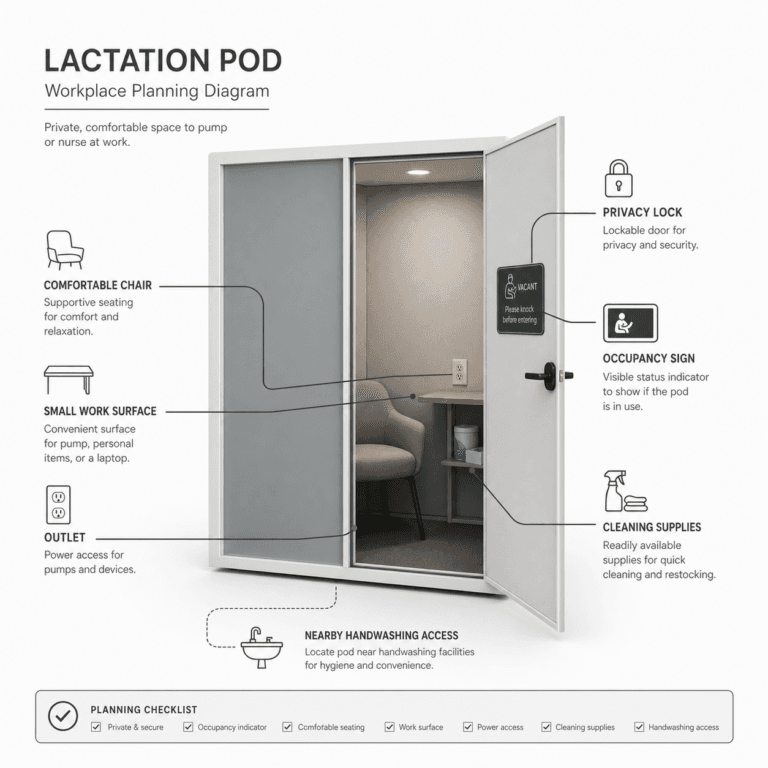
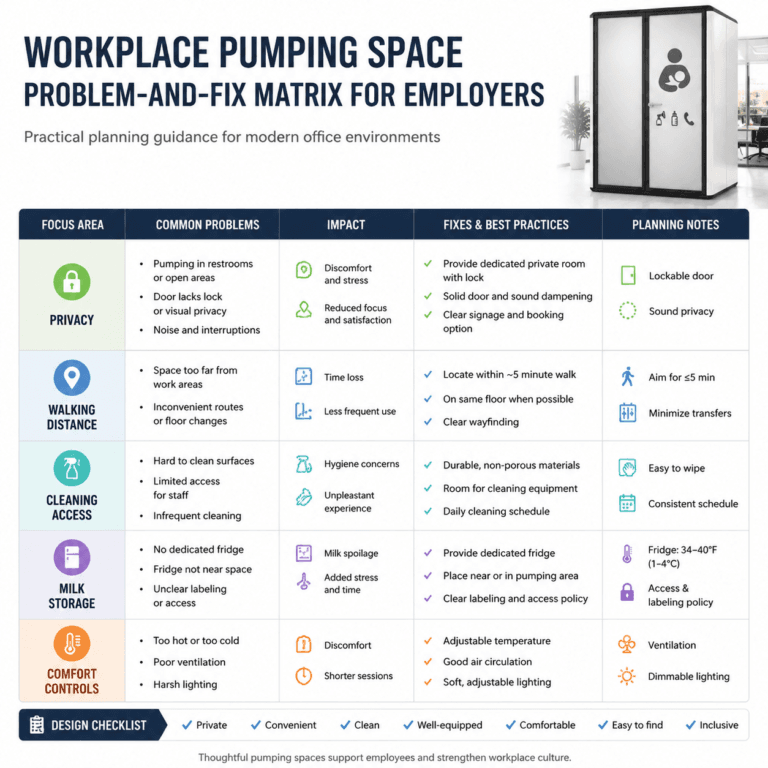
Before confirming room holds, facilities can use the lactation room requirements checklist to check privacy, access control, power, seating, work surfaces, and space readiness.
For employers already working on broader lactation compliance or policy language, B&H Ergonomics’ PUMP Act employer guide covers break time, privacy, and space requirements. Use the schedule template here to coordinate calendar protection, work coverage, and first-week adjustments.
RACI: Who Owns Each Part of the Schedule?
A back-to-work pumping schedule can fail when everyone assumes someone else is handling it. A simple RACI table removes that ambiguity.
| Task | Responsible | Accountable | Consulted | Informed |
|---|---|---|---|---|
| Confirm return planning need | HR | HR | Employee, manager | Facilities if space is involved |
| Protect work calendar blocks | Manager | Department lead | Employee | Team only as needed |
| Hold the lactation space | Office manager / facilities | Facilities lead | HR | Manager |
| Coordinate coverage | Manager | Department lead | Team lead | Employee |
| Maintain space readiness | Facilities | Facilities lead | HR | Office manager |
| Resolve repeated conflicts | HR | HR | Manager, facilities | Employee |
| Review first-week fit | Manager | HR | Employee | Facilities if changes are needed |
This is not bureaucracy for its own sake. It keeps support from depending on the employee being the project manager of her own accommodation every day.
[Insert approved image: employer RACI chart for pumping schedule support; alt text: RACI chart for back-to-work pumping schedule support]
Where a Lactation Pod Fits in This Schedule
A schedule should come before a product decision. Consider a purpose-built option only when the schedule reveals a location or capacity problem.
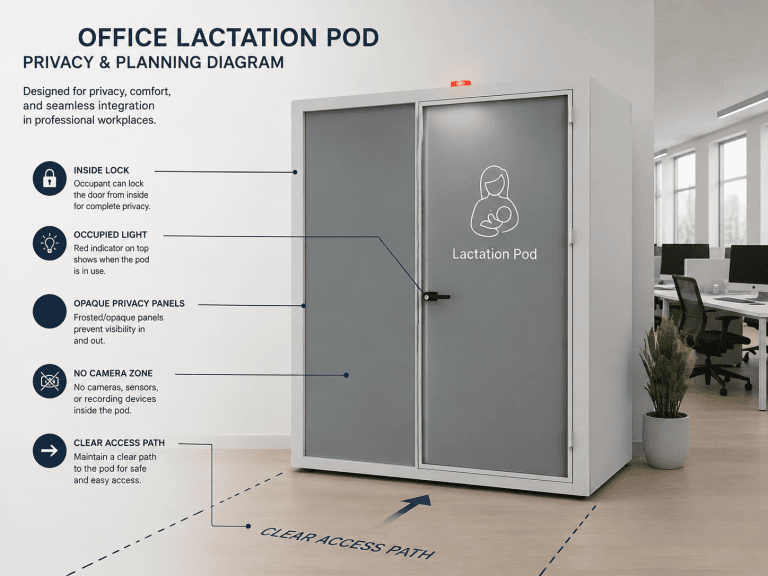
B&H Ergonomics’ lactation pod options are relevant when HR and facilities cannot support the template with the existing workplace layout. For example, the current room may be unavailable during the needed windows, too far from the team, or difficult to reserve consistently.
The pod should still be treated as one part of the operating plan. The employer still needs calendar rules, manager coverage, and a named owner for follow-up.

First-Week Adjustment Log
The first schedule is rarely perfect. Build adjustment into the process so the employee does not have to treat every change as a special request.
Use a simple log:
| Checkpoint | Question | Action If Not Working |
|---|---|---|
| Day 1 | Did the employee know the schedule owner and backup contact? | Resend the access summary and name one point of contact |
| Day 2-3 | Were calendar blocks respected? | Adjust team meeting rules or manager reminders |
| End of week 1 | Did coverage work without repeated explanations? | Update coverage owner or time windows |
| End of week 1 | Did any access conflict repeat? | Escalate to HR, facilities, or office manager |
| Day 30 | Is the schedule stable enough to continue? | Keep, revise, or add capacity |
The log should be short. Long forms discourage use. The goal is to fix friction quickly, not document every personal detail.
For health-related handling and storage details, use official guidance such as the CDC’s breast milk storage and preparation guidance. Keep medical handling instructions separate from the workplace scheduling process.
Employer Action Checklist
Before an employee returns, confirm these items:
- Name the HR, manager, and facilities owners for the schedule.
- Confirm broad time windows without requesting unnecessary medical detail.
- Choose neutral calendar labels.
- Confirm who covers time-sensitive work.
- Name a backup contact for access problems.
- Decide when the first-week review will happen.
- Keep the team message neutral and work-focused.
- Escalate repeated conflicts to HR or facilities.
- Review the schedule after the first week.
- Check stability again after 30 days.
A strong back-to-work pumping schedule should feel ordinary. The employee should not have to solve the same access problem every day.
FAQ
What should an employer include in a back-to-work pumping schedule?
An employer should include broad time windows, neutral calendar labels, manager coverage, a backup contact, and a first-week review. The personal pumping routine belongs to the employee and their healthcare or lactation support team.
How early should employers plan a pumping schedule before an employee returns?
Start several weeks before the return date when possible. That gives HR, facilities, and the manager time to assign owners, protect calendar blocks, coordinate coverage, and explain the adjustment process before the first day back.
What should managers say to the team?
Managers should keep the message neutral and work-focused. They can say there is a recurring coverage block and urgent requests should route to a named contact. The team does not need the employee’s personal medical or family details.
Is a lactation pod required for a returning to work pumping schedule?
No. A lactation pod is not automatically required. It becomes relevant when the schedule cannot be supported by the existing layout, reservation process, or location. The schedule template should reveal that need before the product conversation starts.
Should employers tell employees exactly when to pump?
Employers should avoid rigid or intrusive scheduling. Pumping needs can vary. The employer should support broad time windows, protected calendar blocks, and coverage while relying on official guidance and counsel for legal interpretation.