Quick Answer
PUMP Act requirements generally mean employers must provide reasonable break time and a private place, other than a bathroom, for covered nursing employees to express breast milk for up to one year after childbirth. For workplace planning, the space should be shielded from view, free from intrusion, functional, dry, ventilated, and supported by clear access policies.
Last Updated: June 10, 2026 | Author: William | Richard | Estimated Reading Time: 11 minutes
What the PUMP Act Requires Employers to Provide
The PUMP Act is not just an HR policy update. It affects how an employer plans space, schedules breaks, trains managers, and prevents accidental intrusion; for operational implementation, use the back-to-work pumping schedule template for employers to assign recurring windows, coverage, and backup contacts.
At the federal level, the U.S. Department of Labor’s Pump at Work guidance explains that most nursing employees are entitled to reasonable break time and a private place to express breast milk at work for up to one year after the child’s birth. The space cannot be a bathroom, and it must be shielded from view and free from intrusion from coworkers and the public.
For employers, I would translate the law into four practical questions:
| Employer Question | Practical Planning Meaning |
|---|---|
| Who is covered? | Most FLSA-covered nursing employees may be entitled to pump-at-work protections. |
| How much break time is required? | The law uses “reasonable break time,” because pumping needs vary by person and schedule. |
| What kind of space is required? | A functional private space, other than a bathroom, shielded from view and free from intrusion. |
| Is the break paid? | If the employee is not completely relieved from duty, the time must generally be paid. Paid break policies may also affect compensation. |
This article is not legal advice. Employers should review federal, state, local, and industry-specific obligations with HR or legal counsel. My focus here is the physical workplace: how to turn PUMP Act requirements into a workable lactation space plan.
The Space Requirement: Privacy Is More Than a Locked Door
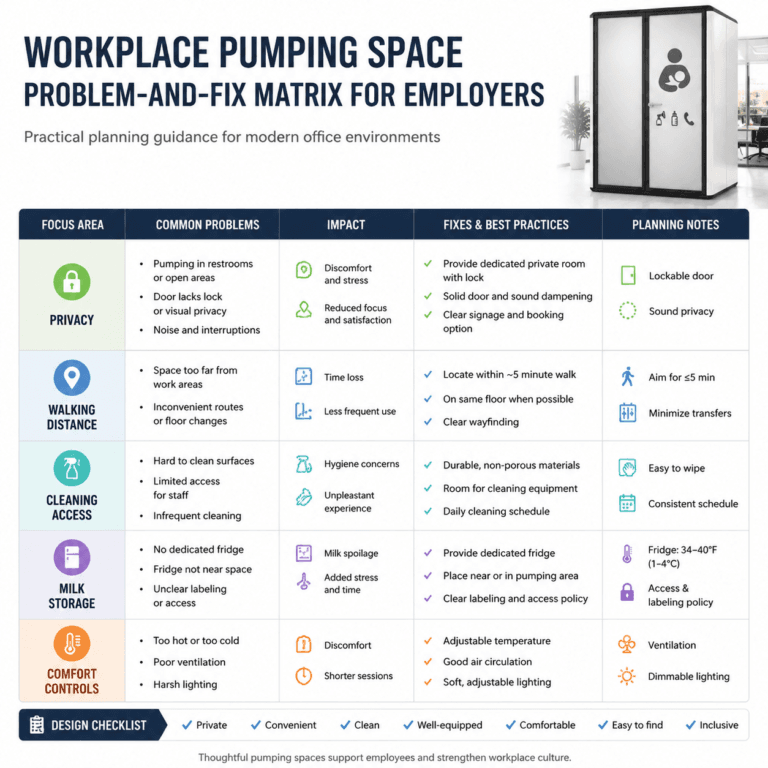
A common mistake is treating privacy as one feature. In practice, privacy has several layers: visual privacy, physical security, acoustic comfort, scheduling control, and user confidence.
A lactation space can technically have a door and still feel unsafe if people knock repeatedly, the door has glass gaps, the booking system is unclear, or the user worries someone may walk in by mistake.
| Privacy Risk | Common Failure | Better Planning Detail |
|---|---|---|
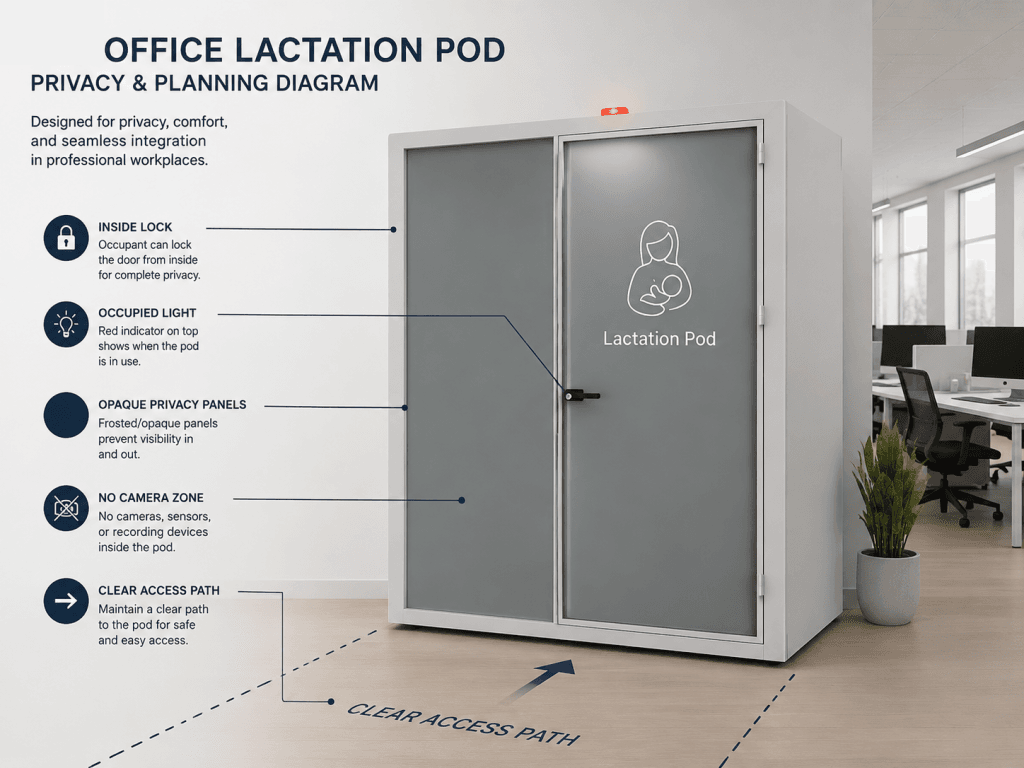
| Accidental entry | Door can be opened from outside | Use an inside lock and a clear occupied indicator. |
| Visual exposure | Glass walls, blinds with gaps, or poor sightlines | Use opaque panels or full visual shielding from public view. |
| Psychological intrusion | People wait outside or treat the room as shared overflow space | Use a dedicated or priority-use policy with clear signage. |
| Camera exposure | Security camera faces the entrance or interior path | Keep the interior and direct entry line outside camera view. |
| Scheduling conflict | Conference room or wellness room is already booked | Use a simple booking system or a dedicated lactation pod. |
For a workplace lactation pod, the goal is not only to stop someone from opening the door. The goal is to make the user feel that the space is expected, protected, and normal to use.
Does a Lactation Pod Need Plumbing?
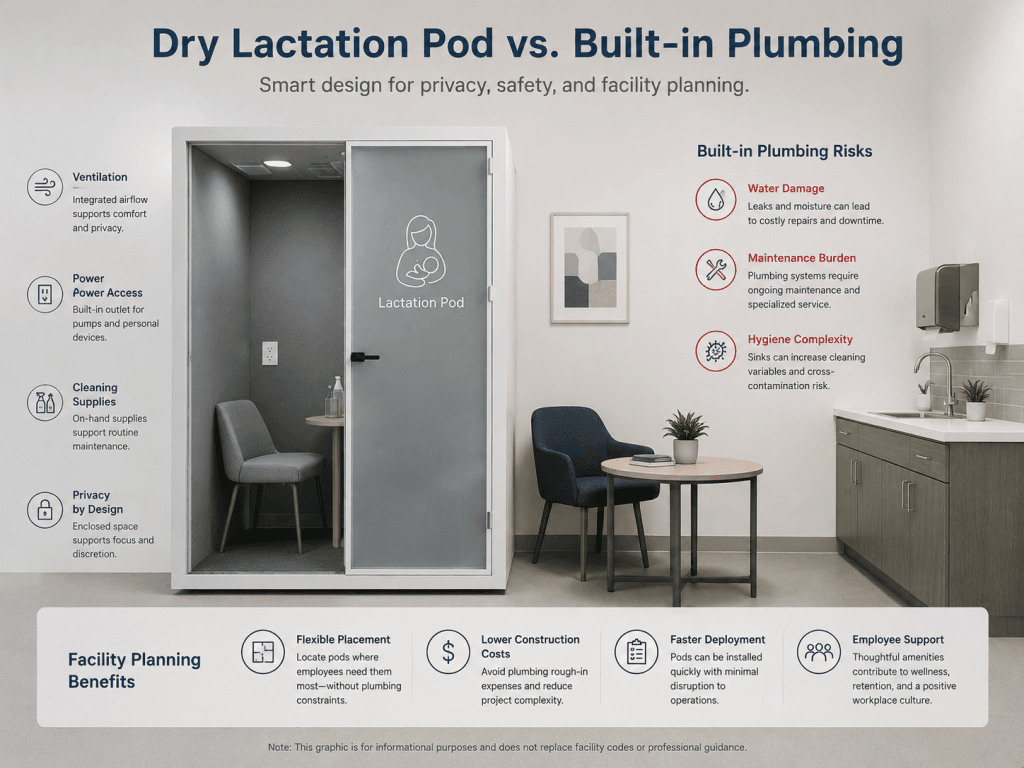
In most office, healthcare, small business, and co-workplace projects, I would not recommend building water supply or drainage directly into the pod unless there is a specific facility reason and a verified maintenance plan.
A dry pod body is usually the cleaner and more flexible approach. The better setup is:
- a dry lactation pod interior;
- a nearby handwashing sink outside the pod;
- cleaning supplies such as disinfecting wipes;
- a clear cleaning schedule;
- good ventilation;
- no unnecessary moisture inside the enclosure.
The sink should be reasonably accessible, but it should not be so close that moisture, splashing, or damp cleaning habits create hygiene concerns around the pod. Wet areas can encourage bacterial growth if maintenance is poor, especially in enclosed or semi-enclosed spaces.
| Option | Advantage | Risk or Limitation |
|---|---|---|
| Built-in sink inside pod | Convenient in theory | Adds plumbing cost, moisture risk, leak risk, cleaning burden, and possible bacteria concerns. |
| Sink immediately beside pod | Easy access | May expose the pod area to splashing, humidity, and wet-floor issues. |
| Dry pod with nearby sink | Keeps the pod simpler, drier, and movable | Requires thoughtful placement so users can wash hands without walking too far. |
| Dry pod plus cleaning supplies | Supports daily upkeep without plumbing | Supplies and cleaning responsibility must be managed. |
For most employers, I would treat “dry, private, ventilated, easy to clean, and near but not crowded by a sink” as the safer facility-planning standard.
What a Practical Lactation Pod Should Include
The best lactation space is not the fanciest one. It is the one that employees can actually use without stress.
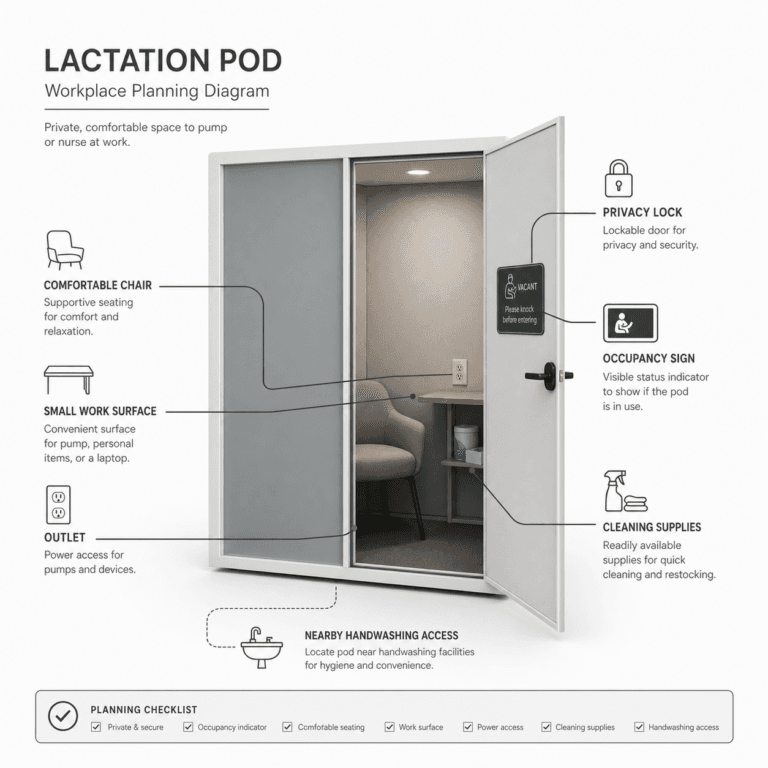
For PUMP Act requirements and workplace planning, these features should be considered baseline:
| Feature | Why It Matters |
|---|---|
| Inside lock | Helps prevent accidental entry and supports user control. |
| Occupied indicator | Reduces knocking and confusion from coworkers. |
| Ventilation | Keeps the enclosed space more comfortable during use. |
| Power access | Supports electric breast pumps and phone charging. |
| Lighting | Makes the space feel intentional and usable, not temporary. |
| Movable structure | Helps employers avoid permanent construction when flexibility matters. |
| Dry interior | Reduces unnecessary plumbing and moisture-management concerns. |
Furniture depends on the project. A tabletop and chair may be included, selected as optional furniture, or specified by the employer. The important point is that the user needs a stable surface for pump equipment and comfortable seating for repeated use.
If an employer wants a purpose-built option instead of converting a room, B&H Ergonomics offers lactation pod options for employers that can be evaluated alongside room conversion, wellness-room scheduling, or permanent construction.
Planning Notes for Small Businesses, Healthcare, and Co-Workplaces
Different workplaces face different friction points.
For a small business, the biggest issue is usually space. A company may not have a spare room that can be dedicated to lactation use. A movable lactation pod can help avoid construction while still creating a defined private space.
For healthcare facilities, the issue is often cleanliness, circulation, and mixed user groups. Employees, patients, or visitors may need privacy. A dry pod body, nearby sink access, cleaning supplies, and careful placement can matter more than decorative finishes.
For a co-workplace, management is the hard part. The space may serve employees from multiple companies or members with different schedules. Clear signage, booking rules, access control, and cleaning responsibility should be decided before installation.
Deployment and Procurement Options
One reason employers consider pods is speed. A permanent room build-out can involve design, trades, permits, downtime, and landlord approval. A movable pod may help employers create a private pumping space faster and with less disruption.
A movable pod can also be treated as a flexible facility asset rather than a fixed room. In many projects, employers like the FF&E logic: if the office layout changes, the pod may be relocated instead of abandoned.
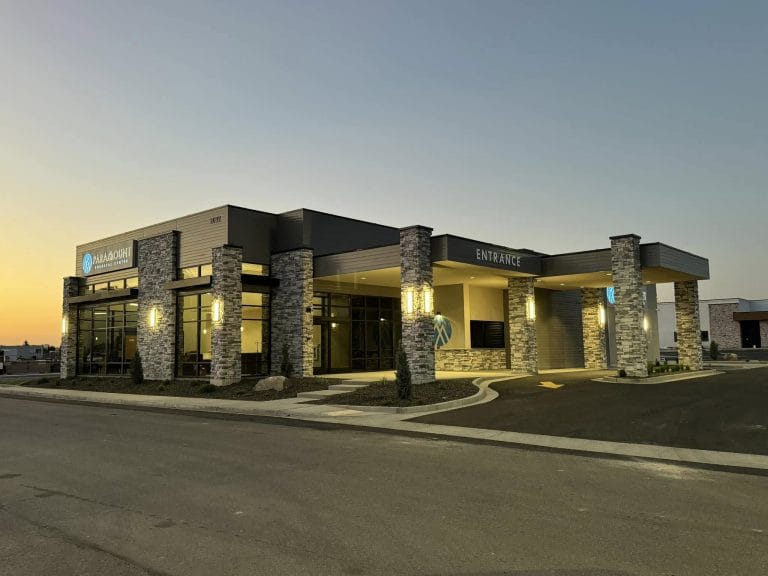
For a practical healthcare example, the Paramount Surgical Center lactation pod case study shows how one facility added a private pumping space in a lounge or waiting area and planned door-to-door delivery as part of the project scope.
Delivery terms should be confirmed during procurement. Depending on the buyer’s import and logistics capability, B&H Ergonomics can support different delivery approaches:
| Delivery Option | Buyer Fit |
|---|---|
| FOB | For buyers who prefer to manage shipping and customs clearance themselves. |
| CIF | For buyers who want shipping arranged to the destination port but still handle later import steps. |
| DDP / door-to-door delivery | For buyers who want a more complete delivery path with duties and final delivery handled under the agreed term. |
The right delivery term depends on budget, timeline, customs experience, and who will be responsible for unloading and final placement.
Employer Action Checklist
Use this checklist before approving a lactation space plan.
| Area | What to Confirm |
|---|---|
| HR policy | Confirm who is covered, how breaks are requested, and how managers should respond. |
| Legal review | Check federal, state, local, and industry-specific lactation accommodation rules. |
| Privacy | Confirm inside lock, occupied indicator, visual shielding, and no camera exposure. |
| Space function | Confirm power, ventilation, lighting, seating, tabletop, and cleaning supplies. |
| Hygiene | Keep the pod dry, avoid unnecessary plumbing, and place it near but not too close to a sink. |
| Facilities | Measure the footprint, delivery path, power access, and surrounding circulation. |
| Procurement | Confirm FOB, CIF, or DDP terms, unloading responsibility, and installation support. |
Once the legal baseline is clear, use the workplace lactation Room requirements guide to compare privacy, power, ventilation, placement, installation, and procurement details before requesting specifications.
FAQ
What are the main PUMP Act requirements for employers?
The main PUMP Act requirements are reasonable break time and a private place, other than a bathroom, for covered nursing employees to express breast milk for up to one year after childbirth. The space should be shielded from view, free from intrusion, and functional for pumping.
How can employers prevent someone from walking in by mistake?
Use an inside lock, occupied indicator, opaque privacy panels, clear signage, and a scheduling or priority-use policy. The goal is to prevent accidental entry and reduce repeated knocking or uncertainty around whether the space is available.
Does a lactation pod need plumbing?
Usually, no. A dry lactation pod with nearby sink access and cleaning supplies is often more practical. Built-in plumbing can add moisture, maintenance, leak, and bacteria concerns. The sink should be accessible but not so close that damp conditions affect the pod area.
Are pump breaks paid under the PUMP Act?
The pay rule depends on whether the employee is completely relieved from duty and how the employer treats other paid breaks. The DOL Fact Sheet #73 explains the federal compensation conditions, including when an employee is not completely relieved from duty. Employers should review that guidance together with their own wage policies.
Can a small business use a lactation pod instead of building a room?
Yes, a lactation pod may be a practical option when a small business lacks a suitable spare room. The employer still needs to review applicable legal obligations, but a movable pod can help create a private pumping space without major construction.