Quick Answer
You may losing focus at work because the task is unclear, messages keep changing your priorities, meetings fragment the day, or speech and movement in the workspace repeatedly pull your attention away. Track the pattern before choosing a fix. Define the next output, change the communication rule, repair the meeting structure, or test a quieter location. If the same environmental problem remains during normal occupancy, evaluate whether the office needs dedicated individual focus capacity.
Last Updated: July 28, 2026 | Author: Richard | Estimated Reading Time: 9 minutes

Scope: Workplace Attention, Not a Medical Diagnosis
This guide addresses attention that breaks during work because of tasks, communication, meetings, or the office environment. If “lose focus” refers to sudden changes in vision, severe symptoms, or a health concern, seek advice from a qualified clinician instead of treating the issue as a workplace design problem.
What Losing Focus at Work Looks Like
Losing focus is not only feeling bored. It is a repeatable pattern in which attention leaves the intended task before the work has reached a useful stopping point.
| What you notice | What it may indicate | What to check first |
|---|---|---|
| You reread the same paragraph or spreadsheet row | the task lacks a clear next action or nearby speech is competing for attention | define the next output, then test a quieter location |
| You change tasks whenever a message arrives | routine communication is acting like an urgent alert | review channels, response windows, and notification rules |
| You attend many meetings but make little progress | the calendar has no continuous work block | identify meetings that can become asynchronous updates |
| You keep looking up or turning toward the room | movement or visible activity is in the focus path | change desk orientation or move the activity boundary |
| You delay one difficult task and complete many small tasks | the work has too much uncertainty or emotional friction | break the deliverable into one observable first result |
| Focus improves away from the office and collapses at the desk | the workspace may be a recurring bottleneck | compare locations during normal occupancy |
One sign is not enough to identify a cause. The useful question is whether the same pattern repeats in the same context.
The Four Common Causes of Losing Focus
1. The Task Does Not Define the Next Result
“Work on the proposal” or “review the project” describes a category, not a finish line. When the next result is unclear, attention drifts toward easier tasks, new requests, or low-effort checking.
Write the first useful output in concrete terms: complete the pricing section, compare two layouts, draft the opening recommendation, or list the unanswered assumptions. If the first result cannot be stated, the planning problem comes before the focus problem.
2. Digital Communication Keeps Reopening Priorities
Email, chat, project updates, and calendar alerts create more than interruptions. They also create a decision about whether each new item should replace the current task.
Check whether every channel is allowed to interrupt every role. A workable system separates urgent contact from routine questions and information that can wait. Without that distinction, employees may stop notifications but continue checking them because the response expectation is unclear.
3. Meetings Break the Day Into Unusable Pieces
A calendar can be full of short meetings and still leave no realistic time for concentrated work. Several small gaps may be too short to establish context, produce a result, and leave a useful handoff.
Review recurring meetings by outcome. Keep live sessions for decisions, problems, reviews, and dependencies that need real-time input. Move readable status updates into an asynchronous format and protect at least one continuous block for work that cannot be completed in fragments.
4. The Physical Environment Keeps Calling Attention Back
Nearby speech, people crossing the field of view, calls at adjacent desks, and informal questions can make an open workspace a constant monitoring task. This is especially noticeable when understandable conversations remain audible even after notifications are controlled.
Start with reversible tests: change the desk orientation, move call-heavy activity, set a quiet-zone rule, relocate a focus-heavy role, or use an existing enclosed room. If the improvement appears only when the office is unusually empty, the change is not a reliable solution.
A recurring B&H Ergonomics buyer pattern is that desk screens are installed first while speech and walk-by movement still reach the same focus desks. That pattern calls for a layout and activity audit before another desk accessory.
A 15-Minute Focus-Loss Audit
Use one normal workday rather than an unusually quiet day. Record the event when attention leaves the intended task.
| Record | Example | Why it matters |
|---|---|---|
| Time and task | 10:20, writing a client recommendation | shows which work is most vulnerable |
| Trigger | chat alert, nearby call, unclear next step | identifies the immediate trigger |
| Action taken | replied, looked up, changed task, left desk | shows the switching behavior |
| Recovery condition | resumed after message, moved rooms, never resumed | shows whether the barrier is local or structural |
| Lowest-cost test | batch chat, move seat, define output | creates a practical next experiment |
Do not count every normal movement or background sound. Record events that change the task, require reorientation, or repeatedly pull attention back to the room.
Match the Fix to the Cause
| Dominant cause | First fix to test | Escalate when… |
|---|---|---|
| Unclear task | define one concrete output and the next action | priorities continue to change during the block |
| Digital interruption | batch routine messages and define an urgent channel | the team still expects instant replies everywhere |
| Meeting fragmentation | remove low-value recurring meetings and protect a longer block | no meaningful focus time remains on a normal calendar |
| Speech or movement | change location, zoning, and call behavior | the same distraction returns during normal occupancy |
| Mixed causes | run one test for each layer rather than buying a product immediately | several teams share the same unresolved environmental need |
The lowest-cost fix is not always the final fix. It is the quickest way to learn which layer is responsible.
When the Environment Is the Root Cause
An enclosed focus setting becomes relevant when attention improves in a suitable quiet space but repeatedly collapses at the normal workstation. That pattern suggests an environmental bottleneck, not a personal failure.
Before planning a product, confirm that:
- the work requires recurring periods of sustained concentration;
- the team has already tested reasonable task, communication, meeting, and layout changes;
- existing private rooms cannot meet the demand; and
- the space will be used often enough to justify dedicated capacity.
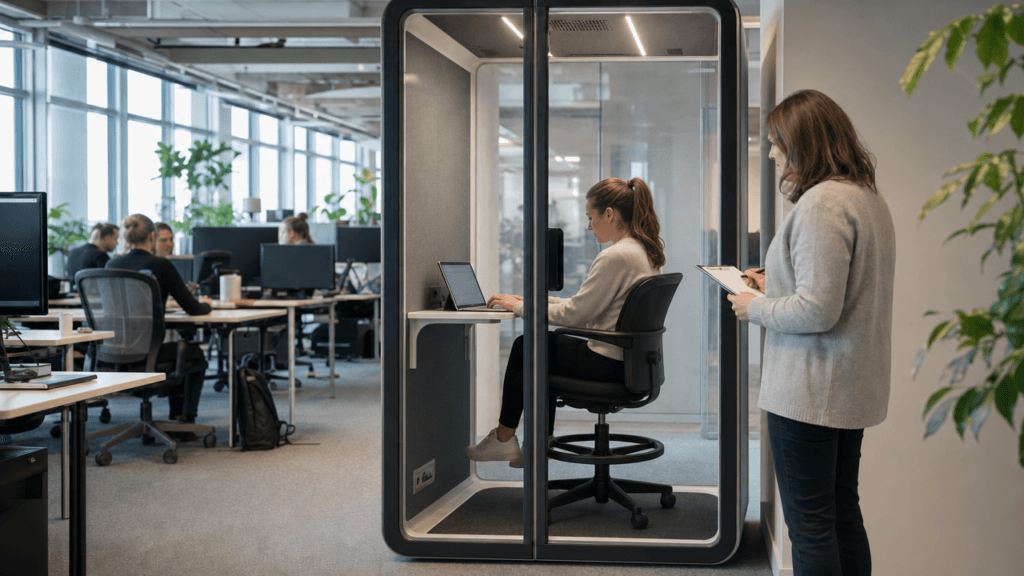
When those conditions are met, a properly sized work pod can give individual work a defined setting inside the office. Check the actual chair, desk, monitor, lighting, power, ventilation, and expected session length. A compact phone booth planned for short calls is not automatically an ergonomic setting for extended computer work.
Do not use a work pod to hide an overloaded workload, unclear priorities, or a meeting culture that expects constant availability. Those causes need an operating change first.
From Diagnosis to Prevention
Once the main cause is clear, make the response repeatable. Our prevention and maintenance plan for staying focused at work covers protected focus blocks, communication windows, meeting rules, workstation preparation, and weekly maintenance checks.
A Five-Day Root-Cause Test
Use one normal workweek to test each likely cause before choosing a longer-term response.
| Day | Action | What to learn |
|---|---|---|
| Monday | record five meaningful focus-loss events, their triggers, and recovery conditions | the two most frequent barriers |
| Tuesday | write one concrete output before a demanding block and record each drift point | whether task ambiguity is the trigger |
| Wednesday | log every alert or message that changes the task and note the expected response time | whether communication rules are reopening priorities |
| Thursday | map meetings around one focus-heavy task and mark where context is lost | whether calendar fragmentation is the constraint |
| Friday | repeat the same demanding task at the normal desk and in a quieter location during normal occupancy | whether the physical setting changes the result |
At the end of the week, choose the next action based on the evidence. If the problem follows the task across locations, review workload and process. If it improves in a suitable quiet space and returns at the desk, plan the environment rather than asking the employee to try harder.
FAQ
Why Do I Lose Focus at Work Even When My Phone Is Away?
Your phone may not be the main trigger. Check task clarity, chat and email expectations, meetings that split the day, nearby speech, and visual movement. Focus usually improves when the dominant cause is addressed rather than when one device is removed.
Is Losing Focus Always a Productivity Problem?
No. It may be a planning, communication, meeting, or workspace problem. Treat it as a pattern to investigate. The right response may be a clearer deliverable, a team rule, a calendar change, or a different work setting.
Are Headphones Enough for an Open Office?
Headphones can reduce some background sound, but they do not remove visible movement, meeting fragmentation, unclear priorities, or the expectation of immediate replies. Use them as one reversible test and compare the result with other changes.
When Should a Company Consider a Work Pod?
Consider one when recurring focus work remains disrupted after practical task, communication, meeting, and layout changes, and when existing enclosed rooms cannot meet demand. Specify the work pattern and ergonomic requirements before selecting the product.