
Quick Answer
Phone booth ventilation keeps an enclosed call space comfortable by moving stale air out and fresh room air in. Buyers should check total CFM, air-change speed, fan noise, intake and exhaust placement, and whether users can adjust fan speed. For longer calls, ventilation is a usability feature, not a minor accessory.
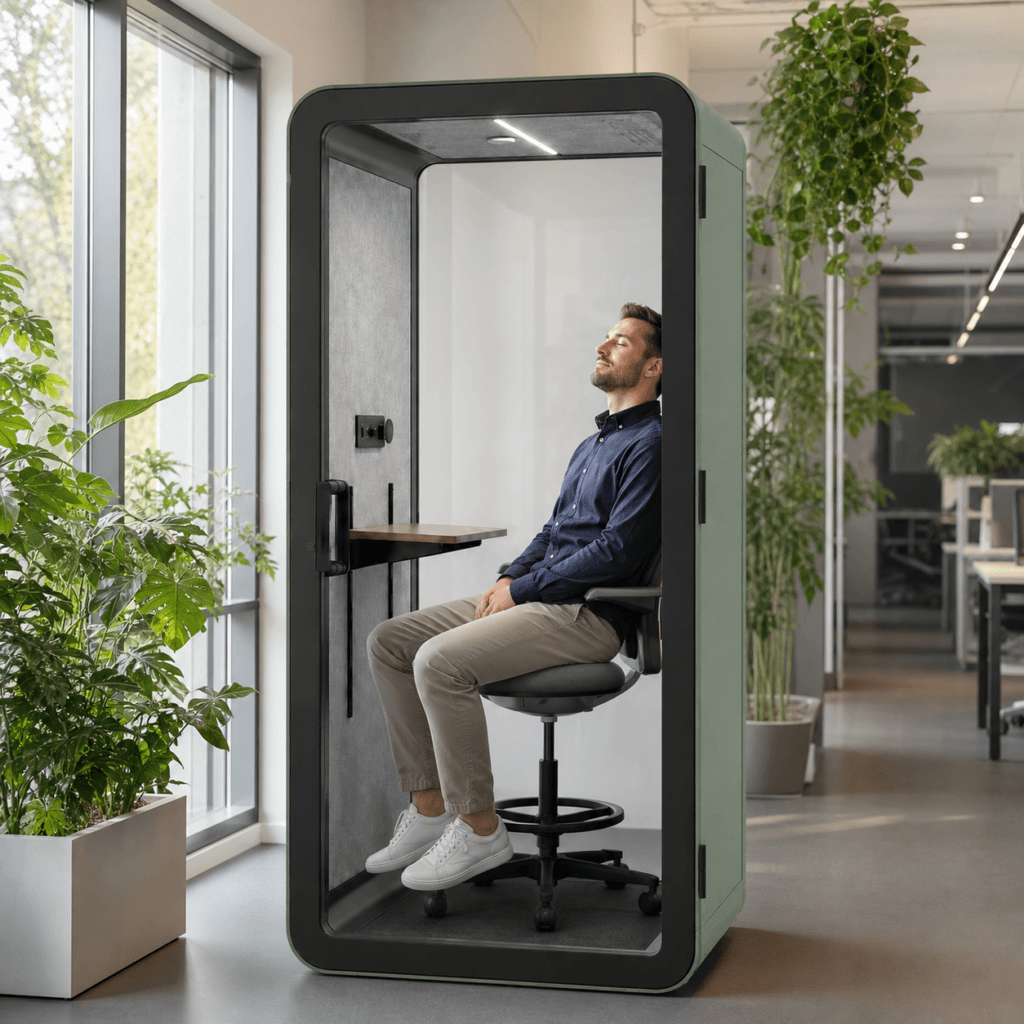
Why Ventilation Deserves a Separate Spec Check
A quiet enclosure can still fail if people avoid using it after ten minutes. In my experience, poor cabin comfort usually comes from one of three technical details: weak airflow volume, fan noise, or an intake and exhaust path that does not move air through the user zone.
That is why phone booth ventilation deserves its own buying check. The goal is not to scare buyers with dramatic CO2 claims. The practical question is simpler: can one person sit inside the cabin for a private call or video meeting without feeling stale air, heat buildup, fan distraction, or pressure to open the door?
If you are comparing a one-person office phone booth, treat ventilation as part of the product’s working performance alongside acoustic privacy, lighting, power, and interior ergonomics.
Last Updated: July 7, 2026 | Author: Richard | Estimated Reading Time: 8 minutes
Why Air Exchange Matters in a Small Enclosure
A call enclosure has a much smaller air volume than a normal office room. One person, one laptop, lighting, and a closed door can change the interior comfort quickly. The cabin does not need to feel windy, but it does need controlled air movement.
Good ventilation design helps with:
- moving air through the breathing zone instead of only around the ceiling or wall cavity;
- refreshing the small internal air volume quickly enough for longer calls;
- reducing the need to crack the door open for comfort;
- balancing airflow with fan noise and microphone pickup;
- protecting the value of acoustic privacy, because an uncomfortable enclosure will not be used consistently.
Building-level ventilation is still important. ASHRAE Standards 62.1 and 62.2 are useful references for facility teams reviewing broader HVAC context, while Harvard Healthy Buildings COGfx research has examined links between indoor air quality, ventilation, CO2, and cognitive performance. A phone booth is not a replacement for building HVAC, but its internal airflow design affects the experience inside the enclosure.
The Four Ventilation Numbers Buyers Should Understand
Ventilation specifications can look technical, but the buying logic is clear. I usually look at four items first: CFM, ACH, fan noise, and adjustability.
| Ventilation Factor | What It Means | Why It Matters in an Enclosed Call Space |
|---|---|---|
| CFM | Cubic feet per minute of airflow | Shows how much air the fan system can move |
| ACH | Air changes per hour | Estimates how quickly the internal air volume is refreshed |
| Fan noise | Operating sound from the ventilation system | A loud fan can interfere with calls and microphones |
| Adjustable control | User or system control over fan speed | Lets users balance airflow, draft comfort, and sound comfort |
CFM alone is not enough. A high airflow number can still feel poor if the air short-circuits from inlet to outlet without crossing the breathing zone. ACH alone is also not enough if the fan is loud, rattles, or creates a direct draft at the user’s face. The best review combines airflow volume, air path, grille placement, fan speed, and acoustic handling.
[Insert image: calm professional breathing comfortably inside a fresh-feeling enclosed call space]
What B&H Ergonomics Uses in a Single-Person Configuration
For B&H Ergonomics single-person configurations, the ventilation layout uses two intake points and two exhaust points. Based on B&H product data, each fan is rated at approximately 51.4 CFM with a listed noise value of 25.6 dB-A. The single-person configuration provides about 102 CFM total airflow.
In practical buyer language, that means the interior air is refreshed about once every 1.5 minutes, or roughly 40 air changes per hour under the stated configuration. Users can also adjust fan speed, which matters because not every person wants the same airflow during a short phone call, a long video meeting, or a quiet focus session.
| B&H Size / Configuration | Approx. Airflow Reference | Buyer Use Note |
|---|---|---|
| S single-person configuration | 102 CFM | Private calls and video meetings |
| M configuration | 108 CFM | Larger single or compact multi-use layout depending on model |
| L1 configuration | 216 CFM | Higher occupancy or larger booth volume |
| L2 configuration | 324 CFM | Larger enclosed meeting use |
| XL / XXL factory configuration | 432 CFM | Larger pod configuration requiring stronger air movement |
These values should still be confirmed against the exact model, size, voltage, fan setting, quote specification, and final model specification sheet before purchase. Ventilation performance also depends on the surrounding office environment, installation conditions, filter or grille condition, and whether vents remain unobstructed.
Airflow Path Matters as Much as Airflow Volume
The most common ventilation mistake is treating a fan like a simple add-on. A fan can move air, but that does not mean the user feels fresh airflow where it matters.
A better phone booth ventilation design should answer these questions:
- Where does fresh room air enter the booth?
- Where does exhaust air leave the booth?
- Does air move across the seated or standing user zone?
- Can airflow be felt without creating an annoying draft?
- Are intake and exhaust points far enough apart to reduce short-circuiting?
- Can the ventilation path work while the door remains closed?
For buyers, this is where a product photo is not enough. Ask for a ventilation diagram or a clear explanation of intake, exhaust, and fan placement. If the supplier only says “it has a fan,” that is not enough information for a commercial office purchase.
Fan Noise Can Make or Break Daily Use
Ventilation is supposed to make the space more usable. If the fan becomes the loudest thing inside the enclosure, it creates a new problem.
For phone calls and video meetings, fan noise matters because microphones pick up steady mechanical sound. The enclosure may still reduce outside office noise, but the user may become distracted by the ventilation system itself. This is why buyers should review fan noise together with acoustic privacy.
A practical test is simple: sit inside the booth, close the door, turn the fan to the setting people are likely to use, and make a short call. Listen for three things:
- a steady but acceptable airflow sound;
- rattling, vibration, or pulsing noise;
- whether the fan sound becomes more distracting than the office noise outside.
If the space is used for confidential calls, also review the relationship between ventilation channels and speech privacy. Air needs a path, but sound can travel through weak openings. For deeper technical context, compare this with the B&H guide to office phone booth acoustics.
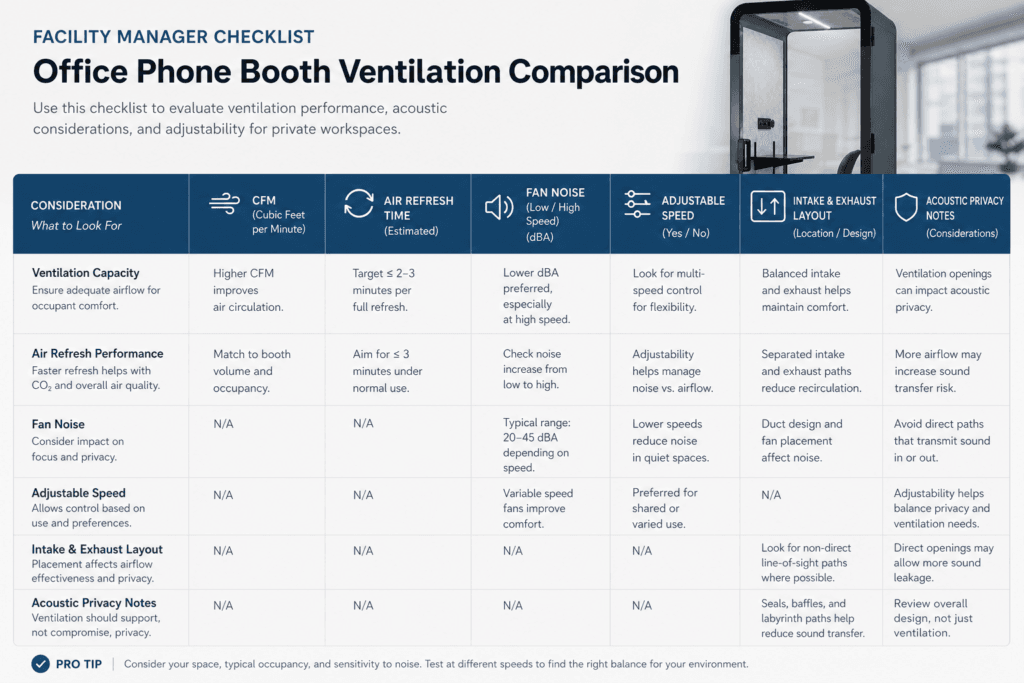
Ventilation Checklist: 10 Questions to Ask Before You Buy
Use this checklist before approving a booth quote.
| Question | What a Strong Answer Should Include |
|---|---|
| What is the total CFM for this exact size? | A model-specific airflow number, not a vague “strong fan” claim |
| How many intake and exhaust points are used? | Clear explanation of air entry and exit |
| How often is the air refreshed? | An estimated air-change interval or ACH calculation |
| Is fan speed adjustable? | User control or selectable settings |
| What is the fan noise level? | A stated noise reference and the setting used |
| Where are the vents located? | Intake and exhaust placement that supports real circulation |
| Can the enclosure be used with the door fully closed? | Yes, without requiring the user to open the door for comfort |
| Does ventilation affect acoustic privacy? | Explanation of how airflow paths are handled without large sound leaks |
| Is service access possible? | A practical way to inspect or maintain the ventilation parts |
| Is the data tied to the quoted model? | The supplier should match the spec to the exact booth being purchased |
[Insert image: facility manager ventilation checklist for office phone booth comparison]
When Adjustable Fan Speed Matters Most
Adjustable fan speed sounds like a small detail until the enclosure is used every day. Some users want stronger airflow during a 45-minute video call. Others prefer a quieter setting for a short private phone call. A fixed fan setting can make one group comfortable and another group annoyed.
Adjustable control is especially useful when:
- the unit is shared by many employees;
- call length varies from short check-ins to long video meetings;
- the surrounding office temperature changes during the day;
- users have different sound sensitivity;
- the unit is placed in a warmer or lower-airflow area of the office.
This is one reason I would treat adjustable ventilation as a commercial usability feature, not a luxury add-on.
What B&H Ergonomics Buyers Should Do Next
If phone booth ventilation is one of your deciding factors, ask for the exact size, airflow configuration, fan noise reference, and control options before comparing price. For B&H Ergonomics single-person configurations, the practical talking point is simple: approximately 102 CFM total airflow, two intake and two exhaust points, air refreshed about once every 1.5 minutes, and adjustable fan speed for user comfort.
For a project quote, also share how the space will be used. Short sales calls, long video meetings, and HR interviews may need the same basic product type but different comfort priorities.
FAQ
What is phone booth ventilation?
Phone booth ventilation is the internal airflow system that moves fresh room air into an enclosed call space and exhausts stale air out. In a one-person configuration, it usually includes fans, intake openings, exhaust openings, air channels, and sometimes adjustable fan controls.
How much airflow should a phone booth have?
There is no single universal number because cabin volume, fan layout, airflow path, and use case all matter. Buyers should ask for total CFM, estimated air-change speed, fan noise, and intake and exhaust placement for the exact model being quoted.
Is adjustable fan speed important in an office phone booth?
Yes. Adjustable fan speed lets users balance airflow and sound comfort. A stronger setting may be useful during longer video calls, while a lower setting may feel better for short calls or users who are sensitive to fan noise.
Does ventilation reduce acoustic privacy?
It can if the booth uses simple openings without acoustic planning. Air needs a path, and sound can also travel through weak paths. A better booth design should explain how airflow is managed while preserving speech privacy and sound reduction.
Does a phone booth ventilation system replace office HVAC?
No. The internal ventilation system circulates air between the enclosure and the surrounding office environment. The building HVAC system still affects room temperature, fresh air supply, filtration, and overall indoor air quality.