Estimate cost scope
Separate model price, quantity, customization, freight, duties, delivery point, assembly, and support.
Office phone booth cost guide
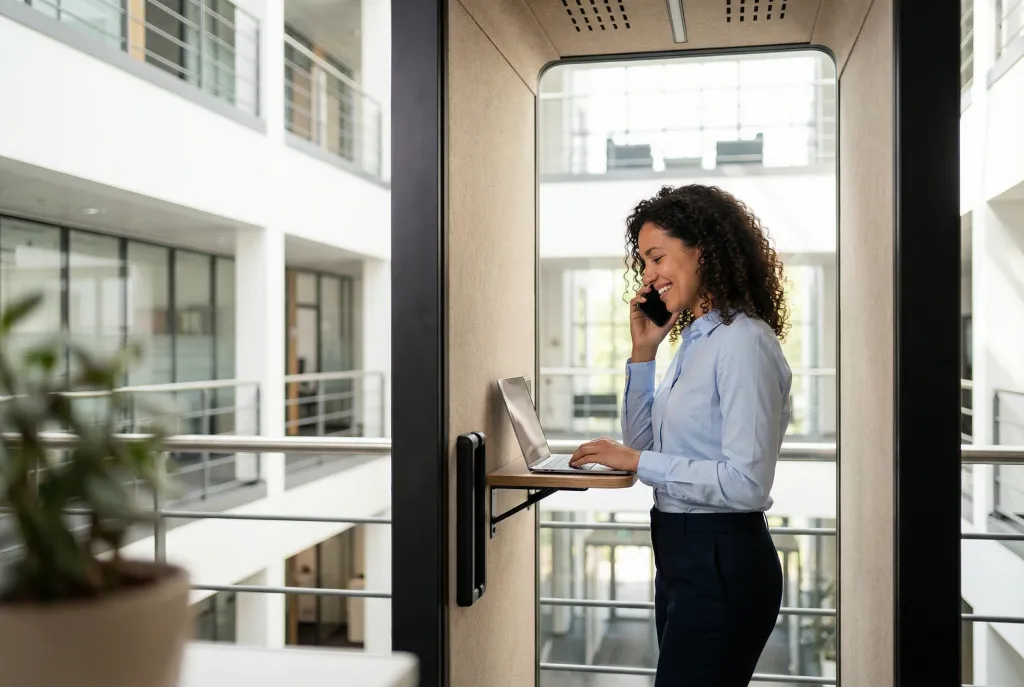
Office phone booth planning guide
Define quantity, fit, acoustic evidence, comfort, delivery access, and quote scope before comparing models. When the project requirements are clear, review the available B&H Ergonomics office phone booth options.
A phone booth for office use is a one-person enclosed workspace for private calls, video meetings, and short confidential conversations without building a permanent room. The right choice depends on peak call demand, placement, verified acoustic evidence, ventilation, lighting, power, delivery access, assembly scope, and total landed cost.
Use this guide to define the project first. Then move to the most specific resource for the next buying question.
Separate model price, quantity, customization, freight, duties, delivery point, assembly, and support.
Office phone booth cost guideConfirm crate size, delivery route, elevator access, doorway clearance, floor condition, and power location.
Office phone booth installation checklistCompare complete-product acoustic evidence instead of relying only on broad soundproof claims.
STC vs NIC acoustic ratings explainerCheck airflow path, fan noise, lighting, work surface, power, and posture before rollout.
Office phone booth ventilation guideAn office phone booth is a compact enclosed workspace designed for one person. Depending on the model, it may include acoustic materials, a sealed door system, glass or solid panels, ventilation, lighting, a work surface, and power access. Unlike a public payphone, it normally relies on the user’s own phone or computer. The distinction between public and workplace phone booths in America helps clarify what buyers are specifying when the same name is used for both products.
The practical goal is not perfect silence. The useful goal is better speech privacy, lower distraction, and a more controlled place for calls or video meetings. Product size, acoustic performance, electrical features, and delivery requirements must still be verified by model.
The booth is strongest when the problem is one-person communication privacy. It is weaker when buyers expect it to behave like a full private office.
| Buyer Situation | Fit | Why It Matters |
|---|---|---|
| Short private calls in open offices | Strong | One-person booths protect call privacy without occupying larger meeting rooms. |
| Video meetings for hybrid teams | Strong | The booth can create a more controlled audio and visual background. |
| HR, finance, or manager check-ins | Strong | Speech privacy matters more than casual open-space convenience. |
| All-day desk work | Usually not | A work pod usually gives more ergonomic space for long sessions. |
| Two-person meetings | Usually not | A small meeting pod is usually more appropriate. |
| Permanent enclosed-room requirements | Not always | A booth is flexible, but it does not replace every built room or site-specific requirement. |
Do not buy only by headcount. Buy by peak call demand. Observe one to two busy weeks, count how many private calls or video meetings happen at the same time, separate demand by department, and decide which booths should be bookable or first-come-first-served.
A phone booth is part of the broader office pod family, but it should not carry every use case.
| Pod Type | Typical Capacity | Best For | Choose Instead When |
|---|---|---|---|
| Office phone booth | 1 person | Calls, video meetings, HR check-ins, and short confidential work | The user needs a full workstation for long sessions. |
| Work pod | Model-dependent | Focus work, writing, coding, analysis, and interviews | The main need is high-turnover calls. |
| Meeting pod | Model-dependent | Team discussion, hybrid collaboration, and client meetings | The main need is one-person privacy. |
For broader planning across phone booths, work pods, and meeting pods, use the B&H Ergonomics office pod guide.
The best office phone booth choice is not made from the product photo alone. Check acoustic evidence, comfort, layout, delivery, and support as one package.
Ask whether the test method is named, whether the complete enclosure was tested, and whether third-party results are separated from office-test results.
Review acoustic termsCheck airflow path, fan noise, inlet and outlet location, lighting, power, work surface, and posture. A booth that feels stale will not be used consistently.
Review comfort checksConfirm footprint, door swing, service access, delivery path, power route, noise zone, user visibility, and booking behavior before approving the layout.
Review placement planningA useful comparison separates interior absorption, sound isolation, speech privacy, and complete-product test results. One rating should not be treated as proof of every acoustic outcome.
| Term | Plain Meaning | Buyer Guidance |
|---|---|---|
| Sound absorption | Reduces reflection and echo inside the booth | Improves voice comfort but does not automatically prevent sound transfer. |
| Sound isolation | Reduces sound transfer between inside and outside | Depends on the complete enclosure, including doors, seals, glass, floor, and ventilation paths. |
| Speech privacy | Makes speech harder to understand outside the booth | This is usually the most practical goal for calls and confidential conversations. |
| STC | A single-number rating commonly used for partitions or components | Useful context, but not enough to describe a complete booth by itself. |
| NIC | A field-style isolation rating between spaces | Depends on site conditions, background noise, and the measurement setup. |
| ISO 23351-1 speech level reduction | A laboratory method for furniture ensembles and enclosures | More relevant when the complete booth is tested as a product. |
| Factory-tested sound level difference | A controlled internal measurement | Keep it separate from third-party laboratory results and record the test conditions. |
ISO 23351-1:2020 covers sound level reduction for furniture ensembles and enclosures used to improve speech privacy. ASTM E413 and ASTM E336 provide useful context for sound insulation ratings and field measurements.
Comfort affects whether people use the booth consistently. Review the complete operating experience, not only the exterior design.
| Feature | What to Check | Why It Matters |
|---|---|---|
| Ventilation | Airflow path, fan noise, inlet and outlet position, service access | Users avoid booths that feel stale or distractingly loud. |
| Lighting | Face lighting, brightness, glare, and controls | Video calls need a clear visual environment without uncomfortable glare. |
| Power | Outlet type, charging ports, cable routing, destination compatibility | The electrical configuration must match the intended devices and project location. |
| Work surface | Height, depth, stability, and laptop fit | Calls often include note-taking, screen sharing, or short focused tasks. |
| Posture | Standing, stool, or chair use | Match posture and interior space to the expected session length. |
ASHRAE indoor air quality resources and EPA guidance for offices and large buildings provide useful background for enclosed workplace comfort. Product airflow and fan-noise data must still be verified by model.
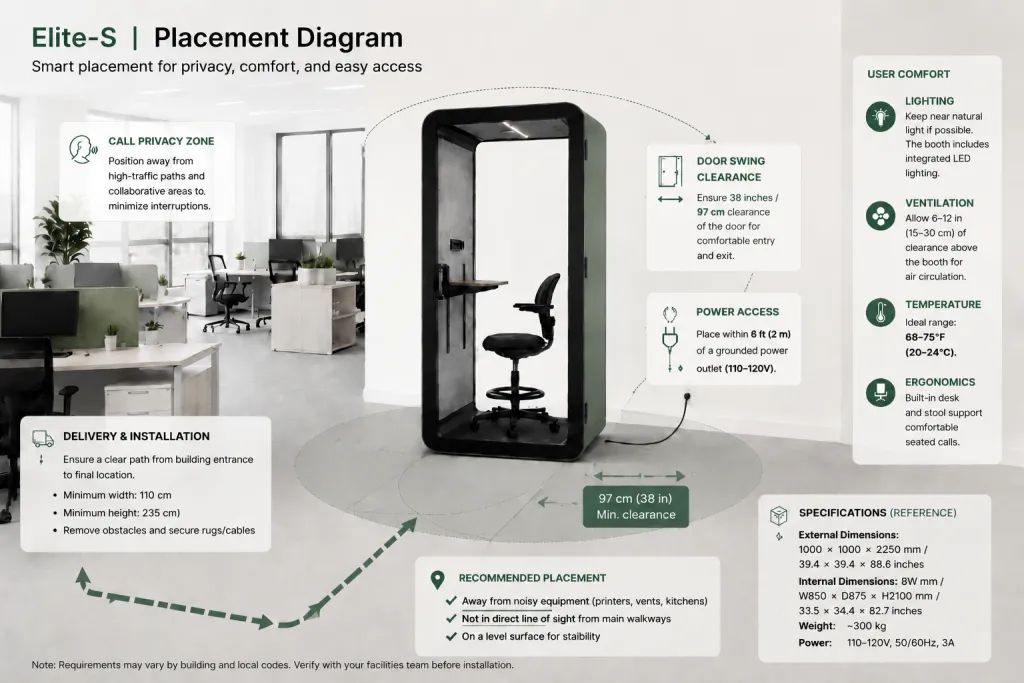
Placement determines whether the booth is convenient, comfortable, serviceable, and reachable through the building.
| Planning Item | What to Measure or Confirm |
|---|---|
| Footprint | Booth width, depth, height, and final occupied area |
| Door and user route | Door swing, entry clearance, nearby circulation, and accessibility considerations |
| Service space | Access for cleaning, panel service, ventilation checks, and maintenance |
| Delivery path | Narrowest doorway, corridor turn, elevator, stair, and final-room access |
| Power route | Nearby connection point, cable path, and trip-hazard control |
| Noise zone | Distance from pantries, printers, reception, and loud collaboration areas |
| Booking behavior | Reserved, shared, or first-come-first-served use |
For deeper interior and finish planning, use the B&H Ergonomics office phone booth layout planning guide.
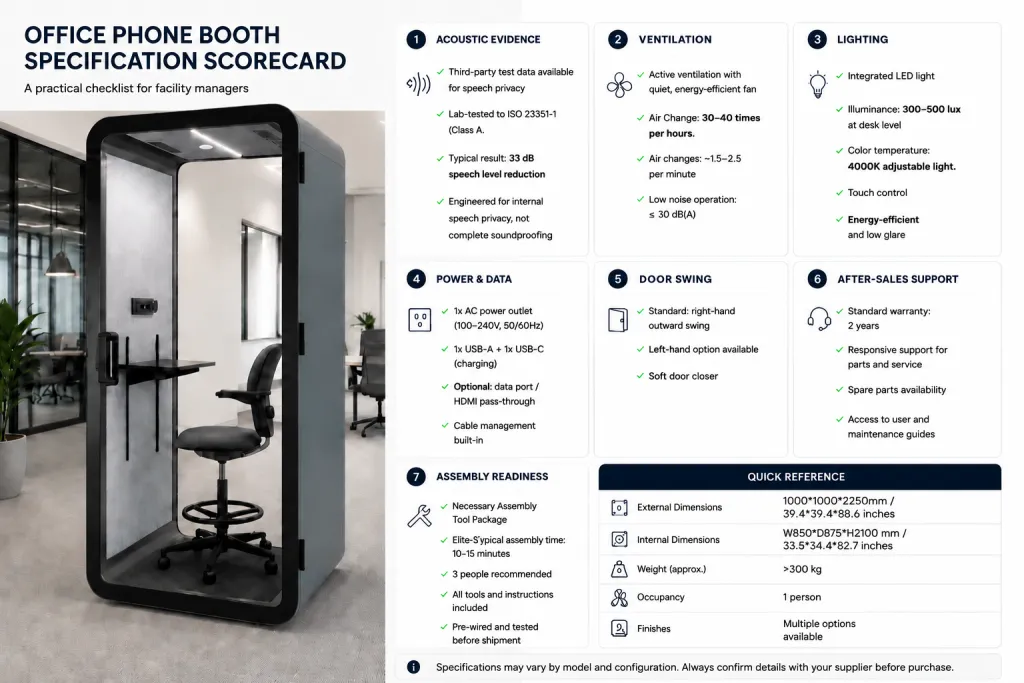
Elite-S is a useful B&H Ergonomics reference model because it shows why buyers should separate laboratory results, controlled factory testing, product specifications, delivery scope, and installation documentation.
Use the scorecard to identify vague answers before a model reaches final approval.
| Score Area | Strong Answer | Weak Answer |
|---|---|---|
| Acoustic evidence | Named method and complete-product context | Vague soundproof claim |
| Comfort | Ventilation, lighting, posture, and power explained | Only exterior design shown |
| Layout fit | Footprint, door route, and service access checked | Product selected from a photo alone |
| Delivery | Freight, duties, delivery point, and responsibilities defined | Landed scope remains unclear |
| Assembly | Tools, labor, instructions, and responsibility confirmed | Installation burden discovered late |
| Customization | Finish and OEM requirements confirmed before quoting | Custom requests added after pricing |
| Destination review | Electrical and site questions raised early | Location-specific issues left until installation |
| Support | Parts, warranty, documentation, and service path explained | No clear after-sales process |
Separate the full landed project scope before approving a purchase order. A low product price can become a poor comparison when freight, duties, site handling, assembly, or support remain undefined.
| Cost Area | What to Clarify |
|---|---|
| Product price | Base model, included features, optional upgrades |
| Quantity | One booth, pilot batch, or multi-site rollout |
| Customization | Color, finish, branding, OEM changes |
| Freight | Shipping method, packaging size, destination terms |
| Duties and taxes | Whether DDP or another Incoterms arrangement is used |
| Delivery point | Warehouse, curbside, building entrance, or final room |
| Assembly | Self-assembly, local installer, or included service |
| Site work | Power access, unloading, route handling, and local building requirements |
| Support | Replacement parts, warranty handling, documentation |
When DDP is available for a project, it can make landed cost clearer by defining how import duties and customs handling are addressed in the agreed delivery arrangement. The ICC explanation of DAP and DDP provides neutral background on these delivery terms. Confirm unloading, final-room movement, unpacking, and assembly separately. For current pricing factors, use the B&H Ergonomics office phone booth cost guide.
Confirm color, finish, branding, electrical configuration, and repeat-order requirements before final pricing. Custom requests can affect lead time, packaging, documentation, and minimum project scope.
The more complete this information is, the easier it is to avoid quote revisions, delivery surprises, and scope gaps.
After the checklist is ready, B&H Ergonomics can help review quantity, placement, finish requirements, delivery terms, and quote details for a one-person call booth project.
Short answers for facility managers, office designers, procurement teams, and operators comparing one-person office booths.
Office phone booth size depends on the model, door swing, user posture, ventilation design, and service access. Buyers should review footprint, height, delivery route, final placement area, nearby power access, and any required clearance before approving a layout.
Estimate booth quantity by peak simultaneous private calls, not only headcount. Observe one to two busy weeks, separate demand by department, and start with a pilot layout when demand is uncertain.
Place it near the team that needs call privacy, but away from pantry noise, printers, reception traffic, and crowded circulation paths. Confirm footprint, door swing, delivery route, nearby power, cleaning access, and building safety rules before final placement.
The final cost depends on model, quantity, acoustic specification, customization, freight, duties, delivery term, assembly method, and after-sales support. Compare total project cost, not only product price.
Ask for the named test method, whether the complete booth or only a component was tested, the reported metric, the test conditions, and the current report for the model being considered. Keep ISO 23351-1 speech level reduction, STC, NIC, and factory-tested sound level difference clearly separated.