Quick Answer
Choose an office sound masking system when the main problem is distracting speech across a shared open area. Choose acoustic pods when people need a defined place for private calls, meetings, or focused work. A white noise machine can help one small area, but it is not the same as a zoned commercial masking system. Many offices use both: masking for the open background and pods for tasks that should not happen at an exposed desk.
Last Updated: August 21, 2026 | Author: William | Review: Richard | Estimated Reading Time: 10 minutes
Why “White Noise for Office” Can Mean Two Different Solutions
Teams often search for white noise for office after a simple complaint: nearby conversations keep pulling attention away from work. The phrase can describe two very different purchases:
- A desktop or portable white noise machine that covers one room, desk group, or reception area.
- A planned office sound masking system that distributes a tuned background sound across defined zones.
The first is a local device. The second is an acoustic design decision that depends on ceiling conditions, coverage, workstation layout, existing background sound, and commissioning. Treating them as interchangeable can leave a large office with uneven coverage or create the impression that confidential conversations are protected when they are not.
| Search phrase | Usually describes | The buyer should clarify |
|---|---|---|
| White noise for office | A general background sound or small device | Is one local area the problem, or does an entire zone need a consistent acoustic baseline? |
| Office white noise machine | Portable or desktop equipment | Is the goal comfort and distraction control, or speech privacy for a specific task? |
| Office sound masking system | A zoned workplace acoustic layer | Which areas need coverage, tuning, and post-installation review? |
| Acoustic pods | Enclosed workplace furniture | Which calls, meetings, or focus sessions need a destination outside the open floor? |
What an Office Sound Masking System Does
An office sound masking system adds controlled background sound so that speech from farther away is less intelligible. The goal is not silence. The goal is to reduce the clarity and salience of conversations that were not intended for the listener.
The U.S. General Services Administration’s Sound Matters guidance describes layered sound control that can include absorption, blocking, and covering. Masking is primarily a covering layer; it does not repair every source of noise in a floor plan.
Sound masking is a sensible starting point when employees report:
- distant conversations that remain easy to follow;
- a generally exposed or acoustically uneven open floor;
- speech distraction across several workstation neighborhoods;
- a need for a more consistent background sound level; or
- moderate privacy needs that do not involve sensitive conversations at open desks.
Before specifying a system, check the layout and the room surfaces. A call-heavy team beside a focus-heavy team may need zoning or relocation first. Hard ceilings, glass, and reflective finishes may also require absorption so the masking system is not asked to solve reverberation by itself.
For a broader diagnosis, use the open office noise reduction plan to separate source control, absorption, layout, behavior, and masking decisions.
What Sound Masking Cannot Do
Sound masking is not soundproofing, a sealed room, or a guarantee of confidential communication. It can make distant speech harder to understand, but someone nearby may still hear or understand a conversation. It also provides no visual privacy and does not create a place for a video call, interview, or one-on-one meeting.
Do not use masking as the only response when the stated need is:
- an HR, legal, finance, or recruiting conversation;
- a client or sales call that should not be overheard;
- a video meeting that disrupts neighboring teams;
- focused work that requires control over interruptions; or
- a confidential discussion at an exposed workstation.
Those are task and space problems. The next question is where the work should happen, not how much background sound to add.
When Acoustic Pods Are the Better Choice
An acoustic pod gives a person or small group a defined destination away from the open floor. Depending on the model and configuration, the buyer can review enclosure construction, visual separation, lighting, ventilation, power, capacity, and the evidence for the complete product.
Pods are usually the better fit for:
- private phone and video calls;
- HR interviews and employee conversations;
- finance, legal, and recruiting work;
- leadership one-on-ones;
- focused individual work;
- short meetings when formal rooms are occupied; and
- teams that need an on-demand privacy option rather than a permanent room for every task.
The product decision still needs boundaries. A pod should not be described as completely silent or universally soundproof. Ask for model-specific acoustic documentation and confirm the tested configuration. ISO 23351-1 provides a laboratory method for measuring speech level reduction for furniture ensembles and enclosures. That metric is more useful for a complete pod than an unlabeled dB number for one panel, but test results still depend on the model, setup, installation, and surrounding conditions.
For the wider selection decision, review B&H Ergonomics’ office pod guide before choosing between a one-person booth, a work pod, or a meeting pod.
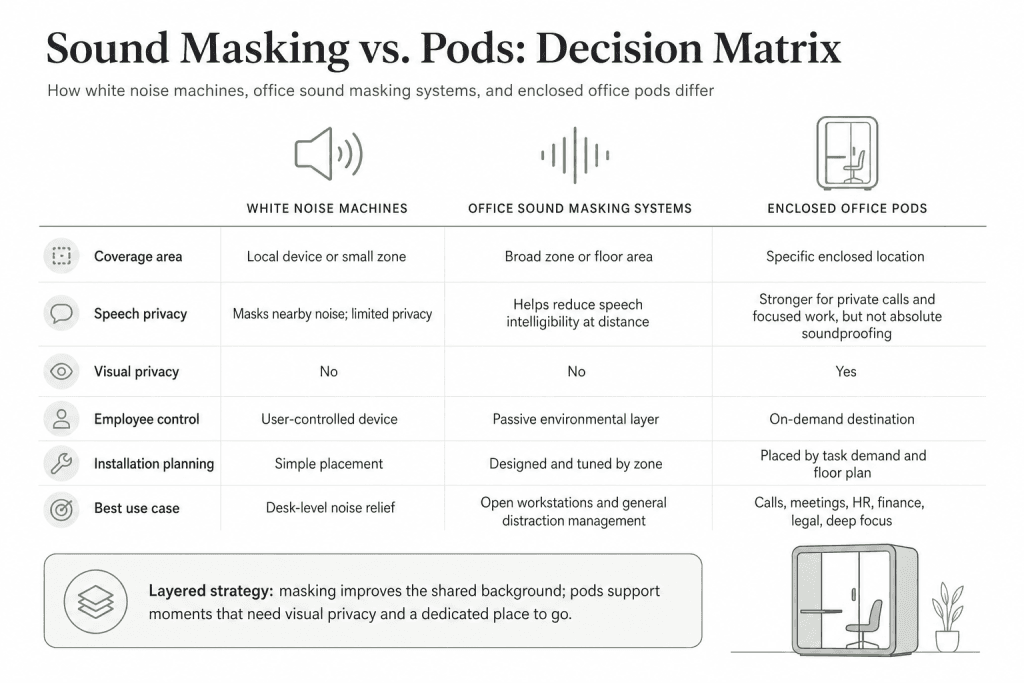
Sound Masking vs Acoustic Pods: Decision Matrix
| Decision factor | Office sound masking system | Acoustic pods |
|---|---|---|
| Main job | Reduce the intelligibility and salience of distant speech | Provide an enclosed destination for a defined task |
| Coverage | A planned zone or shared floor area | A specific location and capacity |
| Best first use case | General distraction across open workstations | Private calls, meetings, interviews, or focused work |
| Visual privacy | None | Enclosure and sightline control depend on the configuration |
| Employee control | Passive environmental layer | On-demand space that employees can enter when needed |
| Installation logic | Coverage map, tuning, ceiling conditions, and commissioning | Placement, route, power, ventilation, capacity, and assembly |
| Main limitation | Does not create a private room or protect a nearby conversation | Does not improve the acoustic baseline across the entire open floor |
| Evidence to request | Coverage and commissioning approach, zoning, and adjustment process | Complete-product acoustic method, tested model, configuration, and installation requirements |
| Better buyer question | “Do we need less intelligible background speech across this zone?” | “Do people need a place to go for this work?” |
The matrix points to the practical difference: masking changes the shared environment, while a pod changes the setting for a task.
When Offices Should Use Both
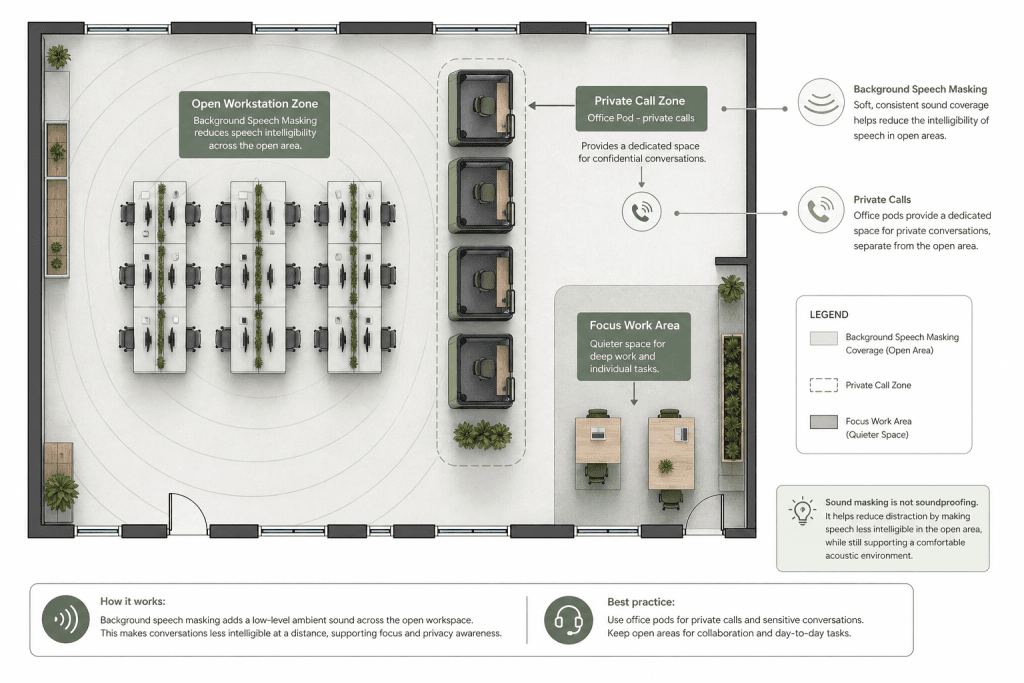
Many workplace projects need a layered plan instead of a single purchase. A useful sequence is:
- Identify the dominant complaint: source noise, reverberation, distant speech, visual exposure, or lack of private space.
- Improve the room itself with layout changes and absorption where hard surfaces create reflections. B&H’s office acoustic panels can be evaluated as one part of that absorption layer.
- Add sound masking where distant speech remains distracting across open workstations.
- Place pods where calls, meetings, or focus sessions need an enclosed destination.
- Review employee feedback after the changes are in use, then adjust zoning, behavior rules, or equipment settings.
Sound-absorbing curtains can be useful in some reflective or temporary areas, but they should not be presented as a substitute for an enclosed private workspace. Every layer should be assigned a specific problem so that the project team can tell whether it worked.
Buying Checklist for Facility Managers
Before buying an office sound masking system
- Map the areas where speech distraction is reported and note the time of day.
- Decide whether the goal is comfort, reduced distraction, or a defined speech-privacy outcome.
- Check team adjacencies, ceiling height, hard surfaces, glass, and existing HVAC or equipment noise.
- Ask how zones will be designed, tuned, commissioned, and adjusted after occupancy.
- Confirm how the system will be explained to employees so it is not mistaken for soundproofing.
- Identify the conversations that must move to an enclosed space even after masking is installed.
Before buying acoustic pods
- Count peak simultaneous demand for private calls, focus work, and small meetings.
- Match capacity and interior layout to the actual task, not only to the available footprint.
- Confirm placement, delivery route, door clearance, power, ventilation, lighting, and network needs.
- Request acoustic evidence for the exact model and configuration being quoted.
- Ask which test method and metric are used, and do not compare unlike metrics as if they were the same.
- Plan cleaning, maintenance, booking or etiquette rules, and a review of real usage after installation.
The procurement brief should also record what the solution does not promise. That single step prevents a background sound system from being sold as confidential space and prevents a pod’s test result from being treated as a guarantee of zero sound transfer.
B&H Perspective: Match the Acoustic Tool to the Work
The most common planning mistake is to treat every office noise complaint as one problem. Distant chatter across a large open floor and a confidential call at an exposed desk require different interventions.
Use masking to improve the background where people continue to work in shared space. Use an enclosed pod when the work itself needs separation, visual privacy, or a controlled place for a call or focus session. If both conditions exist, design the open-floor acoustic layer and the private-space capacity together.
When the brief confirms that enclosed space is part of the answer, compare B&H Ergonomics acoustic office pods by use case, capacity, configuration, and project requirements. Ask for the evidence pack for the exact model, and have the facility, design, and procurement teams review the complete installation rather than relying on a single headline acoustic number.
FAQ
Is white noise the same as an office sound masking system?
No. White noise usually describes a general background sound or a small local device. An office sound masking system is a planned, zoned workplace layer that should be evaluated for coverage, tuning, and the actual layout.
Does sound masking make office conversations private?
No. It can reduce the intelligibility of more distant speech, but it does not create visual privacy or a private room. Sensitive conversations should take place in an enclosed space.
When should an office choose pods instead of sound masking?
Choose pods when people need a place for private calls, video meetings, interviews, one-on-ones, or focused work. Those tasks need a destination, not only a change to the background sound.
Can sound masking and acoustic pods be used together?
Yes. Masking can improve the shared open-office baseline, while pods provide enclosed destinations for tasks that should not happen at an exposed desk. They solve different layers of the same workplace planning problem.
What acoustic evidence should a pod buyer request?
Request the tested model and configuration, the test method, the metric, the classification if one is reported, and the conditions that apply to the result. ISO 23351-1 is a relevant reference for speech level reduction of complete furniture ensembles and enclosures. Do not treat a component rating, an unlabeled dB value, and a complete-enclosure result as interchangeable.