Quick Answer
To reduce noise in office spaces, identify the source before choosing a product. Use layout and work rules for activity conflicts, absorption for echo, sound masking for distant speech, personal headsets for individual relief, and enclosed rooms or pods when calls and focused work need a separate destination. Most offices need a layered plan because no single treatment controls every type of noise.
Last Updated: July 20, 2026 | Author: Richard | Estimated Reading Time: 11 minutes

Start With the Noise Source, Not a Product
When a team says the office is too noisy, that complaint can describe several different problems. Employees may be hearing every word of a nearby conversation. The room may have too much reverberation. A ventilation unit may be producing a mechanical hum. Calls may be happening in the wrong place, or a sensitive conversation may have nowhere private to go.
Those problems do not share one solution.
I usually start with two questions:
- Which sound is disrupting the work?
- Does the team need lower distraction, better speech privacy, or both?
At B&H Ergonomics, we treat this as a workplace planning problem before a product-selection problem: document the work pattern, privacy requirement, and space constraint, then decide whether the office needs operating changes, room treatment, or enclosed task space.
The first question identifies the source. The second defines the outcome. Without both answers, it is easy to buy acoustic products that improve the room but leave the original complaint unresolved.
For example, wall panels can soften a reverberant room, but they do not turn an open workstation into a confidential space. Noise-canceling headphones may help one person concentrate, but they do not prevent nearby employees from hearing a client call. A pod can provide an enclosed destination for that call; the office soundproofing guide for phone calls explains when enclosure is the right boundary and when room treatment is the wrong tool. A pod still will not repair a noisy HVAC system.
What Type of Office Noise Are You Trying to Reduce?
Use the following matrix as a first-pass diagnosis. It is a planning tool, not a substitute for formal acoustic measurement when a project requires technical specifications.
| What People Notice | Likely Source | How to Check It | Best First Direction |
|---|---|---|---|
| “I can understand every nearby conversation.” | Intelligible speech traveling across workstations | Walk the area during call-heavy periods and record where words remain clear | Zoning, call relocation, masking, or enclosed call space |
| “The room sounds sharp, busy, or echoey.” | Reflections from glass, concrete, exposed ceilings, or other hard finishes | Compare the room during occupied and quiet periods; use a qualified consultant when reverberation data is needed | Absorptive finishes, panels, ceiling treatment, or soft furnishings |
| “Calls interrupt the whole team.” | Call-heavy work happening at open desks | Review where calls occur and whether appropriate rooms are available at peak times | Call policy, team adjacency changes, booths, rooms, or pods |
| “A hum or rattle is always present.” | HVAC, printers, appliances, fans, or mechanical equipment | Switch equipment off individually where safe and ask facilities to inspect persistent sources | Maintenance, equipment relocation, isolation, or mechanical repair |
| “Footsteps, doors, or activity from another area carry through the space.” | Impact noise or structure-borne transmission | Trace the timing and path of the sound rather than judging it from one desk | Building or architectural assessment, door hardware, floor treatment, or separation |
| “Private conversations are exposed.” | A shortage of suitable enclosed space | Compare demand for private calls with the number and availability of rooms | Enclosed rooms, booths, or pods with verified acoustic information |
ISO 22955:2021 addresses acoustic quality in open-plan offices. Its relevance for buyers is practical: acoustic expectations should match the activity taking place in each zone rather than assuming the entire floor needs the same treatment.
Office Noise Solutions: What Each Method Can and Cannot Fix
The useful comparison is not which product is “best.” It is which method matches the source, the required outcome, and the constraints of the space.
| Method | Best Use | What It Does Not Solve Well | Planning Note |
|---|---|---|---|
| Work rules and scheduling | Long calls at desks, informal conversations, avoidable interruptions | Echo, mechanical noise, or a chronic shortage of private space | Effective only when teams can follow the rule without losing access to needed rooms |
| Layout and zoning | Loud and quiet teams placed too close together | Confidentiality or strong sound transmission | Separate call-heavy roles from deep-focus work before adding products |
| Absorption | Reverberation and harsh reflections | Dependable speech privacy or sound isolation | Use office acoustic panels and related treatments only after identifying the reflective surfaces and target area |
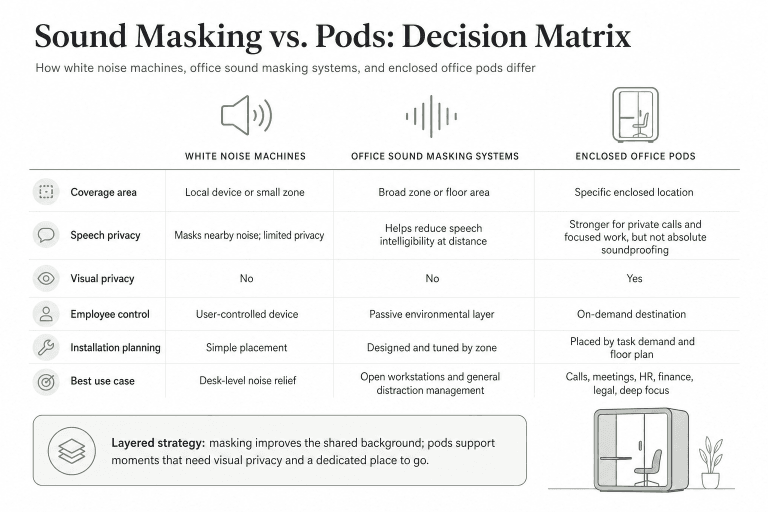
| Sound masking | Reducing the intelligibility of distant background speech | Visual privacy, confidential calls, or equipment noise | An office sound masking system needs professional coverage and commissioning; adding random white-noise devices is not the same thing |
| Noise-canceling headsets | Individual concentration and call listening | Room-wide noise control or preventing others from hearing speech | Treat headsets as a personal tool, not as the office acoustic strategy |
| Architectural isolation | Sound passing through walls, ceilings, doors, or the building envelope | Workflow conflicts in the open area | May require an acoustic consultant, contractor, landlord approval, and construction work |
| Enclosed rooms or pods | Private calls, focused work, video meetings, interviews, and short one-to-one conversations | HVAC faults, exterior noise, or general reverberation across the whole floor | Match occupancy, placement, power, ventilation, access, and acoustic evidence to the task |
This comparison also explains why buying more of the same treatment can fail. If panels reduced the echo but employees still understand nearby calls, the remaining problem is speech transmission or space planning. If masking makes distant speech less noticeable but HR conversations still happen at desks, the office still lacks an appropriate private destination.
How to Reduce Noise in an Office Step by Step
1. Record the Complaint by Place, Time, and Task
Avoid a survey that asks only whether the office is noisy. Record where the problem occurs, when it is worst, what people are doing, and which sound they notice.
A simple log can include:
- zone or workstation group;
- time of day;
- noise source;
- task being interrupted;
- whether words are understandable;
- whether the issue is distraction, confidentiality, or both;
- what employees currently do to cope.
Patterns matter more than isolated comments. A sales team may create predictable call peaks. A finance group may need quiet during reporting periods. A shared meeting room may be occupied by one-person video calls because no smaller space exists.
2. Define the Outcome Before Comparing Products
“Quieter” is too vague for procurement. Choose a clearer outcome:
- reduce reverberation in a hard-finished zone;
- make distant conversations less intelligible;
- move long calls away from open desks;
- provide a dependable place for private conversations;
- reduce meeting-room demand from solo calls;
- separate collaborative and deep-focus activities.
The outcome determines what evidence matters. Absorption products need relevant absorption information. Enclosures need acoustic evidence that reflects enclosure performance. A layout change needs an operational test showing that noisy and quiet activities no longer conflict.
3. Correct Avoidable Workflow and Adjacency Problems
Low-disruption changes should come before a large purchase when they can address the source.
Move call-heavy teams away from concentration-heavy roles. Set clear expectations for long video calls. Create a quiet work zone that is not also a circulation path. Reserve large meeting rooms for tasks that need their capacity. Place printers, coffee points, and informal discussion areas away from work that requires sustained attention.
These changes cost less than construction, but they still need management follow-through. A quiet zone that becomes an overflow meeting area will not remain quiet.
4. Treat the Room Where Reflections Are the Problem
If the room has excessive reverberation, target the surfaces and zones creating the problem. Possible treatments include ceiling absorbers, wall panels, suitable floor finishes, upholstered furniture, and acoustic screens.
Do not judge the result only by whether the room feels softer. Return to the original complaint. Did conversations become less intrusive? Did the treatment help only one zone? Are confidential calls still exposed? The answer determines whether the next step is more absorption or a different category of solution.
5. Add a Background Layer Only When It Matches the Goal
Sound masking can support a more consistent acoustic background and make distant speech less intelligible. It should be designed for the space rather than improvised with consumer speakers or desktop white-noise devices.
Masking is not a substitute for a private room. It also does not repair a loud fan, stop impact noise, or prevent visual exposure. Use it when the target is broad speech distraction across an open area, not when the task requires an enclosed conversation.
6. Provide Enclosed Destinations for Work That Should Not Stay Open
Some tasks create noise and require privacy at the same time. Sales calls, recruiting interviews, HR conversations, client video meetings, focused writing, and short one-to-one discussions should not compete indefinitely for the same open floor.
The planning question is not simply whether to add an enclosure. It is how many people need one, how long they use it, where demand peaks, and what level of privacy the task requires.
When Office Noise Is Really a Speech-Privacy Problem
Speech distraction and speech privacy are related, but they are not identical.
An employee may be distracted because a nearby conversation is understandable. A manager may have a privacy problem because the conversation contains sensitive information. Absorption and masking may reduce how far speech carries or how clearly it is understood, but a sensitive conversation often needs physical separation as well.
This is where acoustic office pods can become part of the plan. They provide enclosed task space without requiring every short call or focused session to occupy a conventional meeting room. The buyer still needs to evaluate occupancy, placement, ventilation, power, accessibility, and the acoustic evidence for the specific model, while appropriate professionals confirm site-specific fire protection and building requirements.
The owner-page handoff should happen only after the noise source is clear. A team with a rattling air-handling unit needs facilities support. A team with exposed calls and no available small rooms has a different problem and a stronger case for enclosed space.
What Office Pods Can and Cannot Fix
Office pods can help when the workplace lacks appropriate destinations for noisy or privacy-sensitive tasks. They are commonly considered for private calls, video meetings, interviews, short meetings, and individual focus work.
They do not make the entire office silent. They do not remove reverberation from every open area, correct mechanical equipment, block exterior construction noise, or replace building-wide acoustic design.
Buyers should also compare acoustic claims carefully. ISO 23351-1:2020 provides a method for measuring speech level reduction for furniture ensembles and enclosures. That is different from material absorption data, wall STC values, or an informal difference between two sound-level readings. Ask what was tested, which method was used, and whether the result applies to the exact product configuration being considered.
If enclosed space is the right category, the office pod guide explains how to compare task, occupancy, placement, services, and procurement requirements before selecting a configuration.
A 30/60/90-Day Office Noise Reduction Pilot
Test the noise diagnosis through a staged pilot before committing to a wider redesign. Record what changed and whether the original complaint improved. If the review also exposes circulation, room-access, or maintenance problems, use the workplace improvement checklist to assign that wider facilities work. Keeping the actions separate helps the team see whether the remaining problem needs acoustic treatment, a layout change, or better daily operation.
| Period | Action | Evidence to Record | Decision at the End |
|---|---|---|---|
| First 30 days | Map complaints, call peaks, room demand, reflective zones, and mechanical sources | Complaint type, location, time, affected task, room-booking pressure | Identify the two or three highest-impact problems and assign an owner for each |
| Next 60 days | Test adjacency changes, call rules, targeted absorption, masking in a defined area, or access to enclosed space | Repeat complaints, calls moved from desks, room use, employee observations, unresolved privacy incidents | Continue, adjust, or stop each intervention based on the problem it was meant to solve |
| Next 90 days | Scale only the measures that worked and prepare specifications for larger purchases or building work | Coverage needs, placement constraints, utilization, maintenance, power, ventilation, access, and budget | Approve the next phase with a clear scope rather than a generic request for “more soundproofing” |
For a larger or technically sensitive project, use qualified acoustic and building professionals to establish measurement methods and acceptance criteria. Employee feedback is useful, but it should not be presented as a formal acoustic rating.
What to Record Before Requesting a Layout or Quote
When the diagnosis points toward enclosed task space, prepare the following information before asking suppliers to recommend a layout:
- a current floor plan with dimensions and circulation routes;
- total headcount and expected office attendance;
- number of calls, video meetings, interviews, and focus sessions during peak periods;
- typical session length and occupancy;
- which conversations require stronger privacy;
- current meeting-room inventory and booking pressure;
- preferred pod locations and any daylight or visibility constraints;
- available power, data, ventilation, and fire-protection conditions;
- delivery route, doorway, lift, floor-loading, and installation constraints;
- relocation or future reconfiguration requirements;
- the acoustic evidence and product documentation required by procurement.
This information allows a supplier to discuss quantity and configuration in the context of the real workplace problem. It also helps the buyer reject proposals that recommend a product without explaining which noise source or task it is meant to address.
The most effective office noise plan is rarely the one with the most products. It is the one that assigns each problem to the right intervention, tests the result, and provides enclosed space only where the work genuinely needs it.
FAQ
What is the best way to reduce noise in an office?
Start by identifying whether the main problem is understandable speech, reverberation, equipment, impact noise, poor team adjacency, or a shortage of private space. Match the method to the source: absorption for reflections, masking for distant speech, maintenance for equipment, zoning for activity conflicts, and enclosed space for calls or focused work that should not remain open.
How can an office reduce noise without renovation?
Begin with team zoning, call rules, quiet periods, equipment relocation, soft furnishings, freestanding acoustic treatments, properly designed sound masking, and better use of existing rooms. Freestanding pods may also add enclosed task space without constructing permanent rooms, although they still require layout, services, access, and safety planning.
Do acoustic panels stop people from hearing conversations?
Acoustic panels absorb reflected sound and can reduce reverberation, but they do not usually provide dependable speech privacy by themselves. If people still understand nearby conversations, the office may also need better separation, masking, or enclosed space.
Are noise-canceling headphones enough for an open office?
They can help an individual manage distraction, but they do not reduce the noise experienced by everyone else, prevent coworkers from hearing a call, or solve poor room acoustics. They are a personal tool rather than a complete workplace noise-control plan.
Do office pods eliminate all noise?
No. Pods can provide useful sound reduction and a more private task environment, but results depend on the product, test method, installation, site conditions, and surrounding space. Buyers should compare verified acoustic evidence and avoid absolute acoustic claims.