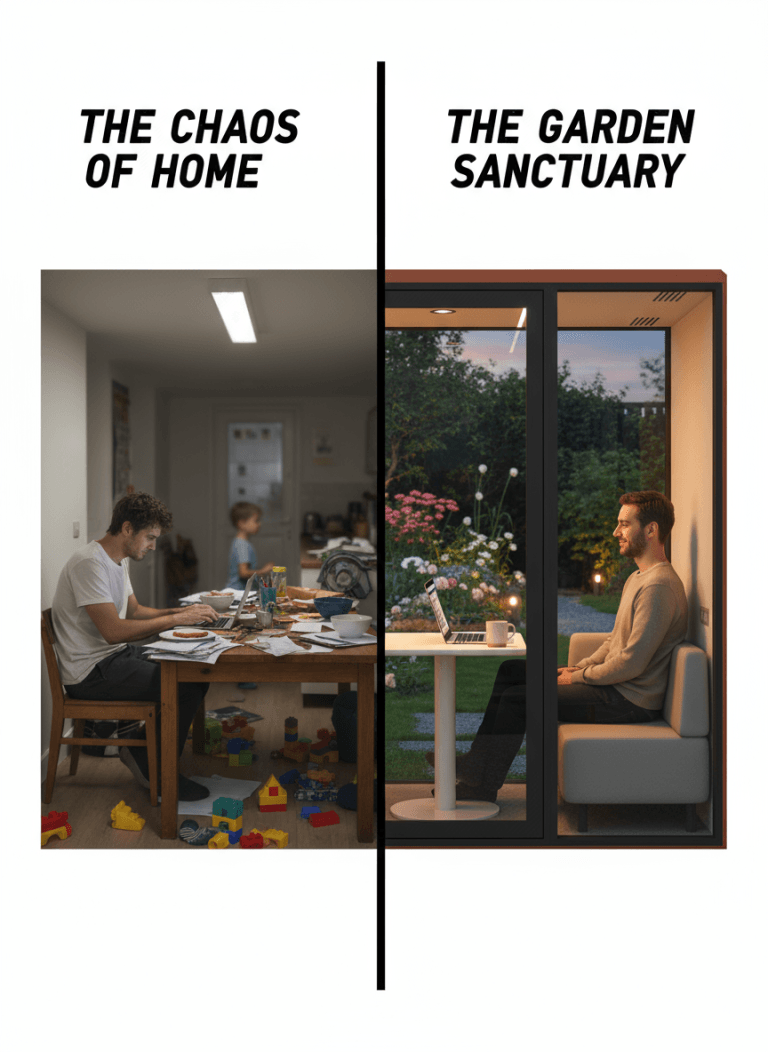
For years, I’ve watched the quiet revolution of office pods. But recently, these pods started a great escape, migrating from corporate floors to suburban backyards. This is an exciting shift, but it’s a field littered with financial landmines and logistical nightmares.
The single biggest lie in the garden office industry is selling you a “product” when they should be guiding you through a “project.” They show you a stunning photo with a tempting price tag, making you believe that a click of a button is all that separates you from work-from-home bliss.
Let me be brutally honest: that is complete nonsense.
A garden office pod is not a piece of furniture you order online. It is a small-scale construction project. Ignoring this fact is the fastest way to turn your dream of work-life balance into a nightmare of permits, unexpected invoices, and a very expensive, unusable shed.
As an engineer, I’m here to pull back the curtain. This is your ultimate garden office pod guide. We will walk through every critical step, from the dirt under the pod to the Wi-Fi signal inside it, so you can make this investment with your eyes wide open.
Last Updated: Oct, 2025 | Estimated Read Time: 13 minutes
Garden Office Pod Guide

The #1 Hurdle: Can I Actually Get a Backyard Office Pod in My Garden?
Before you even look at prices or designs, this is the first and only question you should be asking: “What are the logistical requirements to get a pod to its final location in my yard?” The answer determines the feasibility of your entire project.
Do I need planning permission for garden office pod in the US?
Many sellers will give you a vague “it’s usually not required.” Do not accept this. The responsibility, and any legal or financial penalty, falls on you, the homeowner.
In the United States, regulations are highly localized at the city and county level.
- Forget “Planning Permission”: The terms you need to search on your local municipality’s website are “Accessory Dwelling Unit (ADU),” “Accessory Structure,” or “Shed Regulations.” These documents will outline the rules for outbuildings.
- The Size Threshold: Most jurisdictions have a size limit (e.g., 120 sq ft, 150 sq ft, or 200 sq ft) below which a permit is not required for a non-habitable structure. However, there are other critical rules regarding height and distance from property lines (setbacks).
- The HOA is More Powerful Than the Government: Before you do anything else, read your Homeowners’ Association (HOA) covenants. They have the final say on what you can and cannot build in your yard. I have seen more projects torpedoed by a surprise HOA rejection than by any city permit issue. Get their approval in writing first.
| Common US Regulation Thresholds | (Examples Only – Always Check Locally) |
|---|---|
| Size Exemption | Often under 120-200 sq. ft. |
| Height Limit | Typically 8-15 ft. |
| Setback Rules | Must be a certain distance from property lines (e.g., 5 ft from side/rear). |
| Electrical Work | Almost always requires a separate electrical permit and inspection. |
Richard’s Insider Tip: Call your local planning or building department. Say, “I’m thinking of installing a pre-fabricated detached home office structure, about 10×12 feet. What rules for accessory structures do I need to follow?” A 15-minute phone call can save you thousands of dollars and months of headaches.
What Kind of Garden Office Pod Foundation you need?
A pod needs a perfectly level and stable base. The type of garden office pod foundation impacts cost, permanence, and site disruption.
| Foundation Type | Cost | Installation Time | Site Impact | Best For |
|---|---|---|---|---|
| Concrete Slab | High ($1,000 – $5,000+) | Days (Excavation, pouring, curing) | High (Permanent, disruptive) | Poor soil conditions; Best for any backyard office pod. |
| Ground Screws | Moderate ($1,500 – $4,000) | 2-4 Hours | Very Low (Minimal disturbance, removable) | Fast, eco-friendly, and adjustable. |
| Concrete Deck Blocks | Low ($300 – $800) | 4-8 Hours (DIY friendly) | Low (Sits on top of gravel bed) | Smaller, lighter pods on relatively level ground. |
The concrete slab is often recommended by suppliers because it’s the best. But for you, ground screws offer a faster, less disruptive, and more flexible solution that doesn’t permanently scar your property. (It’s super important to place the pod base horizontally!)
How Do You Handle Delivery for Properties with Tight Access?
This is the moment that separates professional suppliers from amateur resellers. Many companies sell beautiful pods that are fully pre-assembled. This sounds convenient until you realize it requires a crane to lift it over your house. This can add $5,000 – $20,000+ to your cost and introduces massive liability risks.
The Solution: Look for a supplier offering a modular or flat-pack design.
Products like the Space Oasis Garden Pods from B&H are engineered to be delivered in components. Each panel is designed to fit through a standard doorway or side gate. A modular design lets you easily assemble the pod on-site like a Lego, in a few hours, in its final location. This approach solves over 90% of site access challenges and eliminates the need for expensive cranes.

What is the True, All-In Garden Office Pod Cost?
The sticker price you see online is not the final price. It’s the down payment on your project. To avoid sticker shock, you must budget for the Total Cost of Ownership.
Use this formula for a realistic estimate: True Cost = Pod Price + Delivery + Installation + Foundation + Electrical Connection + Optional Upgrades
In most cases, the True Garden Office Pod Cost will be 1.5x to 2.0x the advertised pod price.
Beyond Outdoor Office Pod: Uncovering the Hidden Costs
Here is a transparent breakdown of what you should expect to budget for a mid-range, 120 sq. ft. outdoor office pod.
| Cost Component | Typical Price Range (USD) | Notes |
|---|---|---|
| Pod “Sticker Price” | $15,000 – $25,000 | This is just for the unit itself. |
| Delivery | $1,000 – $3,500 | Varies greatly by distance and carrier. |
| On-Site Installation | $2,000 – $5,000 | For a flat-pack model, and doesn’t have modular design. Modular Deisgn Out Door Pod let you easy DIY, while a crane for a pre-assembled pod is extra. |
| Foundation (Ground Screws) | $1,500 – $4,000 | Includes materials and professional installation. |
| Electrical Hookup | $2,500 – $6,000+ | This is the biggest hidden cost. Includes a licensed electrician, trenching, armored cable. |
| Landscaping/Pathways | $500 – $2,000 | To make the area around the pod usable and attractive. |
| Permits (if required) | $200 – $1,000 | Fees for building and/or electrical permits. |
| Estimated True Cost | $22,700 – $46,500+ | A significant jump from the initial sticker price. |
Which Optional Upgrades Are Actually Worth the Money?
- HVAC (Heating & Air Conditioning): In 95% of the US, this is not optional; it is mandatory. A pod without climate control is a greenhouse in the summer and an icebox in the winter, making it useless for much of the year. A ductless mini-split system is the most efficient and effective solution. It’s a worthy investment of $2,000 – $4,500.
- Built-in Furniture: Not recommended any furniture unless it’s built-in. Like a wall-mount desk, maximizes every square inch far better than standalone pieces you buy later.
Will It Feel Like a Posh Shed? Ensuring Year-Round Comfort
This is where engineering and material science matter. A cheap pod will feel like a shed. A well-engineered pod will feel like a seamless extension of your home.
Why Insulation and Glazing Are Critical
- Insulation: The best pods use Structural Insulated Panels (SIPs) or high-quality composite panels with a core of dense rockwool or polyurethane foam. This is vastly superior to a traditional wood frame with fiberglass batts, offering better thermal performance and airtightness.
- U-Value: This measures how quickly heat passes through a material. A lower U-value is better. For windows and doors, look for double-pane, argon-filled glass with a U-value of 0.30 or lower. For walls, a high-performance pod should have a U-value under 0.20.
How Important is a Proper Ventilation System?
Critically important. A well insulated garden office pod can quickly build up CO₂ and humidity from just one person breathing. This leads to drowsiness and a stuffy feeling—the “silent productivity killer” we’ve discussed in office pod ventilation. A simple exhaust fan isn’t enough. A proper system creates air circulation, pulling in fresh air and expelling stale air, ensuring you stay alert and comfortable all day.
How Soundproof Is It?
Sellers love to throw around the term “soundproof.” No pod is truly soundproof. What you’re looking for is effective sound isolation. A well-built garden office should provide a Noise Reduction (NR) of around 30-35 decibels (dB).
What this means in the real world:
- An 85 dB gas-powered lawnmower outside will sound like a 50-55 dB quiet conversation inside.
- Your confidential work calls at a normal speaking volume (60 dB) will be completely inaudible just a few feet outside the pod.
This level of performance requires not just insulated walls but also acoustic glass, high-quality door seals, and no air gaps. It’s the difference between a real office and a box where you can still hear your neighbor’s dog barking.

Solving the Last 50 Feet Problem: Power and Wi-Fi
This is the final logistical hurdle that can derail an entire project.
how to get power to a garden office
Let me be unequivocal: Do not use an extension cord. It is a massive fire hazard, a code violation, and it will not provide stable power for your computer and equipment. The only safe and correct method is to have a licensed electrician run a dedicated, armored, direct-burial cable from your home’s main electrical panel to a new sub-panel for the pod. This provides safe, reliable power for your lights, outlets, and HVAC system.
Wi-Fi: The Good, The Bad, and The Best
Getting a strong internet signal across your yard is a common challenge.
- The Bad (Don’t Do This): A standard Wi-Fi extender. They are notoriously unreliable, cut your bandwidth in half, and are prone to interference.
- The Good (Acceptable Solution): A Mesh Wi-Fi system. Place one of the mesh nodes inside the pod. This creates a much more robust and seamless network than an extender.
- The Best (The Engineer’s Choice): When the electrician is digging the trench for your power cable, have them lay a second conduit and run a direct-burial, shielded Ethernet cable at the same time. This costs very little extra in labor and provides you with a rock-solid, full-speed, wired internet connection that is immune to interference. Plug a dedicated Wi-Fi access point into it inside the pod for perfect connectivity.
The Buyer's Checklist: How to Choose Garden Office Pod
When comparing options, use this checklist to cut through the marketing and evaluate the core product.
- [ ] Structure & Materials: Is it built with SIPs or high-quality composite panels, or just a basic wood frame? Is the exterior cladding low-maintenance (metal, composite) or will it require yearly painting/staining (wood)?
- [ ] Doors & Windows: Are they double-pane with Low-E coating and a low U-value? Are the frames thermally broken aluminum or high-quality uPVC?
- [ ] Installation Method: Is it a flat-pack/modular system that can be carried to the site, or a pre-assembled unit that requires a crane?
- [ ] Warranty: What is the structural warranty (should be 3+ years)? What is the warranty on components like doors, windows, and electrical (typically 1 years)?
- [ ] Supplier Reputation: Does the supplier provide full-service support, from design consultation to logistics? Can they answer detailed technical questions about U-values and ACH (Air Changes per Hour)? Companies like Space Oasis from B&H specialize in this engineered approach.
Is It a Good Investment? The Long-Term ROI
A backyard office pod is a significant expense. But it is not a cost; it is an investment in two key areas of your life.
- An Investment in Your Property: You are adding heated, powered, and usable square footage to your property. In many real estate markets, a high-quality garden office can increase your home’s value by 5-7%, often covering the entire cost of the project upon resale.
- An Investment in Your Career: This is the most important return. Calculate the value of reclaiming your focus. If a dedicated, distraction-free space allows you to complete one additional hour of deep work per day, what is that worth to your income, your performance, and your career progression over the next five years? Compared to the recurring cost of a co-working space ($300-$500/month), a garden office pod pays for itself in 3-5 years and leaves you with a permanent asset.
It’s the ultimate solution to the kitchen table chaos and the final step in creating a truly sustainable and productive work-from-home life.
From initial order to a fully functional office, a realistic timeline is 8-16 weeks. This includes production time (3-5 weeks), shipping (6-8 weeks), and on-site work like foundation and electrical (1-2 weeks, depending on contractor availability).
This is complex. If you are self-employed and the pod is used "exclusively and regularly" for your business, you may be able to depreciate its cost or deduct a portion of your home office expenses. Consult with a tax professional for advice specific to your situation.
A garden pod is a versatile space. Many people use them as art studios, home gyms, music practice rooms, meditation spaces, or simply a quiet retreat away from the main house. The excellent sound isolation makes them perfect for loud hobbies.
Recommended Internal & External Links
Internal Links:
External Links:
- Kerman City: A Homeowner’s Guide to – Accessory Dwelling Units
- This Old House: Building a Shed Foundation
- IRS Publication 587, Business Use of Your Home (Including Details for Separate Free-Standing Structures)