Quick Answer
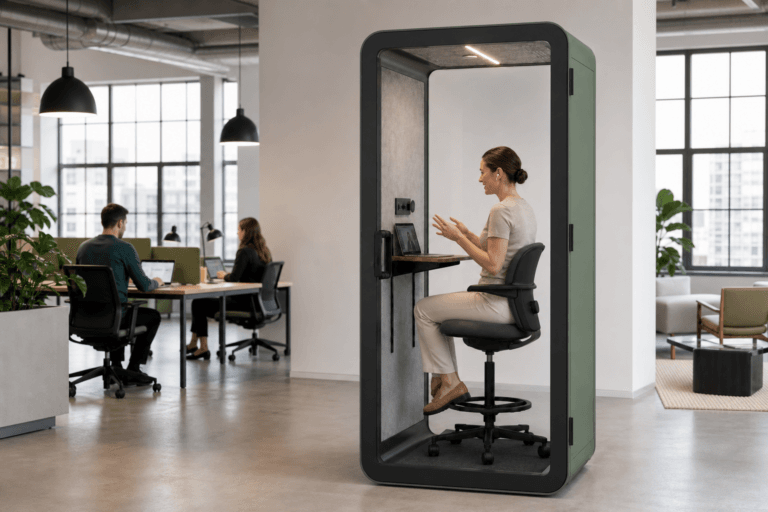
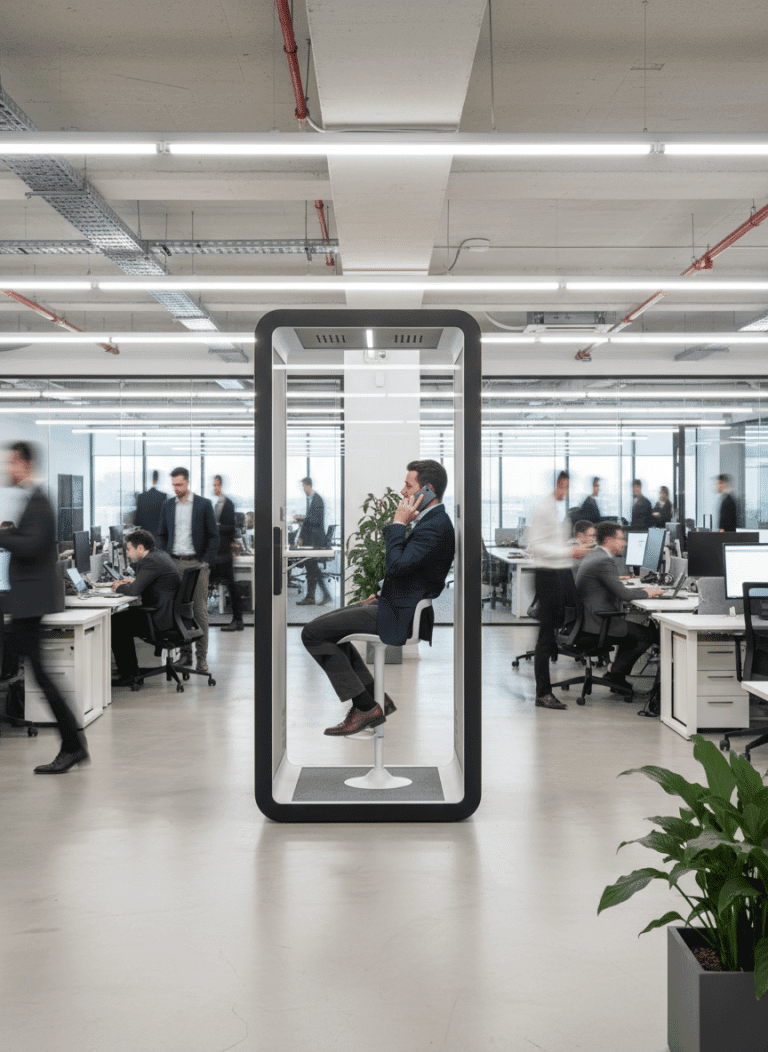
A coworking phone booth is a private one-person space for calls, video meetings, and short confidential conversations inside a shared workspace. Plan it by peak simultaneous call demand, not total membership. Put booths near hot desks first, keep rules simple, separate call use from deep-work use, and confirm access control, ventilation, delivery, and installation needs before ordering.
Last Updated: June 24, 2026 | Author: Richard | Estimated Reading Time: 9 minutes
The Real Coworking Problem Is Not Just Noise
In a normal office, employees usually know where they can take a private call. In a coworking space, that certainty is weaker. A member might be using a hot desk for one day, meeting a client between appointments, joining a funding call, or trying to run a sales demo from an open table.
That is why a coworking phone booth should be planned as part of the member journey, not only as an acoustic product. The booth answers a practical question members ask every day:
Where can I take this call without bothering everyone or exposing the conversation?
This is also why searches such as “wework phone booth” often have broader intent. People are not always looking for one specific brand. They are often looking for the shared-office idea: compact, visible, easy-to-use private call space inside an active coworking environment.
If you are ready to compare one-person call booth options after the workspace plan is clear, B&H Ergonomics office phone booths are the right product category to review.
The 3-Step Coworking Booth Planning Rule
For a shared workspace, I would not start with a furniture count. I would start with three operating questions:
| Planning Step | Question to Answer | Why It Matters |
|---|---|---|
| 1. Count peak private-call demand | How many members need private calls at the same time during busy hours? | This prevents booth quantity from being based only on total membership. |
| 2. Place booths near the highest-friction users | Which members have the least access to private rooms: hot desks, day-pass users, sales teams, founders, consultants, or client-facing members? | Booths work better when they are close to the people who actually need them. |
| 3. Set operating rules before opening | Who can use the booth, for how long, and how will staff handle misuse? | Clear rules protect turnover, cleanliness, member fairness, and meeting-room availability. |
This simple sequence keeps the booth tied to real coworking behavior. A phone booth that is technically good but poorly located, overbooked, or treated like a private office will still feel broken to members.
Start With Peak Simultaneous Calls
Do not plan a phone booth coworking space by total membership alone. Total members can be misleading because many members are remote, part-time, or present at different hours. The better number is peak simultaneous private calls.
In B&H Ergonomics’ experience, a practical first check is:
| Coworking Planning Input | Practical Use |
|---|---|
| 10 to 15 active workstations | Plan for at least one private call booth as a baseline. |
| Sales-heavy, consultant-heavy, or startup-heavy membership | Increase booth count because call overlap is higher. |
| Mostly quiet individual work | Keep the baseline, then review actual use after opening. |
| Meeting rooms occupied by solo callers | Add phone booths before adding another larger room. |
| Members taking calls outside or in corridors | Treat it as a privacy-capacity signal, not only a behavior problem. |
The 10-15 workstation rule is not a rigid formula. It is a useful starting point for early layout planning. Before final purchasing, walk the space during the busiest call windows and count how many people need privacy at the same time.
Put Booths Near Flexible Open Desks First
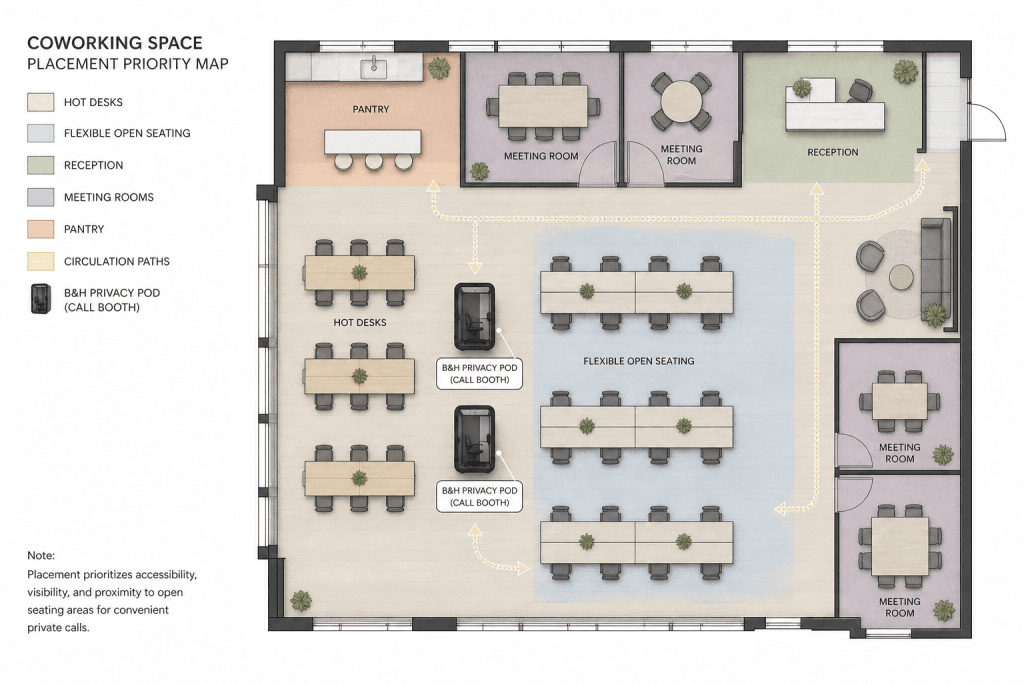
The best first location is usually near the flexible open work area. These members have the least control over their environment. They may not have a private office, a team room, or even the same desk every day.
I would prioritize booth placement in this order:
| Location | Priority | Why |
|---|---|---|
| Near hot desks and flexible open seating | High | This group has the greatest private-call gap. |
| Near small meeting rooms | Medium | Useful when solo callers are taking meeting rooms that groups need. |
| Near reception or community desk | Medium | Good for staff visibility, but avoid turning calls into a public spectacle. |
| Back corridor or hidden corner | Low | Members may not use it if access feels awkward or unsafe. |
| Pantry, printer, or lounge edge | Low | Service noise can weaken the call experience. |
The goal is not to hide the booth. The goal is to make it easy to find without placing it in the loudest part of the floor. If the whole shared workspace plan is still being shaped, use the broader B&H guide to coworking space design before locking the booth location.
Separate Call Booths From Deep-Work Space
For coworking projects, do not push every member need into the same booth.
| Member Behavior | Recommended Direction | Planning Note |
|---|---|---|
| Quick phone calls | Elite-S or another one-person call booth | Best fit when turnover matters and users need short private calls. |
| Video meetings | Elite-S or another one-person call booth | Works well when the main need is a compact, private call setting. |
| Longer quiet work | Dedicated focus space or work pod | Keeps call booths available for members who need real-time communication privacy. |
| Occupying a call booth for two hours of laptop work | Move the user to a focus zone when available | Prevents the phone booth from becoming a private office by accident. |
| Two-person or team discussion | Meeting pod or small meeting room | A phone booth should not replace a group meeting space. |
This separation is important for operations. If every quiet-work user takes the phone booth, the people who actually need private calls will return to the corridor, lobby, or open desk area. A stronger coworking layout gives call users, deep-work users, and small teams different options.
Keep Reservation Simple
B&H Ergonomics office pods do not include booking or reservation software. Do not present the pod as if it comes with a built-in scheduling platform.
For many coworking operators, the simplest reservation methods work well:
| Method | Best Use Case | Management Note |
|---|---|---|
| Notebook mounted near the booth | Small locations | Low cost and easy to understand. |
| Paper sign-up sheet | Low-tech member communities | Works when staff check it daily. |
| Shared Google or Outlook calendar | Operators already using digital calendars | Familiar, but members must follow the rule. |
| Front desk registration | Staffed coworking spaces | Best when access needs more control. |
| First-come-first-served with posted limits | High-turnover call booths | Fastest method, but requires visible etiquette rules. |
The rule should be visible before someone enters the booth. A good coworking booth policy might say:
- Calls and video meetings have priority.
- Suggested use blocks are 15, 30, or 60 minutes.
- Release the booth when the call ends.
- Use a focus pod, work pod, or quiet zone for long deep-work sessions.
- Do not treat the booth as personal storage.
- Leave the surface clear and ready for the next member.
This is not software. It is an operating habit. In coworking, that distinction matters.
Confirm Acoustic Privacy Without Overpromising Silence
Many buyers search for a “soundproof” or “acoustic” booth, but coworking operators should be careful with that wording. The practical goal is speech privacy and reduced distraction, not a promise of total silence.
When comparing booth claims, ask what test method is being referenced and whether the result describes speech level reduction, sound level difference, STC, NIC, or another measurement. ISO 23351-1 is an official standard for measuring speech level reduction of furniture ensembles and enclosures, and it is a useful reference when suppliers describe acoustic booth performance: ISO 23351-1.
For a coworking project, also consider site behavior. A booth placed beside a pantry, printer, or crowded lounge may feel less private even if the product itself is built well. Acoustic results vary by test method, installation, site conditions, and measurement setup.
Optional Access Control: Password Lock or Face Recognition
Some coworking operators want the booth available to all members. Others need stricter access because the booth is reserved for internal teams, premium members, tenants, or staff-managed use.
B&H Ergonomics pods can support optional password locks so only authorized office users can enter. They can also support face-recognition access control, where an administrator records authorized users before those users can open the door.
These are optional configurations. Confirm the requirement before ordering. The access-control decision can affect the quote, configuration, production discussion, and how the booth is managed after installation.
For shared workspaces, I would ask three questions before selecting access control:
| Question | Why It Matters |
|---|---|
| Should every member use the booth, or only specific users? | Determines whether open access is acceptable. |
| Will staff manage reservations manually? | Helps decide whether front desk control is enough. |
| Is the booth for premium membership, internal teams, or restricted office use? | Password or face-recognition access may be more appropriate. |
Check Comfort Before Treating the Booth as Open
Coworking booths get repeated use from people who may not know the space well. Comfort problems show up quickly: stale air, poor lighting, awkward surface height, unclear power access, or fan noise that distracts during calls.
For ventilation context, ASHRAE Standard 62.1 is a common facility reference for ventilation in buildings, while the booth itself still needs its own airflow design and user comfort review: ASHRAE Standard 62.1 and 62.2 resources. If airflow, fan noise, or booth comfort is a deciding factor, review the B&H office phone booth ventilation guide before comparing price.
The Operator’s Daily Checklist
The best coworking space phone booth is the one members understand without asking staff every time. Before opening the booth to members, check the daily experience.
| Daily Check | What to Look For |
|---|---|
| Visibility | Can members find the booth quickly from the open desk zone? |
| Rule clarity | Are time limits and priority rules posted clearly? |
| Access | Does the lock or access method match the membership policy? |
| Comfort | Does the booth feel usable for the expected call length? |
| Noise behavior | Are calls moving out of corridors and open desks? |
| Turnover | Are members releasing the booth after calls? |
| Cleanliness | Is there a simple cleaning routine between heavy-use periods? |
| Staff feedback | Are community managers hearing fewer privacy complaints? |
This checklist is where many coworking layouts win or lose. The booth can be a good product, but the member experience still fails if the rule is unclear, the location is inconvenient, or one user occupies it all afternoon.
What to Confirm With B&H Before Ordering
Once the operating plan is clear, the quote discussion becomes much cleaner.
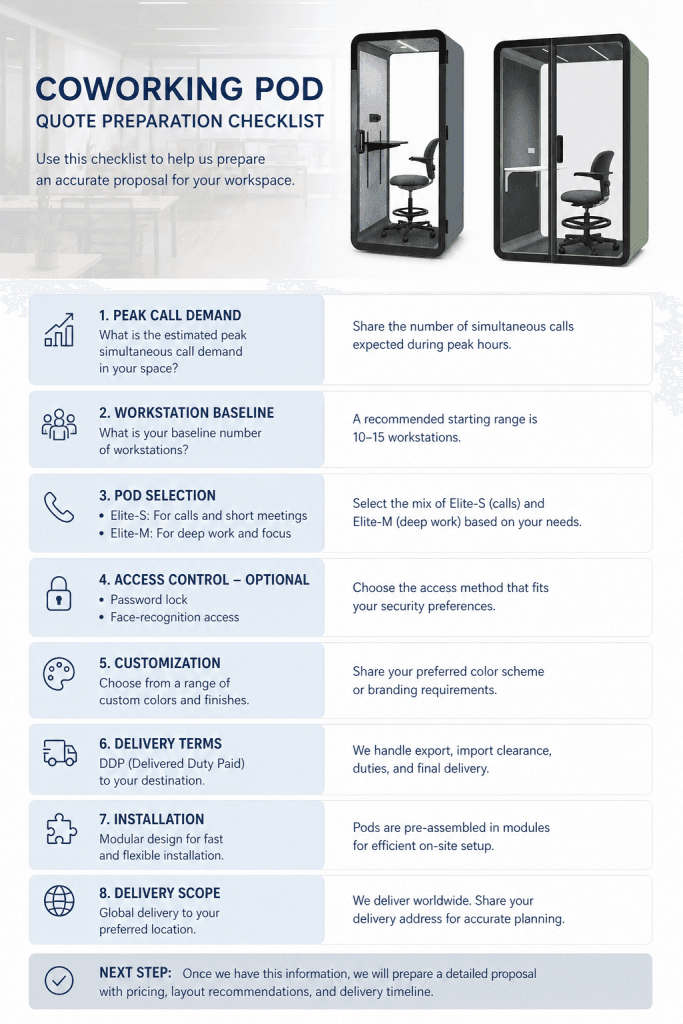
For a coworking project, prepare these details:
- Number of active workstations and expected peak call demand.
- Whether the booth is mainly for calls, video meetings, or longer solo work.
- Preferred booth locations near flexible open work areas.
- Whether password lock or face-recognition access control is required.
- Exterior color, interior finish, and any brand-fit requirements.
- Delivery country, delivery address, and site access limitations.
- Whether DDP delivery is needed where available.
- Expected installation method and available on-site labor.
- Whether the operator is planning one location or a multi-site rollout.
B&H Ergonomics can support DDP delivery options, modular installation, customizable colors, fast assembly under prepared site conditions, and global delivery support. For coworking operators, these details help protect rollout timing and landed-cost clarity, especially when multiple spaces need a consistent specification.
FAQ
How many phone booths does a coworking space need?
Start with peak simultaneous private calls, not total membership. As a first planning check, B&H Ergonomics often treats 10 to 15 active workstations as needing at least one private booth, then adjusts by member type, call overlap, and meeting-room pressure.
Where should a coworking phone booth be placed?
Place it near flexible open desks first. Hot-desk and floating members usually have the least private-call access, so the booth should be close enough to use quickly without sitting directly beside noisy pantry, printer, reception, or lounge activity.
Does B&H Ergonomics provide booking software for office pods?
No. B&H Ergonomics office pods do not include booking or reservation software. Coworking operators can use a notebook, paper sign-up sheet, shared electronic calendar, front desk process, or first-come-first-served rules.
Can B&H pods support password locks or face recognition?
Yes. B&H Ergonomics pods can support optional password locks and optional face-recognition access control. These should be confirmed before ordering because they are configuration decisions, not assumptions that should be added after the fact.
Should a coworking space use a phone booth for deep work?
Only for short sessions when demand is light. If members need long quiet work periods, a dedicated focus zone or work pod is usually better. Keeping the phone booth focused on calls and video meetings protects turnover for the members who need private communication space.